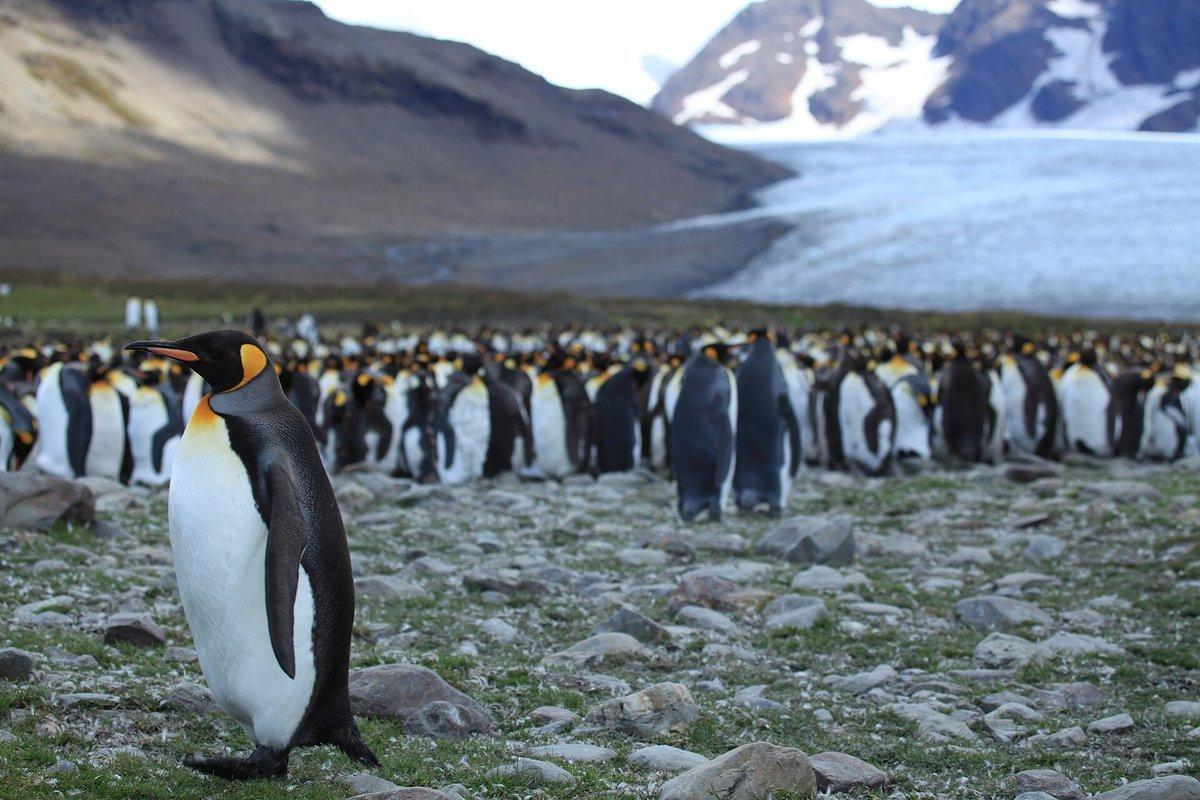
There is a moment, on the black sand of St Andrews Bay, when you stop looking through the viewfinder. You lower the camera because the frame cannot hold it: a third of a million king penguins packed shoulder to shoulder from the surf line to a wall of glacier ice, the sound a single continuous bronze roar, the smell ammoniac and enormous. Elephant seals the size of family cars lie in the shallows like beached submarines. This is not a wildlife encounter. It is a landscape made entirely of animals, and it will rearrange your sense of scale for the rest of your life.
South Georgia and the Falkland Islands are the two great wildlife stages of the sub-Antarctic South Atlantic, and they reward the photographer differently. South Georgia is the overwhelming one — reachable only by expedition ship, hedged by the strictest biosecurity rules on Earth, and stacked with more concentrated wildlife than almost anywhere on the planet. The Falklands are the accessible one — grass-farm islands where you can drive to a king penguin colony from a pub in Stanley, or take a light aircraft to a cliff of rockhoppers. Most serious voyages string them together, often with the Antarctic Peninsula, into a single three-week crossing of the Scotia Sea.
If you have read our Antarctica expedition photography guide, you already have the zodiac technique, the extreme-cold gear management, and the shipboard workflow. This guide assumes that foundation and builds on it. What follows is specific to these two archipelagos — where to point the camera, when the light and the wildlife peak, and the rules that make the whole thing possible.
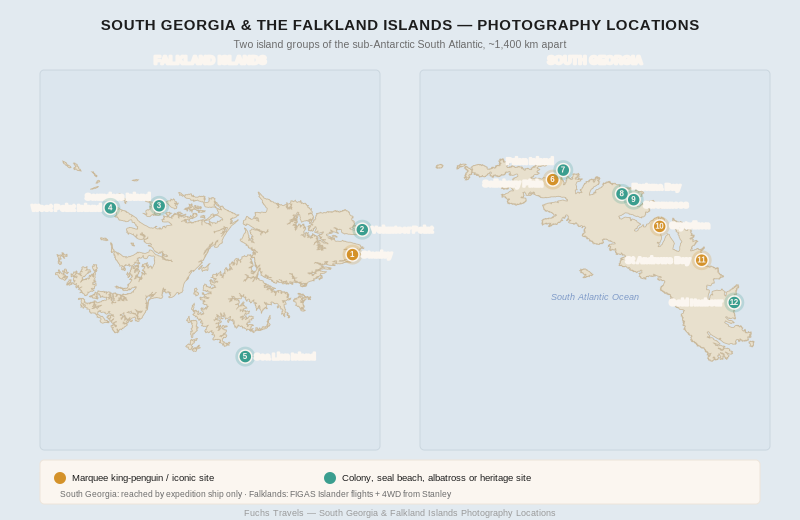
Two Island Groups, One Voyage
Look at the map and the first thing that hits you is the distance. The Falklands sit off the tip of South America; South Georgia lies roughly 1,400 km east-southeast, alone in the open ocean. There is no bridge between them but two or three days of Scotia Sea — swells that separate the photographers who prepared from the ones who did not. Bring the seasickness medication you trust, and treat the sea days as part of the trip: this is prime time for albatross and petrel flight photography off the stern, and for backing up and culling the thousands of frames each landing generates.
The two destinations demand two different strategies.
South Georgia is expedition-ship territory, full stop. There is no airport, no hotel, no independent travel. You reach it as a passenger on a vessel — almost always an IAATO-member operator — and you go ashore by zodiac under a strict landing schedule. Every hour on the island is a privilege granted by permit and paid for in preparation.
The Falklands can be done ship-based or land-based. Expedition ships call at the outer islands on their way to or from South Georgia. But you can also fly in to Stanley and spend a week island-hopping on the government air service, sleeping in farm lodges and shooting the same colonies at your own pace, in your own light, without a departure horn calling you back to the ship. For a photographer who wants to work a location through an entire golden evening, the land-based Falklands trip is quietly one of the best-value wildlife itineraries in the Southern Hemisphere.
South Georgia: The Serengeti of the Southern Ocean
South Georgia is a 170-km crescent of glaciated mountains — the Allardyce Range throws up peaks near 3,000 m straight out of the sea — fringed by beaches that hold some of the densest wildlife aggregations on Earth. You will photograph on maybe six to ten of these beaches over a handful of days. Here are the ones that matter most.
St Andrews Bay
GPS: ●●.●●●●° S, ●●●.●●●●° W
This is the colossus: South Georgia’s largest king penguin colony, commonly cited at around 150,000 breeding pairs, and counting chicks and non-breeders the total birds present can approach half a million. (Survey figures vary by year and season, so treat any single number as an estimate rather than gospel.) A glacier snout provides the backdrop; a braided meltwater river cuts the beach; and everywhere, the brown “oakum boys” — the woolly, comically oversized king penguin chicks — stand in crèches among the adults.
Best light: The bay faces broadly east, so a clear dawn landing lights the colony and the glacier from the front — go early. Overcast is not a consolation prize here; flat light tames the brutal contrast between black-and-white adults and dark volcanic sand, and it saturates the orange ear-patches.
Key compositions: Resist the urge to shoot only the wide “carpet of penguins” frame — everyone brings that home (it is the scene at the top of this guide). Work the scale relationships instead: a single foreground adult sharp against the soft mass of the colony; an oakum boy dwarfed by the glacier; the meltwater river as a leading line into the throng. A telephoto compression shot that stacks penguins, river, and ice into one flattened plane is the signature St Andrews image.
Salisbury Plain
GPS: ●●.●●●●° S, ●●●.●●●●° W
In the Bay of Isles on the north coast, Salisbury Plain is the other mega-colony — frequently cited at tens of thousands of breeding pairs — set on a broad glacial outwash plain that lets you back away and shoot the colony as a landscape band beneath the mountains. Because you can gain a little elevation on the moraine here, Salisbury is the place for the environmental wide shot that St Andrews’ cramped beach denies you.
Key compositions: Get low for courtship behaviour — the sky-pointing “ecstatic” display, pairs bowing and trumpeting — with a long lens and a clean background of blurred birds. The stony plain is a workable neutral canvas; wait for a pair to walk into a gap in the crowd rather than shooting into the visual chaos.
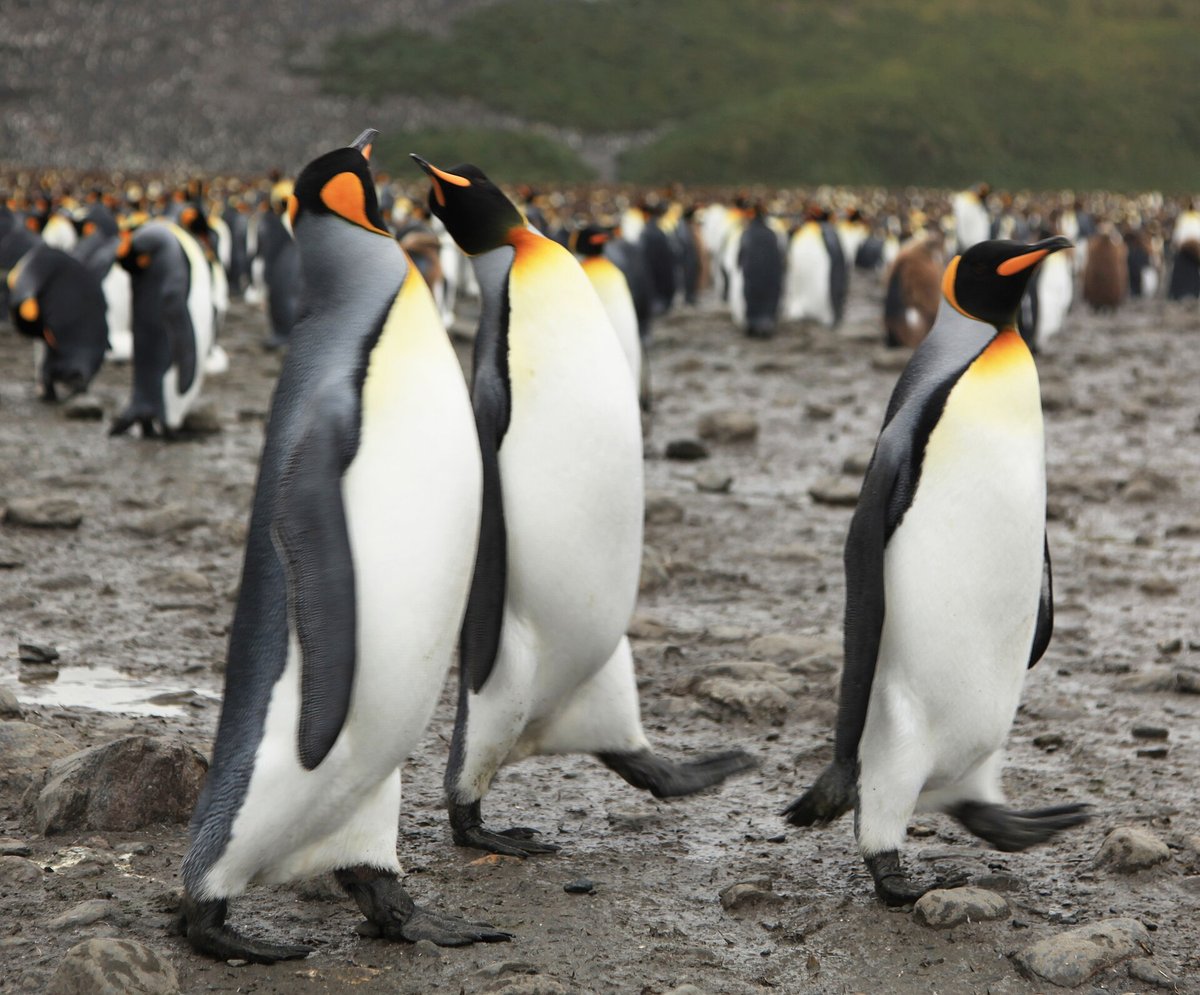
Salisbury Plain — wait for a pair or trio to step into a gap in the crowd; the blurred colony becomes a clean canvas. Photo: Liam Quinn / Wikimedia Commons (CC BY-SA 2.0)
Gold Harbour
GPS: ●●.●●●●° S, ●●●.●●●●° W
A smaller, jewel-box amphitheatre backed by hanging glaciers, Gold Harbour is the classic dawn landing. Kings, gentoos, and — in the right season — hulking southern elephant seals share a beach narrow enough that you are never far from any of it. Because the bay is tucked under high ground to the east, first light comes late and dramatic, catching the glaciers gold before it reaches the sand.
Technique tip: This is a tight beach with fast-changing light. Pre-set two camera bodies — one wide for the elephant seal-and-glacier landscape, one long for penguin portraits — so you are not changing lenses in blowing sand and spray.
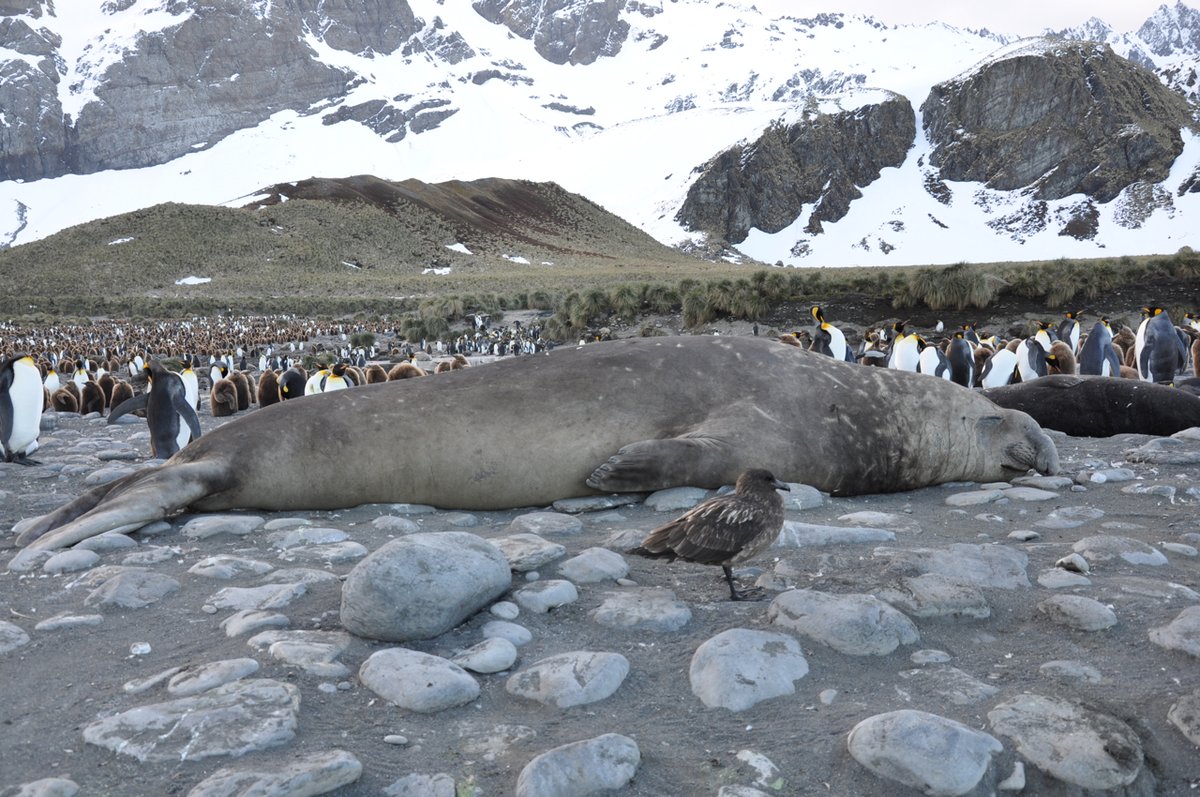
A southern elephant seal hauled out on a South Georgia beach, kings and snow peaks behind — a two-body approach (wide and long) beats swapping lenses in blowing sand. Photo: Serge Ouachée / Wikimedia Commons (CC BY-SA 3.0)
Fortuna Bay and Stromness
GPS (Fortuna Bay): ●●.●●●●° S, ●●●.●●●●° W
GPS (Stromness): ●●.●●●●° S, ●●●.●●●●° W
These two adjacent bays carry the Shackleton story. In May 1916, after the loss of Endurance and the open-boat voyage from Elephant Island, Ernest Shackleton, Frank Worsley, and Tom Crean crossed the uncharted mountainous spine of South Georgia on foot and staggered down into Stromness whaling station to raise the alarm for the men left behind. Many expeditions offer a walk over the final stretch of that route, from Fortuna Bay down to Stromness — a rare chance to make landscape images with genuine narrative weight.
Key compositions: The rusting, off-limits Stromness station framed by the notch in the hills the men descended; the waterfall they down-climbed; king penguins and fur seals scattered across the tussac foreground with the derelict whaling architecture behind. Shoot the story, not just the scenery.
Grytviken
GPS: ●●.●●●●° S, ●●●.●●●●° W
Grytviken is the beating heart of any South Georgia visit — and, by regulation, the first landing, where a government officer conducts the biosecurity audit before anyone goes elsewhere. It is a photographer’s paradox: a place of industrial death (a whaling station that processed tens of thousands of whales) that is now one of the most peaceful and moving spots in the Southern Ocean. Rusting oil tanks, collapsing flensing plans, beached and broken whale-catcher ships, the little white Norwegian whalers’ church of 1913, the small museum — every surface is a study in decay, texture, and colour.
Key compositions: Get in close on the rust — the oranges and ochres against grey sea and green tussac are a colourist’s gift. Use the broken ships as leading lines. The white church against the dark mountain is the clean graphic counterpoint to all that entropy.
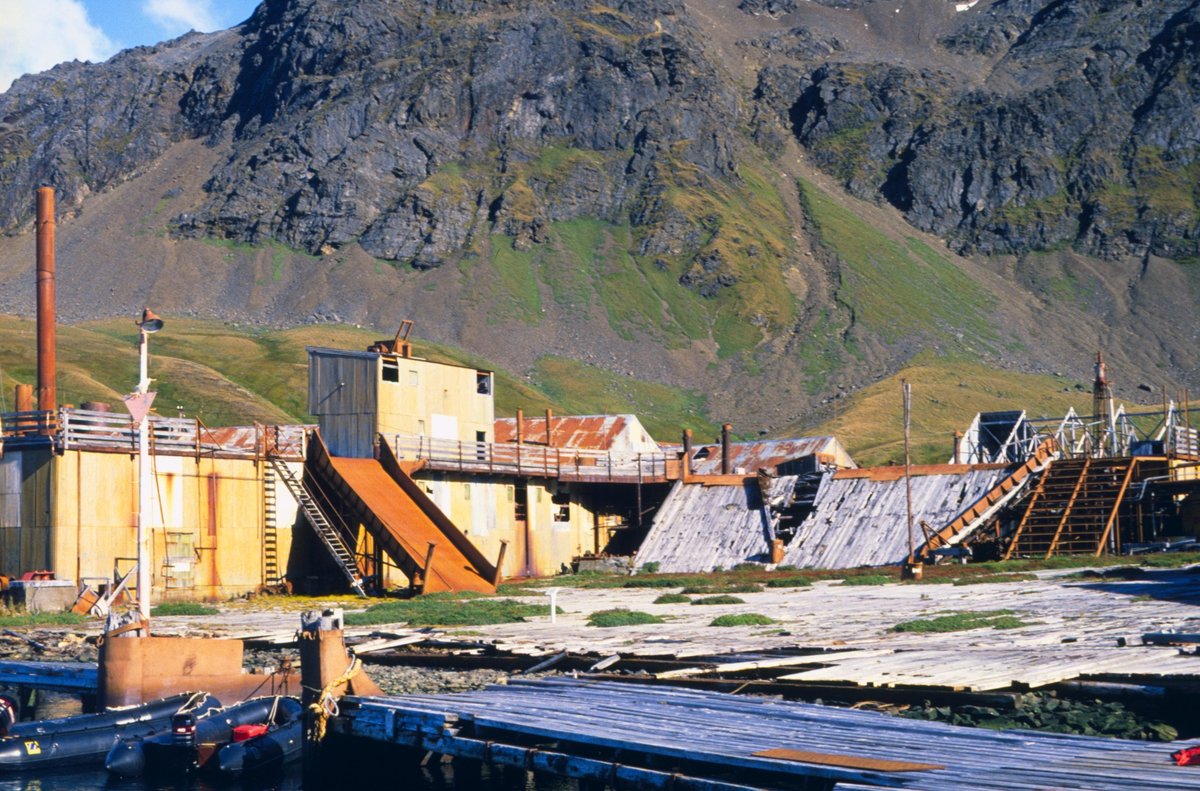
Grytviken — the whaling station’s rusting relics are a colourist’s gift: work in close on the oranges and ochres against grey sea and green tussac. Photo: Hbk33 / Wikimedia Commons (public domain)
A short walk from the station, in the small whalers’ cemetery, stands the granite headstone of Sir Ernest Shackleton, who died of a heart attack aboard Quest in Grytviken harbour on 5 January 1922 and, at his widow’s wish, was buried here among the whalers. The tradition is to gather at the grave and drink a toast — a dram of whisky “to the Boss.” Photograph it quietly and respectfully; a wide frame that places the lone headstone against the enormity of the mountains says everything about the man and the place.
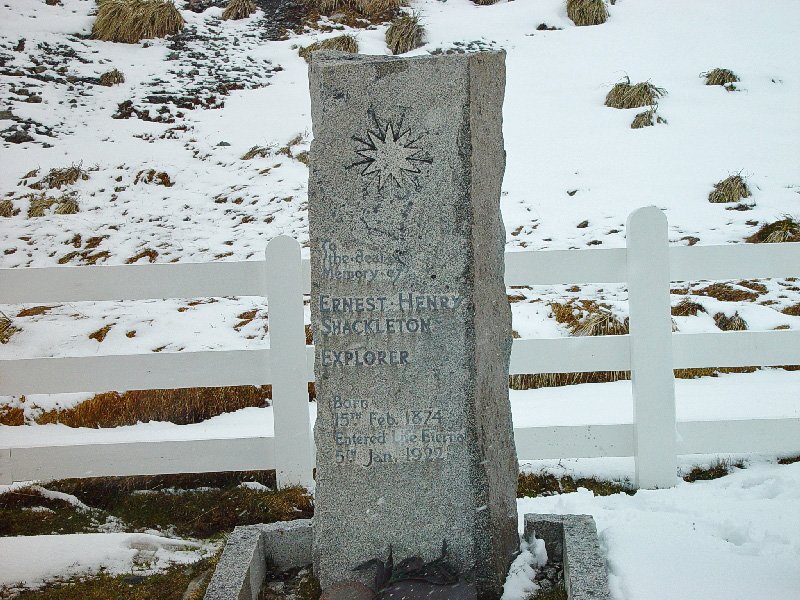
Shackleton’s grave in the Grytviken whalers’ cemetery. Visitors gather here to toast “the Boss.” Photo: Wofratz / Wikimedia Commons (public domain)
Prion Island
GPS: ●●.●●●●° S, ●●●.●●●●° W
In the Bay of Isles, tiny Prion Island is one of the few accessible places to see nesting wandering albatross — the bird with the greatest wingspan on Earth, up to 3.5 m — sitting on tussac nests, and to witness the young birds’ clumsy, magnificent display of those enormous wings. Prion is rat-free habitat protecting burrowing petrels and prions, so visitors are confined to a raised boardwalk and numbers ashore are strictly capped.
An important currency note: Prion Island’s boardwalk has been in disrepair, and the Government of South Georgia (GSGSSI) closed the site to visitors for recent seasons pending repair. Landing there is not guaranteed. Confirm the current season’s status with your operator and against the official GSGSSI visitor documents at gov.gs before you count on it. If Prion is closed, wandering albatross can sometimes be worked from the ship or at Albatross Island; light-mantled sooty albatross — arguably the most elegant of all, slate-grey with a white eye-crescent — nest on cliff ledges around the island and often display in soaring pairs.
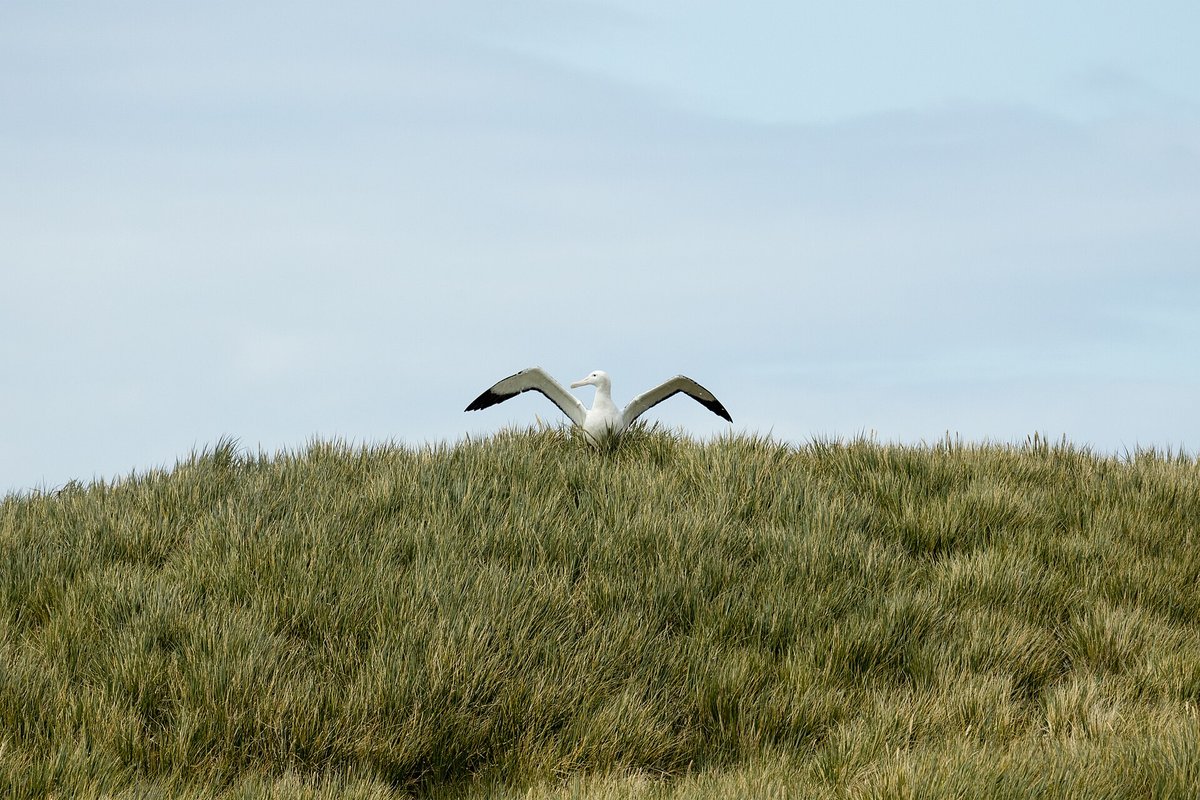
A wandering albatross on Prion Island — access is via a raised boardwalk, and the site has faced closures for boardwalk repair. Confirm status before you count on it. Photo: Godot13 / Wikimedia Commons (CC BY-SA 4.0)
The Wildlife Drama: Seals, Aggression, and a Recovery Story
Elephant seal beachmasters
If you can time a South Georgia trip to early in the season — roughly late September into October and early November — you arrive for the southern elephant seal breeding theatre, and it is theatre of the highest order. Bulls of four tonnes (“beachmasters”) haul out first and fight, rearing chest to chest and slamming their bulk down, drawing blood, roaring through inflated proboscises to hold a harem that can number dozens of females. Pups are born, suckled for around three weeks, then abandoned to become the fat, moulting “weaners” that loiter on the beaches into December and January.
Technique: Shoot the clashes with a fast shutter (1/1600 s or faster) to freeze the flying sand and spray, and get low — belly on the beach, at eye level with the animals — for the mud-and-menace perspective. A wide lens exaggerates the bulls’ size when you have the working distance to use it safely.
Antarctic fur seals — the honest warning
Here is the truth nobody puts in the brochure: on South Georgia in December and January, the beaches belong to Antarctic fur seals, and they are dangerous. Pupping peaks in early December — the majority of pups are born within a ten-day window — and territorial males weighing up to 200 kg will charge, feint, and bite anything that crosses an invisible line, including you. Females defend their pups just as fiercely.
This is not a reason to skip the season; the fur-seal pups tumbling through the tussac are irresistible subjects. But it changes how you move. Give seals a wide berth, never place yourself between a seal and the sea, move slowly and predictably, keep a walking stick or monopod to hand as many guides advise, and always follow your expedition team’s briefed distances (GSGSSI’s Code of Conduct sets the authoritative minimums — cite the current booklet for the exact metres). Photograph fur seals with a longer lens from a respectful distance rather than crowding them for a wide shot.
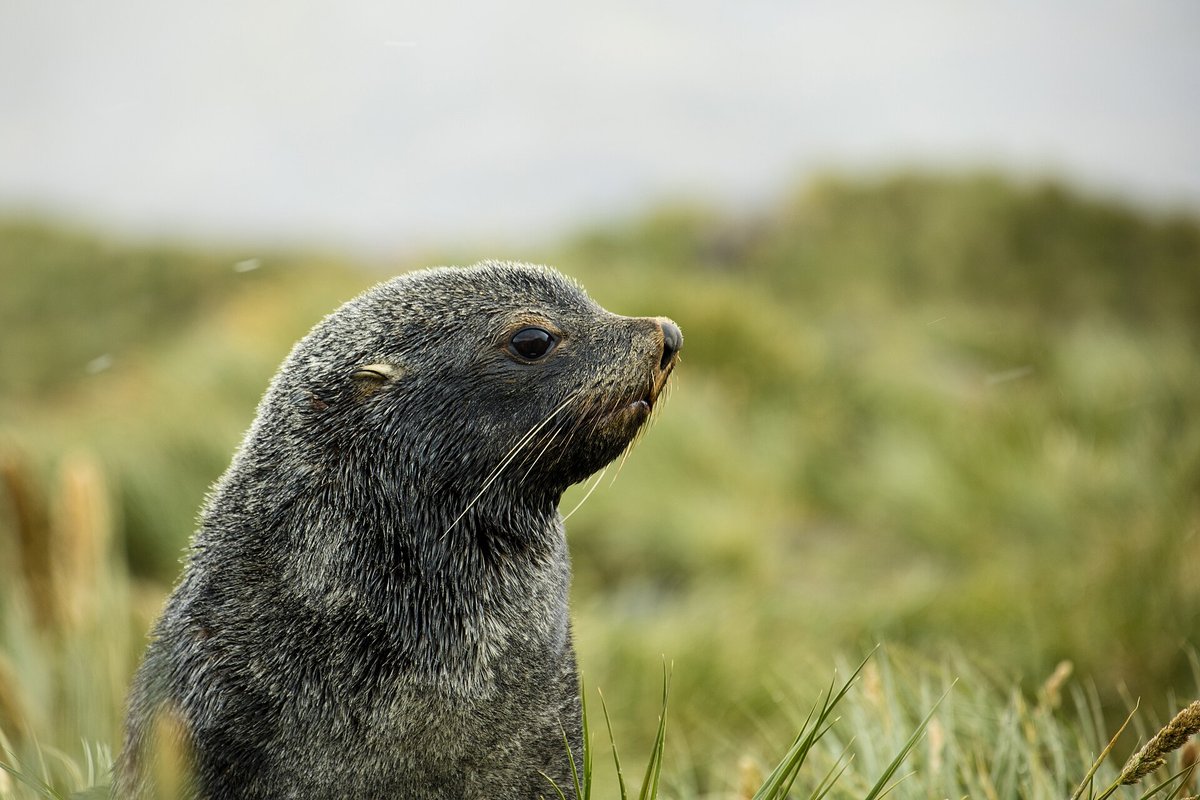
Antarctic fur seal in the tussac. In December and January the bulls are territorial and will charge — work them long, keep your distance, and never get between a seal and the water. Photo: Godot13 / Wikimedia Commons (CC BY-SA 4.0)
A recovery story worth telling
South Georgia is also one of the great conservation success stories, and it is a story a photographer can help tell. For two centuries, rats and mice — stowaways from the sealing and whaling ships — devoured the eggs and chicks of ground-nesting birds. Between 2011 and 2015 the South Georgia Heritage Trust ran the largest rodent eradication ever attempted, baiting more than 1,000 km² of the island by helicopter. In May 2018, after a detection-dog survey found no sign of rodents, South Georgia was declared rodent-free.
The result is audible. The South Georgia pipit — the world’s most southerly songbird, and the only songbird native to the Antarctic region — is singing and breeding again on the mainland; the endemic South Georgia pintail is recolonising former rat-infested ground. Both are small, understated subjects next to a colony of 150,000 kings, but a frame of a pipit singing from the tussac is a frame with a story of recovery inside it. Seek them out.
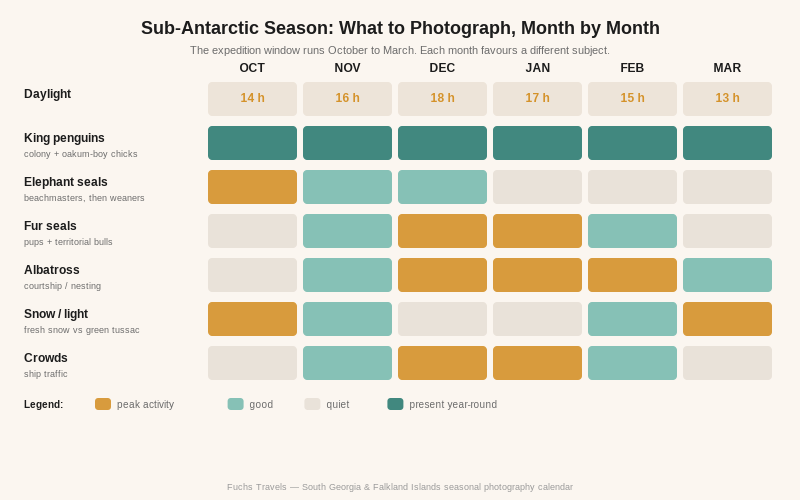
When to Go: The Sub-Antarctic Season
The expedition season runs October through March — the sub-Antarctic spring and summer. There is no aurora window and no midnight sun here as there is farther south; instead there is a procession of wildlife events, and the month you choose determines what you photograph.
| Month | Daylight | Wildlife highlight | Character |
|---|---|---|---|
| October | ~14 h | Elephant seal breeding, fresh snow, king colonies | Early, snowy, dramatic light; few ships |
| November | ~16 h | Elephant seal weaners, courtship building, tussac greening | Transitional; good balance |
| December | ~18 h | Fur-seal pupping peak, penguin chicks hatching | Busiest; longest days; aggressive fur seals |
| January | ~17 h | Oakum-boy chicks, fur-seal pups, albatross | Peak summer; peak ships |
| February | ~15 h | Growing chicks, albatross feeding | Quieter, still lush |
| March | ~13 h | Late chicks, first snows returning | Golden low light; fewest visitors |
The photographer’s read: For breeding drama and moody, snow-dusted beaches, go October–November and accept fewer daylight hours and a bigger sea state. For the sheer volume of chicks and pups and the longest shooting days, go December–January and prepare for aggressive fur seals and more ship traffic. For the best light and the fewest people, late February–March offers low-angle sun, autumn colour in the tussac, and returning snow, at the cost of some wildlife activity winding down.
The Falkland Islands: Accessible Wildlife on Windswept Farms
The Falklands feel like the Scottish Hebrides transplanted to the far South Atlantic — peat, tussac, sheep, Land Rovers, and a small, welcoming British-outpost culture centred on Stanley. What makes them special for photographers is access: this is where the sub-Antarctic wildlife comes within reach of anyone willing to fly a small plane or bounce across a bog in a 4WD.
Volunteer Point
GPS: ●●.●●●●° S, ●●●.●●●●° W
Volunteer Point, a private farm headland northeast of Stanley, holds the Falklands’ largest king penguin colony and is often described as the most accessible king penguin breeding site in the world. You reach it overland from Stanley — roughly a two-and-a-half to three-hour journey, much of it slow off-road driving across camp (the local word for open country), requiring landowner permission and, in practice, a licensed local guide. The reward is kings, gentoos, and magellanic penguins on a genuine white-sand beach.
Key compositions: This is the place for the surreal “penguins on a tropical-looking beach” image — kings marching across pale sand and turquoise shallows under a sky that has no business being that colour this far south. Shoot low at the water’s edge as birds porpoise in and waddle ashore. Because you set your own hours here (no ship horn), stay for the golden evening — the low sun rakes the sand and rim-lights the birds.
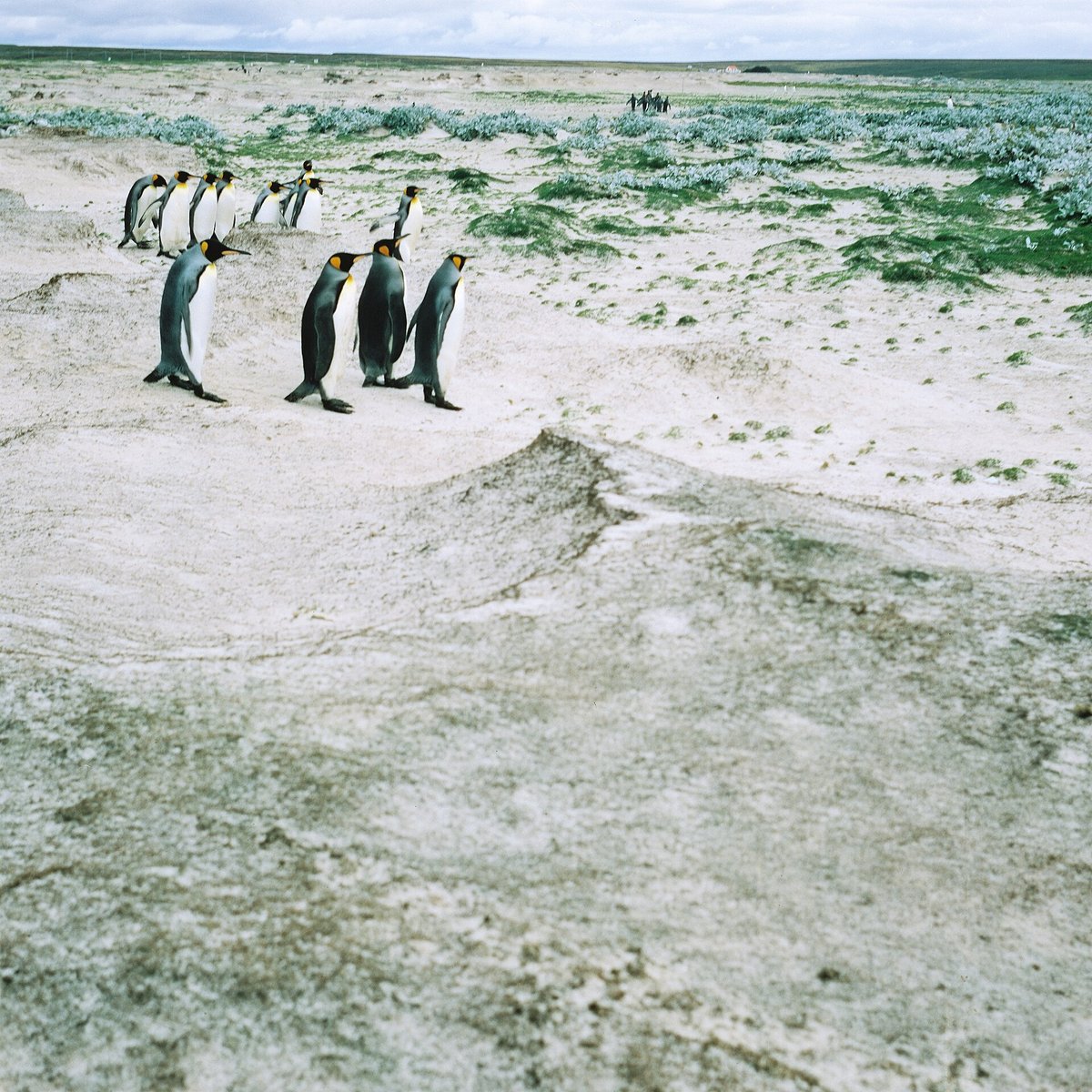
Volunteer Point — kings on genuine white sand, reached by 4WD from Stanley. Land-based access means you can stay for the golden evening the ship-bound never get. Photo: chris lovelock / Wikimedia Commons (CC BY 2.0)
Saunders Island
GPS: ●●.●●●●° S, ●●●.●●●●° W
Saunders is a working sheep farm and one of the great multi-species islands. Its neck of land called The Neck holds gentoos, magellanics, kings, and — on the rocky slopes and cliffs — southern rockhopper penguins, the punkish little birds with red eyes and spiky yellow eyebrows that hurl themselves up sheer rock from the surf. A large black-browed albatross colony nests on the cliffs alongside them.
Technique: Rockhoppers reward patience at the surf-zone “penguin highway” where they land and haul out — a fast shutter and burst mode catch them mid-leap between wave-battered rocks. Get to their eye level; a low angle against the sky separates the bird cleanly from the busy rock.
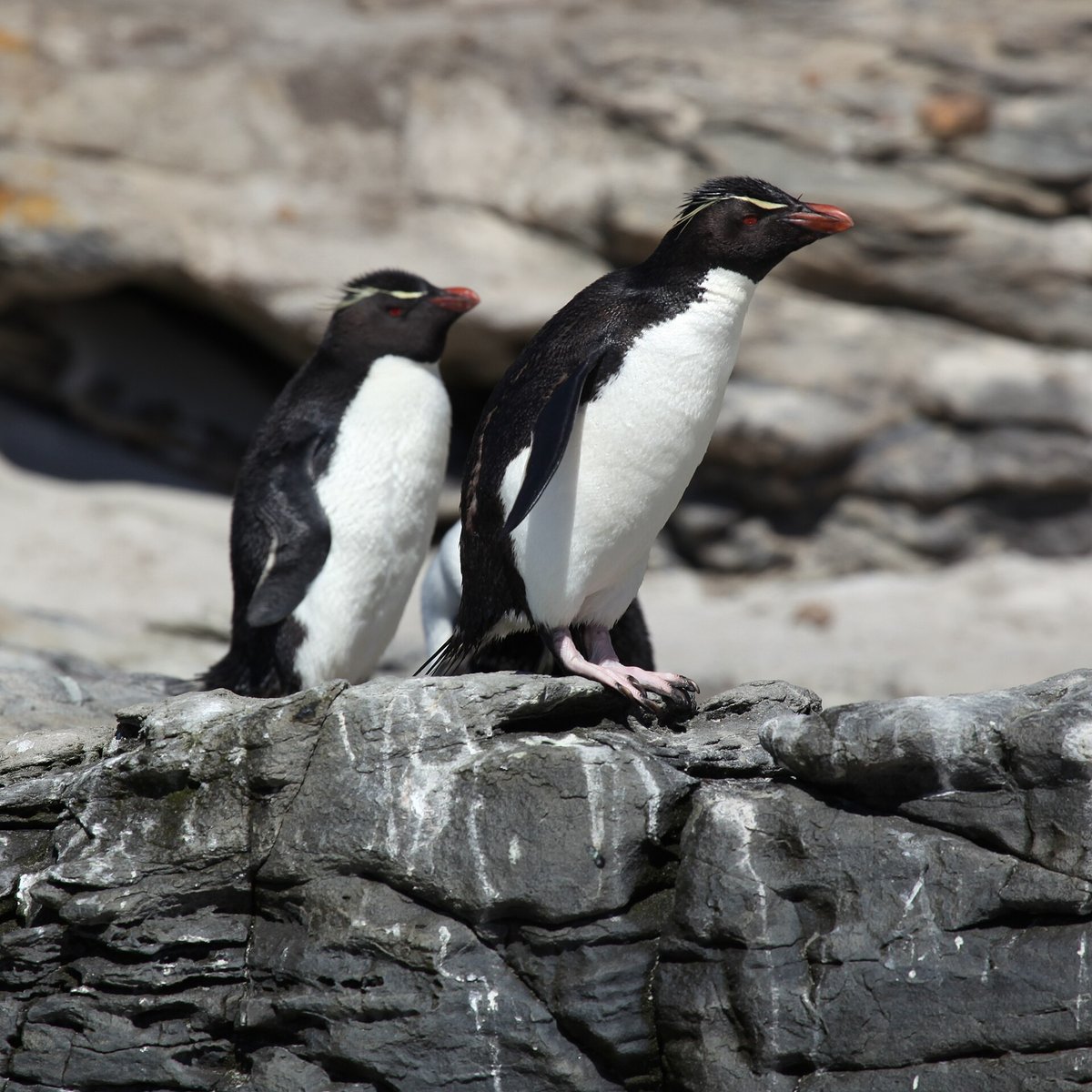
Southern rockhoppers on Saunders Island — work the surf-zone landing rocks with a fast shutter and burst mode, at the birds’ eye level. Photo: Liam Quinn / Wikimedia Commons (CC BY-SA 2.0)
West Point Island
GPS: ●●.●●●●° S, ●●●.●●●●° W
At the northwest corner of the archipelago, West Point Island is famous for a single, extraordinary scene: a colony where black-browed albatross nest interspersed with rockhopper penguins in the tall tussac grass, so you can sit quietly a couple of metres from a nesting albatross on its mud-turret nest, chick beneath it, mate wheeling in from the sea. The Falklands hold the majority of the world’s breeding black-browed albatross — commonly cited at around 70% — across some of the largest colonies on Earth, so this is a bird you photograph at genuine scale here.
Key compositions: The intimate portrait — that soft dark “eyebrow” and pale bill against the green tussac — is the obvious win, but do not miss the flight photography. Position downwind of the cliff edge where birds land into the breeze; a bird banking in with those long stiff wings against blue water is the shot that separates a portfolio from a snapshot collection.
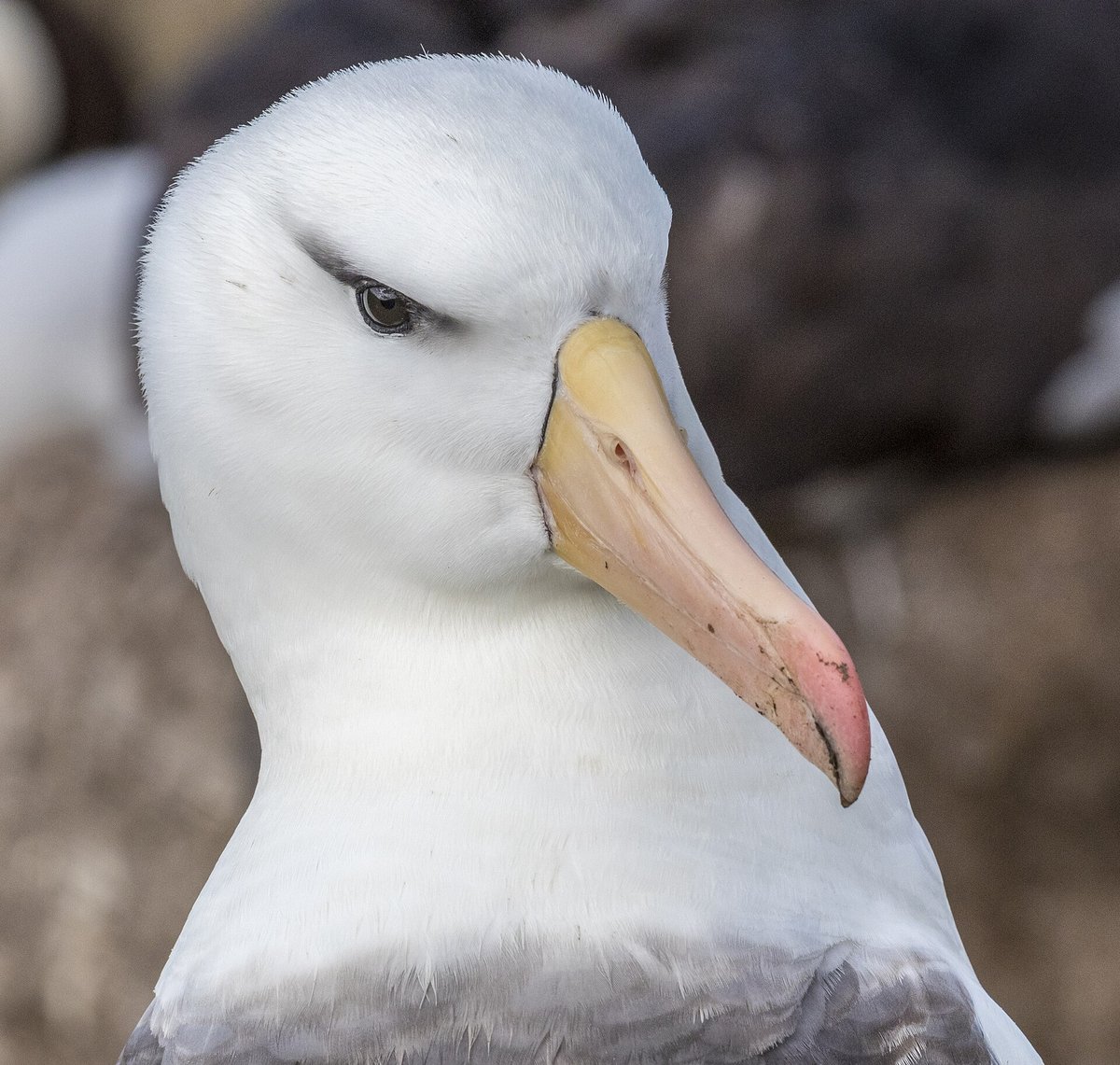
Black-browed albatross at West Point Island — nesting close enough for intimate portraits, but save frames for the flight shots as birds bank in over the cliff. Photo: Godot13 / Wikimedia Commons (CC BY-SA 4.0)
Sea Lion Island
GPS: ●●.●●●●° S, ●●●.●●●●° W
The southernmost inhabited Falkland island is a compact wildlife concentrate: elephant seals hauled out on the beaches, all three local penguin species, sea lions, orca hunting off the points in season, and — a note for drone owners — a local ban on general drone use to protect the wildlife. It is small enough to work on foot over a day or two, which makes it ideal for the slow, considered, land-based approach.
Stanley
GPS: ●●.●●●●° S, ●●●.●●●●° W
The little capital is worth a half-day of frames in its own right: brightly painted metal-roofed houses, the Christ Church Cathedral with its whalebone arch, red telephone boxes, Land Rovers, and the wrecks of old sailing ships rotting in the harbour. It is the human counterpoint to all that wildlife — shoot it as environmental portraiture and street, and you will come home with a rounder story.
Striated caracaras — the camera thieves
Around the seabird colonies you will meet the striated caracara, known locally as the “Johnny rook” — a rare, dark, absurdly intelligent bird of prey found almost nowhere else, and utterly unafraid of people. They will walk right up to you, tug at your bag straps, steal a lens cap or a glove, and generally treat your gear as enrichment. Keep small items zipped away. As subjects they are a gift: their fearlessness lets you make full-frame environmental portraits with a moderate lens, and their curiosity produces genuinely funny behavioural frames.
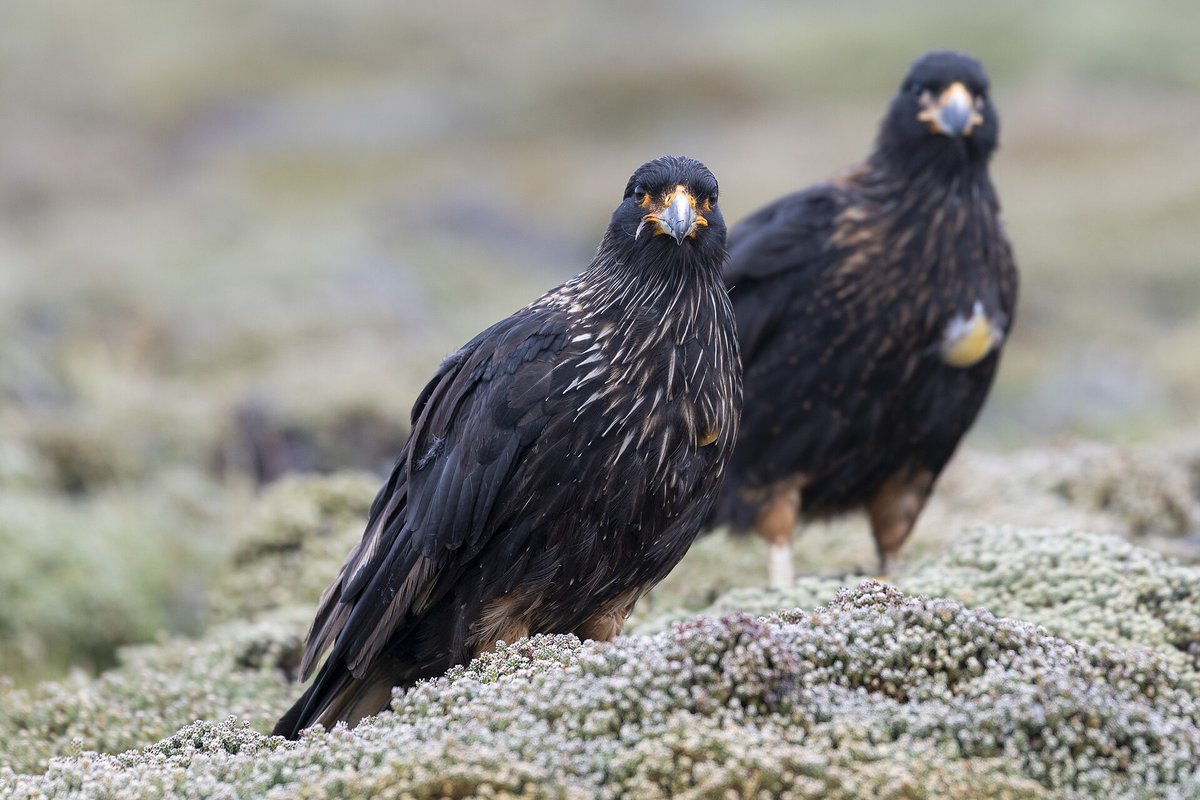
Striated caracaras — the “Johnny rooks” are fearless, intelligent, and will steal anything not zipped away. Their boldness makes for easy environmental portraits. Photo: kuhnmi / Wikimedia Commons (CC BY 2.0)
Technical Craft: Shooting the Sub-Antarctic
Metering white birds, black sand, and snow
The single most common failure here is exposure. A colony of king penguins is a high-contrast trap: brilliant white breasts, jet-black backs, dark volcanic sand, and bright glacier ice, often in the same frame. Your camera’s meter, trying to average all that to middle grey, will blow the white breasts to featureless paper.
Shoot in manual or with exposure compensation and expose for the white. On snow or against bright ice, dial in +0.7 to +1.3 stops so the whites render bright but retain feather texture, then check the histogram — you want the highlight peak pushed right but not clipped. On dark sand with dark birds, the meter over-brightens; pull back. The reliable move is to meter off a mid-tone (a patch of tussac, weathered rock, your own grey glove), lock it, and watch the blinkies.
| Situation | Starting point | Watch for |
|---|---|---|
| King penguins on dark sand | Manual, ISO 400, 1/1000 s, meter off mid-tone | Blown white breasts |
| Penguins on snow/ice | +1 EV compensation, check histogram | Grey, underexposed snow |
| Albatross in flight, bright sky | Shutter priority 1/2000 s, +0.7 EV, auto ISO | Silhouetting the bird |
| Seal fights, blowing sand | 1/1600 s or faster, ISO auto | Motion blur, sand on sensor |
| Grytviken rust detail | Aperture priority f/8, base ISO | Nothing — easy light |
Wind, weather, and the four-seasons hour
South Georgia’s weather is violent and fast. Katabatic winds pour off the glaciers without warning; a calm, sunny landing can become horizontal sleet in twenty minutes, and back again. Landings get cancelled — sometimes the marquee ones — and no operator can promise you St Andrews Bay. Build your expectations around that. Shoot hard when conditions are good rather than saving a scene for “better light later,” because later may not come.
The wind is also a creative tool. It animates the albatross (they need it to fly), streaks the spindrift off the peaks, and drives the moody, cloud-torn skies that suit this landscape far better than blue-sky postcards. A shutter around 1/15 s can turn blowing snow into atmospheric streaks; brace hard or use a monopod, because a tripod is often unusable in the gusts.
Lens strategy
Two bodies, minimal swapping, is the doctrine. A practical kit:
- Wide zoom (16–35 mm) for the colony-as-landscape and the environmental scenes at Grytviken and Volunteer Point.
- The workhorse (24–70 mm and 70–200 mm) — the 70–200 mm f/2.8 is the single most useful lens on the trip, covering penguin portraits, seal behaviour, and Stanley street work.
- A long reach (100–400 mm, 200–600 mm, or a 400/500 mm prime) for albatross in flight, distant orca, and nervous wildlife you must not approach.
A 1.4× teleconverter earns its place for the flight work. Leave the ultra-heavy 600 mm at home unless flight photography is your whole reason for going; the versatility of a 100–400 beats the reach you will rarely deploy from a rolling zodiac.
Salt and moisture discipline
Salt spray is the assassin of expedition gear. Every zodiac transfer coats your kit in a fine saline mist that corrodes contacts and etches front elements. Weather-sealed bodies and lenses are strongly recommended, but sealing is not immunity. Carry a dry bag for the transfers, wipe everything with a barely-damp freshwater cloth then a dry one at the end of each landing, and let cold gear warm slowly inside a sealed bag when you return to the ship so condensation forms on the bag, not inside your lens. Bring far more lens cloths and blower brushes than you think you need.
Rules That Protect the Place
These are not bureaucratic hoops. They are the reason there is still anything here to photograph, and getting them wrong can end your landing privileges — or the wildlife’s future. Treat every one as serious.
Biosecurity and permits (South Georgia)
Every vessel visiting South Georgia does so under a permit issued by GSGSSI, held by the expedition leader or ship’s master; as a passenger you are covered under the vessel’s permit and do not apply individually. Biosecurity is mandatory and legally enforced. Before you set foot ashore you will decontaminate everything: new or scrupulously cleaned boots and outer clothing; no Velcro if you can avoid it (it traps seeds and soil); every seed, soil crumb, and plant fragment picked out of seams, folds, pockets, boot treads, and — critically — your camera bag, tripod feet, and strap Velcro. A government biosecurity audit takes place before the first landing at Grytviken. No fresh food goes ashore. Vacuum and inspect your gear before you pack, not just on the ship. The current rules live in the annual “Visiting South Georgia” booklet at gov.gs — read the latest edition before you travel, because it is reissued yearly.
Drones
On South Georgia, recreational drone flying is effectively prohibited for visitors. Drone use falls under a separate Regulated Activity Permit that ordinary tourists do not hold, and crewed overflights are banned outright; in practice, cruise passengers cannot fly drones. Do not plan any aerial photography on South Georgia.
In the Falklands, drones are permitted but regulated. Rules require keeping well clear of people, vehicles, and buildings (roughly 50 m), staying away from airfields, and — a point tightened in late 2025 — telephoning Stanley and Mount Pleasant air traffic before flying. Because almost all land is private farmland, you also need the landowner’s permission, and the Environment Department should be informed for any wildlife filming. Sea Lion Island bans general drone use entirely. Verify the current Falkland Islands Government drone leaflet before you fly, as the rules are being actively updated.
Conservation framing
The wildlife you are photographing lives on a knife-edge. Antarctic krill — the base of this entire food web, from penguin to whale — is under pressure from warming seas and an expanding fishery, and the albatross that make these islands famous are among the most threatened bird families on Earth, dying on longline hooks far out in the Southern Ocean. The biosecurity you grumble about, the distances you keep, the drone you leave switched off — these are the small dues that keep the place photographable. Make images that argue for its protection, and credit the science and the trusts (the South Georgia Heritage Trust, Falklands Conservation) when you share them.
Logistics and Planning
Getting there
Almost all South Georgia trips are expedition cruises, typically 18–24 days, sailing from Ushuaia (Argentina) or occasionally Punta Arenas (Chile) or Stanley, and usually combining the Falklands, South Georgia, and the Antarctic Peninsula. Expect two to three days of open Scotia Sea in each direction. Book with an IAATO-member operator; it is a mark of the biosecurity and conduct standards this region requires.
A land-based Falklands trip is a different animal: fly into Mount Pleasant (the international airport, via Santiago or via the UK/Ascension link — confirm current routes with your operator, as schedules change), base in Stanley, and island-hop on the Falkland Islands Government Air Service (FIGAS), whose Britten-Norman Islander aircraft fly as an on-demand air taxi to the outer islands’ grass airstrips. Farm lodges on Saunders, Sea Lion, Carcass, and Pebble provide the accommodation.
| Approach | Typical length | Rough cost (per person) | Best for |
|---|---|---|---|
| Full expedition cruise (Falklands + S. Georgia + Antarctica) | 18–24 days | US$15,000–35,000+ | The complete sub-Antarctic; South Georgia access |
| South Georgia-focused cruise | 14–18 days | US$12,000–25,000 | Maximum time on South Georgia beaches |
| Land-based Falklands only | 7–12 days | US$4,000–8,000 + flights | Slow, self-paced wildlife; best value |
Practical notes
- Currency and connectivity: the Falklands use the Falkland Islands pound; connectivity is limited and expensive. On the ship, plan to be offline. Bring hard drives — you will shoot enormous volumes.
- Physical demand: wet zodiac landings, walking on slick rock and tussac, and occasional steep hikes (the Fortuna–Stromness walk among them). Good waterproof boots are non-negotiable.
- Insurance: comprehensive travel and medical evacuation insurance is mandatory for expedition cruises. This is one of the remotest inhabited regions on Earth.
Gear checklist
| Category | Recommendation |
|---|---|
| Bodies | Two weather-sealed bodies; a spare is a genuine safety margin |
| Lenses | 16–35 mm, 70–200 mm f/2.8, 100–400 mm (+1.4× TC); optional 400/500 prime for flight |
| Support | Monopod (more useful than a tripod in wind); beanbag for zodiac work |
| Protection | Dry bag, rain covers, microfibre cloths in bulk, blower, silica gel |
| Power/storage | Double the batteries (cold drains them), 256 GB+ cards, two backup drives |
| Personal | Waterproof knee-high muck boots, waterproof gloves that allow dexterity, layers |
Field Exercises
- The scale frame. At any king colony, make three images of the same colony that each communicate its size differently: one with a single sharp foreground bird against the soft mass, one telephoto compression stacking birds into ice, one wide environmental shot with mountains. Compare which reads “vast” most honestly.
- Expose for the white. Shoot a black-and-white king penguin on dark sand in manual, bracketing in third-stops from your meter’s reading to +1.3 EV. At home, find the frame where the white breast holds feather texture without going grey. Memorise that offset.
- Albatross on the wind. Spend one full session at a cliff (West Point or off the stern) doing nothing but flight panning — 1/2000 s, continuous AF, tracking birds banking into the breeze. Keep only the frames with a catchlight in the eye and a clean wingtip. Expect a 2% keeper rate and be happy with it.
- The story landscape. At Grytviken or Stromness, make one frame that a stranger could read as a story — decay, history, or Shackleton’s crossing — without a caption. Force the composition to carry narrative, not just documentation.
- The honest distance. Photograph a fur seal or elephant seal in a way that is clearly made from a respectful distance (longer lens, environmental context) rather than a crowding wide-angle. Prove to yourself you can make a compelling frame without pushing the animal.
Conclusion
South Georgia and the Falklands ask more of a photographer than almost any other destination — more money, more sea-sickness, more preparation, more discipline about where you put your feet and your drone (you leave it home). What they give back is proportionate. There is no substitute for standing on a beach owned by a third of a million penguins, or sitting a metre from a nesting albatross with a three-and-a-half-metre wingspan, or drinking a dram at Shackleton’s grave with the mountains he crossed rising black behind you.
Go with the humility the place demands. Learn the exposure before you arrive, because the light will not wait while you fumble. Keep your distances, wash your boots, and let the fur seals have their beach. And when the katabatic wind tears the cloud open for ninety seconds and lights the glacier gold behind the colony, shoot as if it will never happen again — because on South Georgia, it might not. The photographs you bring home from here will not just be the best wildlife images of your life. They will be evidence, in an age that badly needs it, that such abundance still exists, and is still worth protecting.