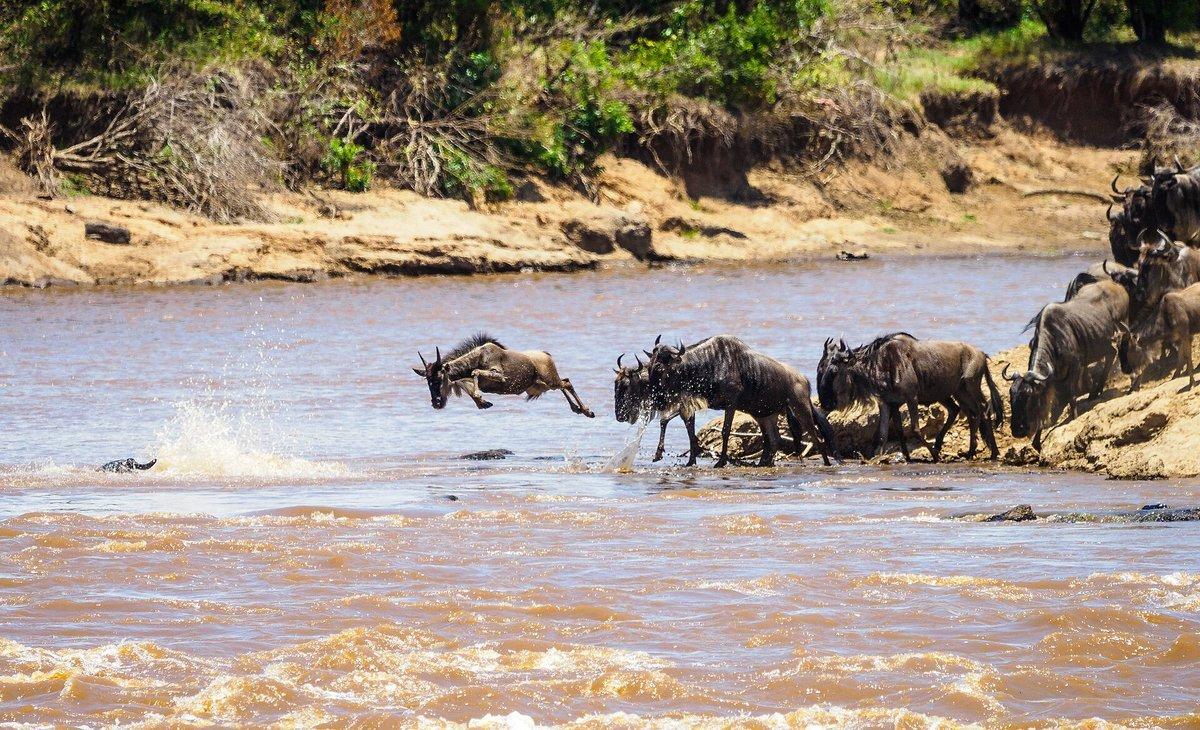
You have been parked on the north bank of the Mara River since dawn. Ten thousand wildebeest are massed on the far side, grunting, jostling, working themselves into the collective nerve it takes to enter water that hides crocodiles the length of your vehicle. An hour passes. Two. The front rank presses to the edge, then bolts back. Your finger has been resting on the shutter so long it has gone numb. Then, with no signal you can detect, one animal leaps — and the whole herd pours over the bank in a torrent of dust, spray and thrashing bodies. For ninety seconds the river is chaos. You do not get to plan for this moment. You only get to be ready when it arrives.
The Great Migration is not a place or a date. It is a 1,000-kilometre circular walk that roughly 1.5 million wildebeest — trailed by several hundred thousand zebra and gazelle — make every year through the Serengeti–Mara ecosystem, driven by rain and the fresh grass it brings. Photographers chase the migration for the river crossings, but reducing it to that single spectacle undersells the ecosystem. The calving on the southern short-grass plains, the leopards of the Seronera woodlands, the lion prides that own the granite kopjes, the dawn balloon drift over an unbroken horizon of grass — these are complete subjects in their own right. This guide covers where the herds are through the year, how to photograph the ecosystem’s defining moments, and how to plan a trip around an event that refuses to keep a schedule.
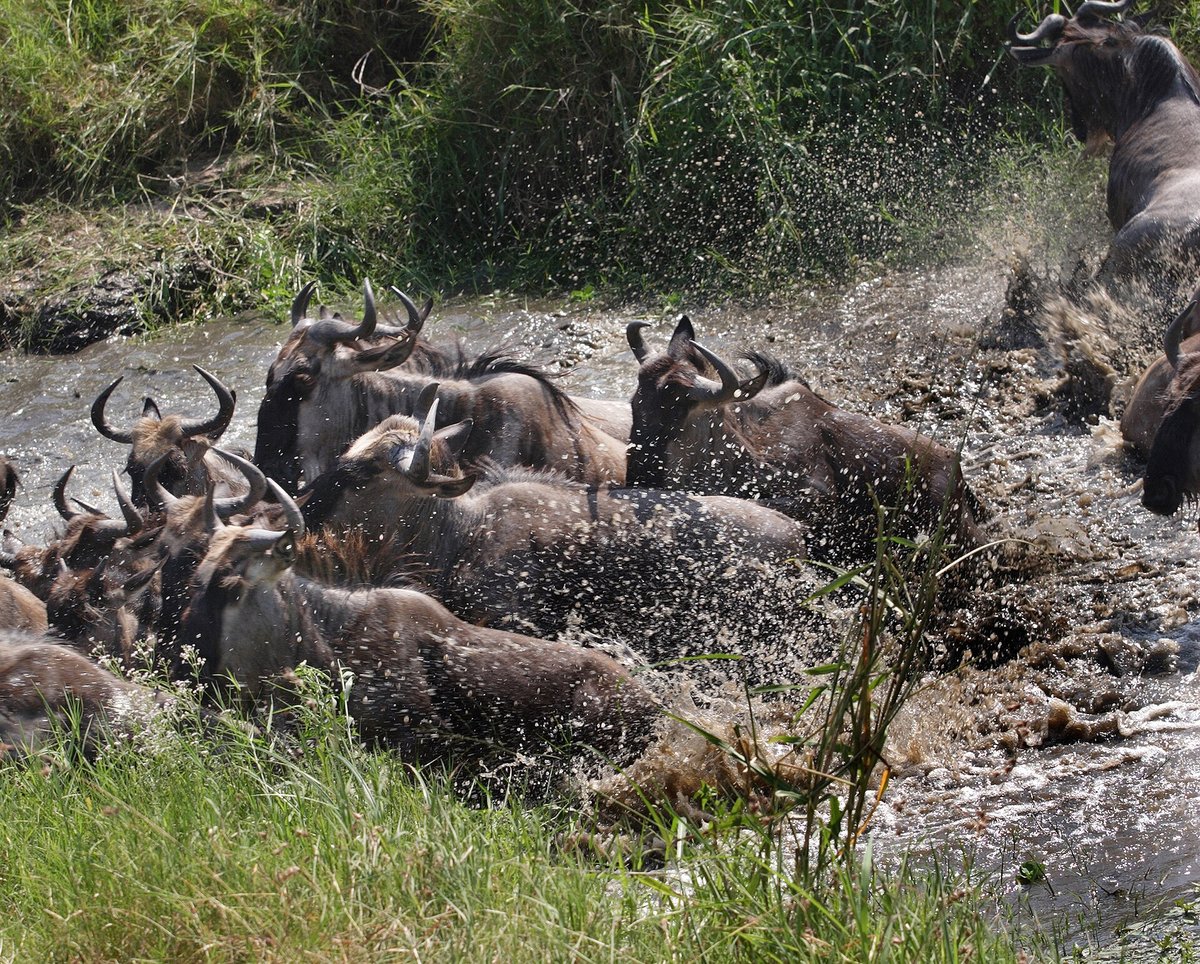
The migration is a moving river of animals — here crossing a smaller tributary in the green season. Photo: Wolves201 / Wikimedia Commons (CC BY-SA 4.0)
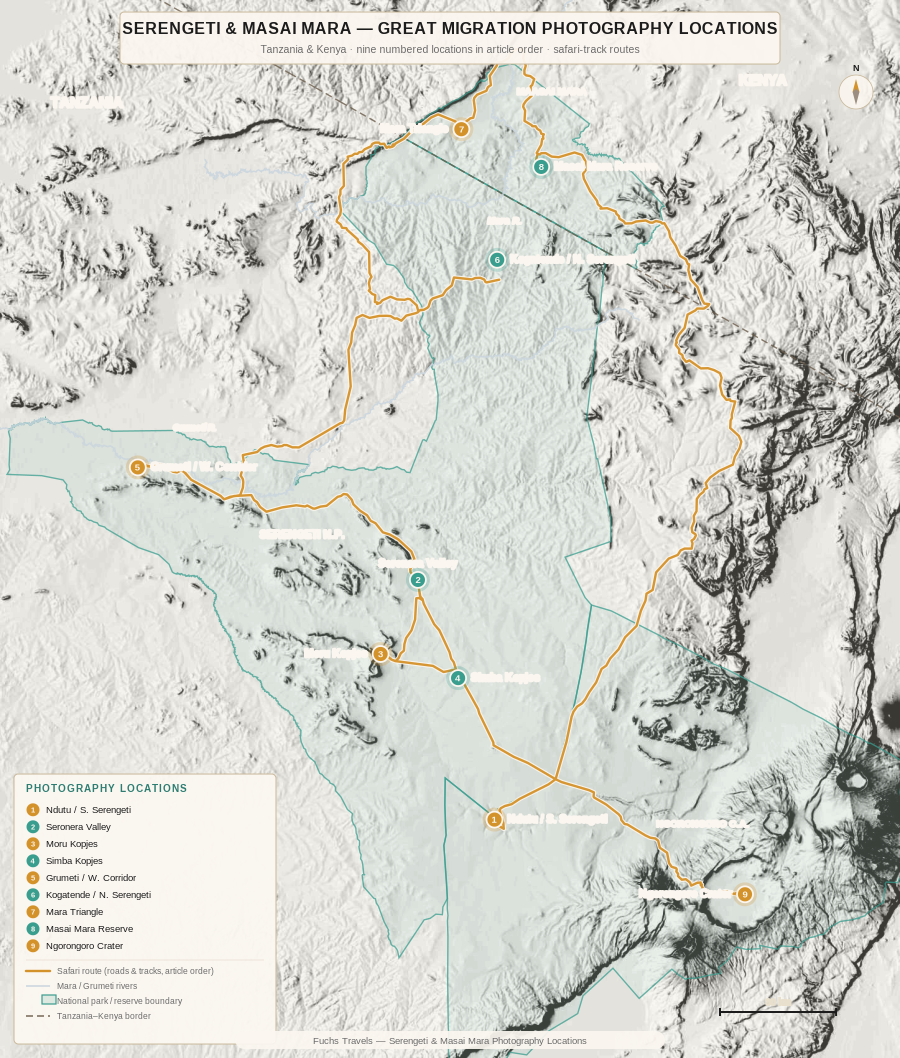
Understanding the Ecosystem
The Serengeti–Mara ecosystem straddles the Tanzania–Kenya border across roughly 30,000 square kilometres. The Serengeti National Park (Tanzania) forms the vast southern bulk; Kenya’s Masai Mara National Reserve — plus its bordering private conservancies — is the smaller northern extension. The Ngorongoro Conservation Area sits to the southeast, most visitors passing through it to reach the southern plains. The whole system tilts gently from the volcanic highlands around Ngorongoro down to the western corridor and Lake Victoria basin.
Rain sets the clock. Two rainy periods — the long rains of roughly April–May and the short rains around November — green the plains in a rolling wave, and the herds follow that green. This is why the migration moves clockwise through the year: south for the mineral-rich calving grounds after the short rains, northwest as those plains dry out, and into the Mara’s permanent grasslands during the long dry season. Everything a photographer plans depends on reading where in this cycle the herds will be.
A word on the two-country reality: the ecosystem is one thing, but it is governed by two national parks authorities with different fees, rules and access styles. The animals ignore the border. Your logistics cannot.
The Southern Serengeti and Ndutu
Ndutu and the Short-Grass Plains
GPS: ●●.●●●●° S, ●●●.●●●●° E
From roughly December to March the herds blanket the short-grass plains around Ndutu, on the Serengeti–Ngorongoro boundary. This is calving season, and it peaks with astonishing intensity: in a compressed two-to-three-week window around February, roughly half a million wildebeest calves are born — as many as 8,000 in a single day at the height of it. The synchrony is a survival strategy, swamping predators with more prey than they can possibly take. For a photographer it means non-stop action: newborns finding their legs within minutes, and the densest concentration of predators you will see anywhere.
Best light: The plains here are flat and open in every direction, so both sunrise and sunset deliver clean low-angle light with nothing to block it. Shoot the first and last hour hard; the midday light on the white-grass plains is flat and harsh.
Key compositions: Use the emptiness. A lone acacia, a single calf against a sweep of grass, a cheetah on a termite mound scanning — the negative space is the composition. For the calving, watch for the tender moments (a mother nuzzling a wet newborn) and the brutal ones (cheetah and hyena hunts) with equal readiness.
Technique tips: This is the season for predator action, so keep a fast shutter (1/1600 or quicker) ready on a super-telephoto. The green short grass is also the most forgiving background you will get all year — clean, even, and colour-complementary to a tawny cat.
Access: Ndutu’s tracks are open, low, and famously permissive for off-track driving relative to the central park (it falls under the Ngorongoro Conservation Area’s rules), which is why cheetah and cat photographers favour it. Roads turn to black-cotton mud after rain — a serious 4x4 and a good driver are non-negotiable.

Calving season concentrates predators on the southern plains — a cheetah family near Ndutu against the clean green grass of February. Photo: Christoph Strässler / Wikimedia Commons (CC BY-SA 2.0)
The Central Serengeti: Seronera and the Kopjes
Seronera Valley
GPS: ●●.●●●●° S, ●●●.●●●●° E
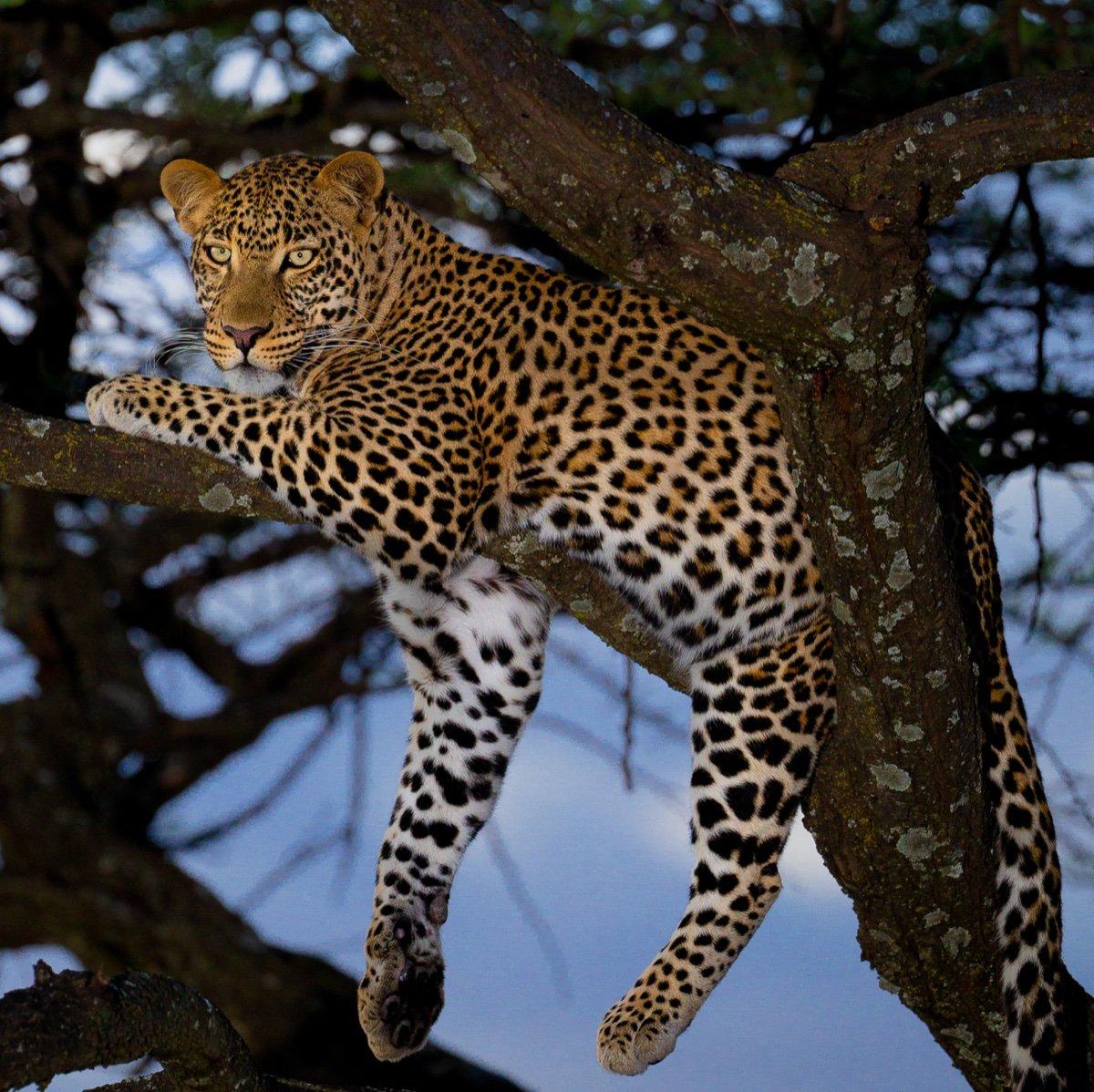
The Seronera Valley, watered year-round by the Seronera River, is the central Serengeti’s wildlife engine and its most reliable big-cat address. The riverine woodland here is famous for leopards, draped along sausage-tree branches, and the permanent water holds resident game long after the migration has moved on. If your trip falls outside the crossing months, Seronera is where you base for guaranteed cats.
Best light: The gallery woodland along the river gives you dappled early light and clean shade. A leopard in a tree is often best shot in the first hour, before the sun climbs and the contrast between sunlit cat and shadowed foliage becomes unmanageable.
Key compositions: For a treed leopard, get low and shoot along the branch rather than up at the belly; wait for the head-up, ears-forward alert posture. For lions on the valley floor, use the riverine grass and doum palms as environmental context rather than filling the frame with fur.
Technique tips: Leopards sit in high-contrast light — dark leaves, bright sky. Meter for the cat’s face and let the background blow if it must; a blown sky beats a black leopard. Expose to the right where you can, but protect the highlights on a pale coat.
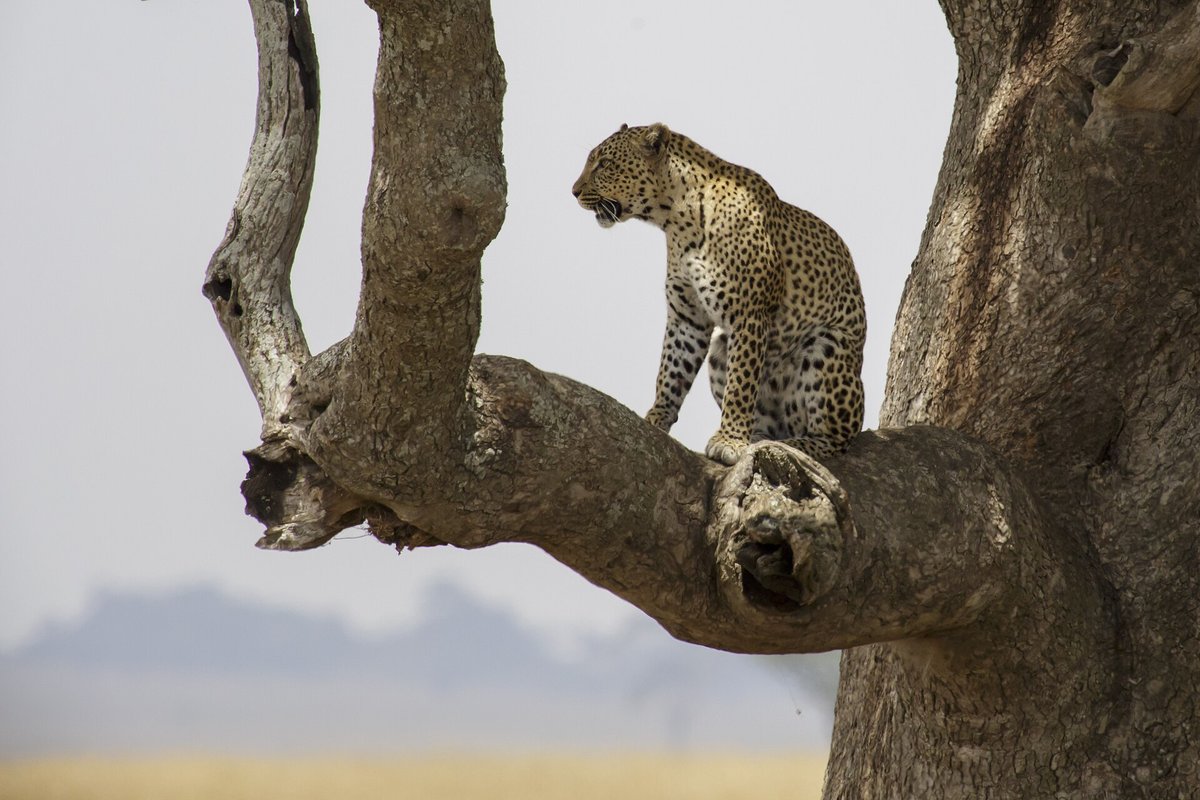
Seronera’s riverine woodland is the ecosystem’s most dependable leopard habitat — shoot along the branch, not up at it. Photo: Thomas Fuhrmann / Wikimedia Commons (CC BY-SA 4.0)
Moru Kopjes
GPS: ●●.●●●●° S, ●●●.●●●●° E
Kopjes — islands of ancient granite rising from the grass sea — are the Serengeti’s most photogenic natural stages. Moru Kopjes, in the south-central park, are the most storied: lions use them as watchtowers and nurseries, and the rocks hold Maasai pictographs and a ringing “Gong Rock.” A lion silhouetted on a kopje at dawn is the classic Serengeti frame that has nothing to do with the migration.
Best light: Aim for first light when a cat is likely to be up on the warm rock catching the sun. The kopjes catch and hold golden light beautifully; a low sun rakes across the granite texture.
Key compositions: Place the cat on the rock, the rock in the plain, and the plain under a big sky — a three-layer composition that reads scale. Or go tight and abstract on the lichen-painted granite and the animal’s shape.
Technique tips: Meter carefully — a dark lion on bright rock will fool the camera into underexposing the cat. Bracket, or dial in positive exposure compensation.
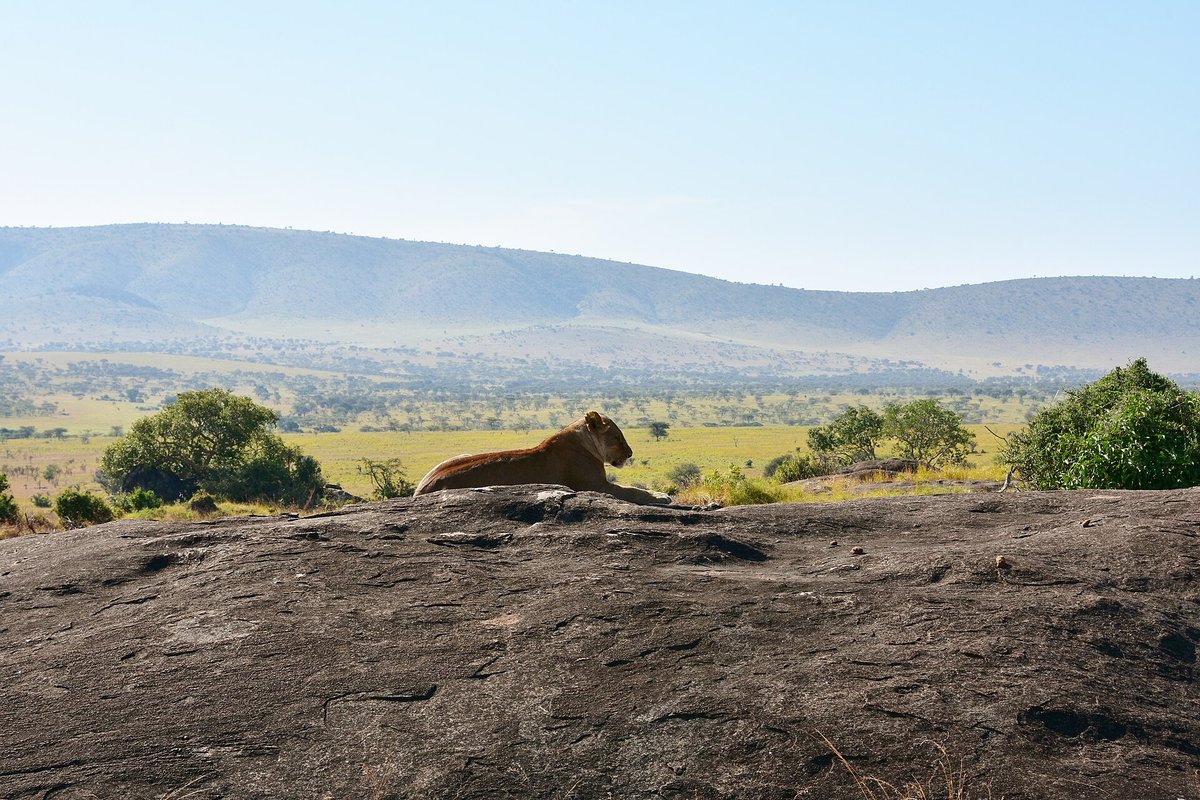
A lioness on a kopje above the plains — a three-layer composition of cat, rock and grassland that says “Serengeti” without a single wildebeest. Photo: Richard Mortel / Wikimedia Commons (CC BY 2.0)
Simba Kopjes
GPS: ●●.●●●●° S, ●●●.●●●●° E
Named for the lions (simba) that reliably haunt them, the Simba Kopjes cluster sits beside the main Seronera–Naabi road, making it one of the more accessible rock outcrops for a dawn cat vigil. Work the same three-layer approach as at Moru, and scout the kopjes at last light too — cats climb up to catch the day’s final warmth.
The Western Corridor
Grumeti River and the Western Corridor
GPS: ●●.●●●●° S, ●●●.●●●●° E
As the southern plains dry through May and June, the herds stream northwest into the Western Corridor, a tongue of the park reaching toward Lake Victoria. Here they meet their first serious water obstacle: the Grumeti River, and the smaller Mbalageti. The Grumeti crossings (roughly June–July) are less explosive than the Mara crossings to come — the river runs in pools rather than a continuous torrent — but they hold enormous, ambush-fed crocodiles and draw far fewer vehicles.
Best light: The corridor’s riverine forest is dense and shaded; crossings can happen at any hour, so light is opportunistic. Early and late give you the warm side-light that models dust.
Key compositions: The Grumeti’s forested banks let you frame crossings with vegetation — a more intimate, less-photographed take than the open Mara banks. Watch the pools for the slow reveal of a submerged crocodile.
Technique tips: This is a good place to practise crossing technique before the higher-stakes Mara. Pre-focus on the entry point, set your exposure for the sunlit water, and shoot in bursts.
Access: The Western Corridor is a longer drive from the central hubs and sees fewer camps, so it rewards those willing to base out there in June–July for relative solitude.
The Northern Serengeti and the Mara Crossings
Kogatende and the Northern Serengeti
GPS: ●●.●●●●° S, ●●●.●●●●° E
From roughly July, the herds reach the northern Serengeti around Kogatende, where the Mara River loops through both Tanzania and Kenya. This is the Tanzanian stage of the great river crossings, and it is every bit as dramatic as the Kenyan side — with materially fewer vehicles, because the northern Serengeti is remote and served by fewer camps. Crossings here happen on the Mara and its tributary the Bologonja, in both directions, as herds ping-pong across the river through the dry season.
Best light: Crossings are unschedulable, so you shoot whatever light the moment gives you. Position early, though — the classic crossings tend to build through the morning as the day heats and the animals grow thirsty and bold.
Key compositions: The northern banks offer both the wide “torrent” frame (herd pouring down a dust chute into the water) and the tight action frame (a single animal mid-leap, a crocodile strike). Decide before it starts which you are shooting — you cannot do both in one burst.
Technique tips: See the river-crossing settings guide below. The single most useful discipline is to commit to a shutter strategy in advance and not fiddle mid-crossing.
Access: Kogatende has an airstrip; most photographers fly in rather than endure the long drive from the central Serengeti. Budget at least three days in the region — crossings can fail to happen for days, then deliver three in an afternoon.
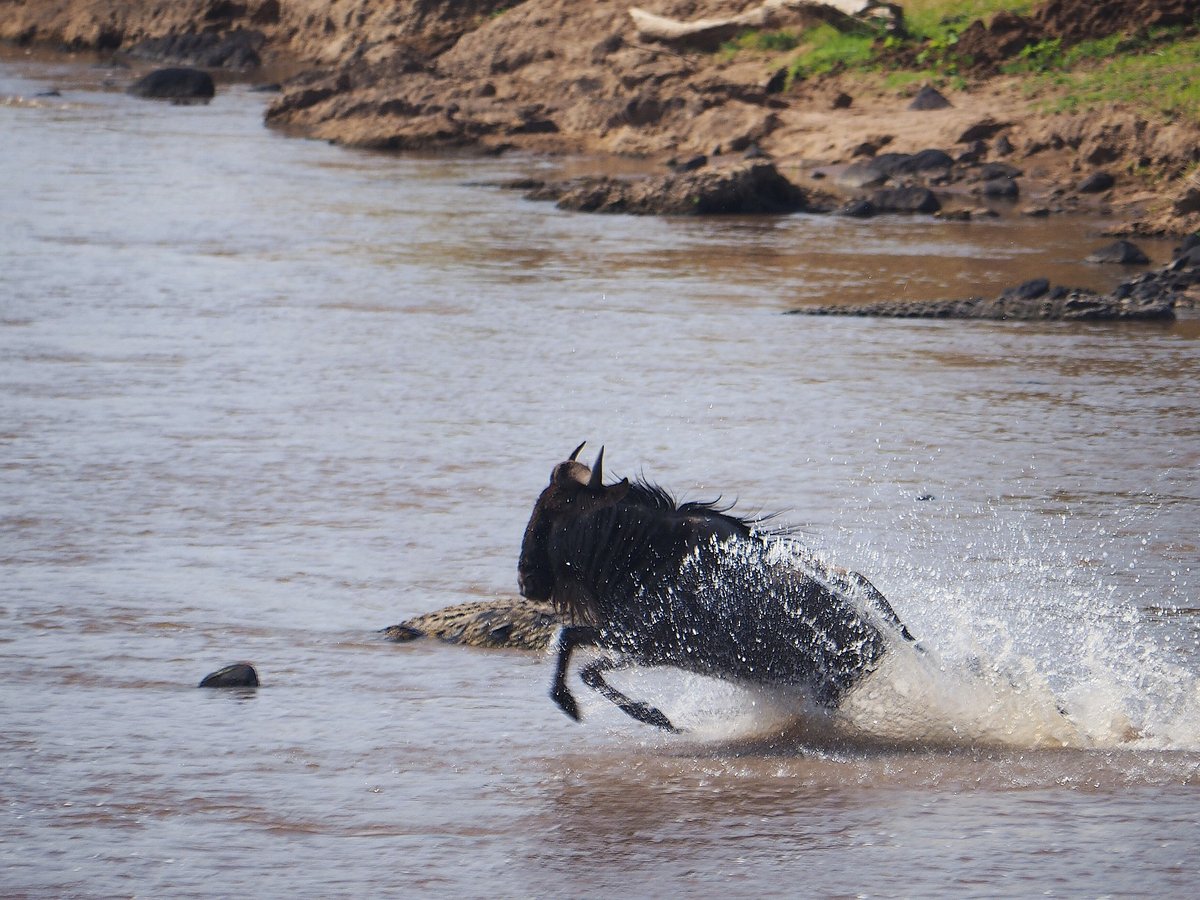
The stakes at every crossing — a wildebeest breaks past a crocodile in the shallows. Nile crocodiles lie in wait at the traditional crossing points. Photo: Leo Li / Wikimedia Commons (CC BY 2.0)
The Masai Mara
The Mara Triangle
GPS: ●●.●●●●° S, ●●●.●●●●° E
The Mara Triangle is the western sector of Kenya’s Masai Mara, managed separately by the non-profit Mara Conservancy. It is generally the least-crowded part of the reserve, with well-run roads and a strong anti-poaching record, and it holds some of the most reliable Mara River crossing points on the Kenyan side (July–October). Rolling grassland backed by the Oloololo Escarpment gives it the most photogenic topography in the Mara.
Best light: The escarpment on the western edge means the Triangle loses its direct sun a little earlier in the evening, but the open eastern grassland catches beautiful low morning light. For crossings, again — you take what the moment gives.
Key compositions: Use the Oloololo Escarpment as a backdrop to give Mara images a sense of place that the flatter reserve lacks. Herds strung across the grassland with the escarpment behind is a signature Triangle frame.
Technique tips: The Triangle enforces its rules — stay on-track except where permitted, and respect crossing etiquette. A long lens (400mm+) lets you keep a respectful distance from the crossing point while still filling the frame.
The Masai Mara National Reserve
GPS: ●●.●●●●° S, ●●●.●●●●° E
The main reserve — the Musiara, Talek and Sekenani sectors — is the Mara of legend, the setting the world knows from decades of wildlife filmmaking, including the BBC’s long-running Big Cat Diary. Its lion prides are habituated and its cheetahs sometimes use vehicles as vantage points. The trade-off is vehicle density: a good sighting in peak season can draw a dozen or more cars.
Best light: The reserve’s gently rolling grassland with scattered balanites trees is made for backlit dawn and dusk work — a lone tree, a cat, a low sun. The famous Mara sunsets, thick with dust and often storm-charged, are a subject in themselves.
Key compositions: Silhouettes. The Mara’s clean horizon and lone flat-topped trees are the classic African-sunset frame. Expose for the sky, let the tree and animal go black, and place the sun deliberately.
Technique tips: For big cats at eye level, get the lens as low as the vehicle allows and shoot at the animal’s eye line — a beanbag on the door sill beats a tripod inside a vehicle every time.
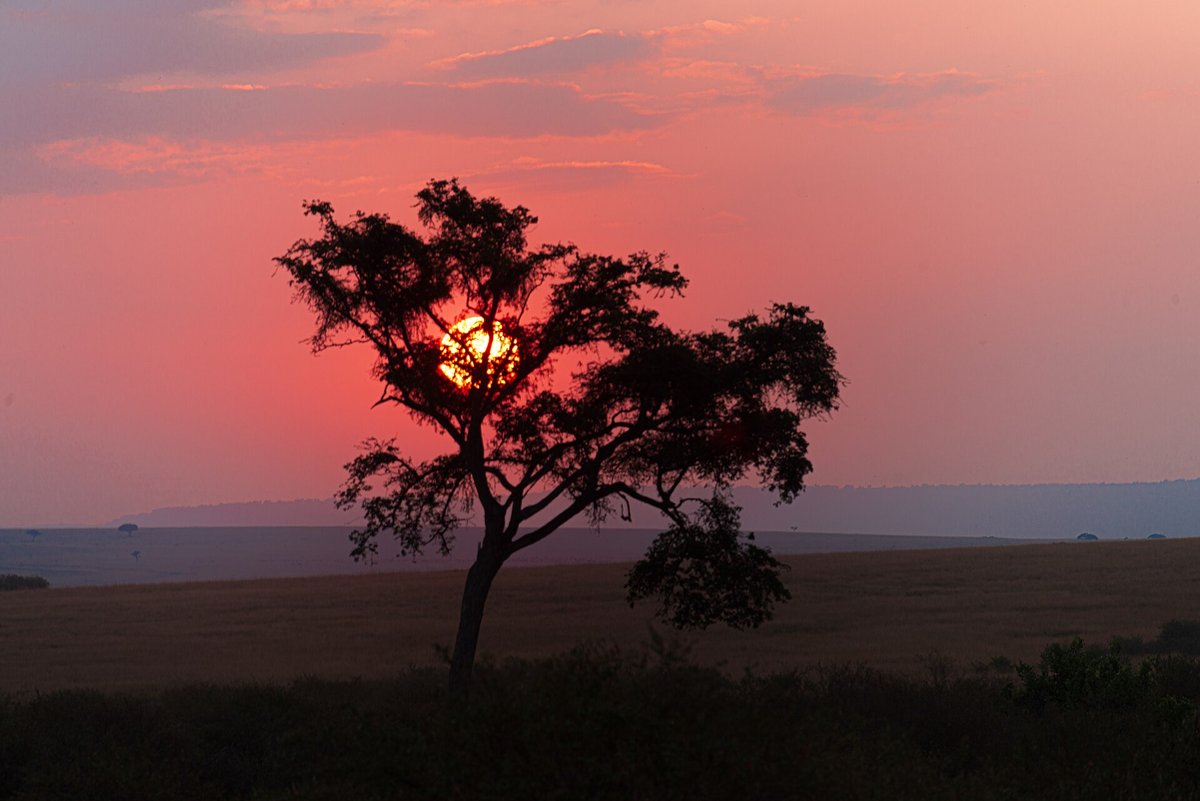
The Mara’s clean horizon and flat-topped trees make the classic African silhouette — expose for the sky and place the sun with intent. Photo: Daniel Case / Wikimedia Commons (CC BY-SA 4.0)
The Private Conservancies
The private conservancies bordering the reserve — Mara North, Naboisho, Olare Motorogi and others — are the photographer’s secret weapon. Leased from Maasai landowners and run on a low-density model, they permit what the national reserve forbids: off-road driving to position for light and angle, night drives, and strict caps on how many vehicles may attend a sighting (often just a handful, versus the reserve’s crowd). The trade-off is that the biggest, most reliable river crossings happen in the reserve and the Mara Triangle, not the conservancies. Many photographers split their Mara time — conservancy for controlled big-cat work, reserve for the crossings.
When to Go: The Migration Calendar
There is no single “best time” — there is a best time for the shot you want. Calving in the south peaks in February; the Mara crossings run July to October. The two are five months and several hundred kilometres apart.
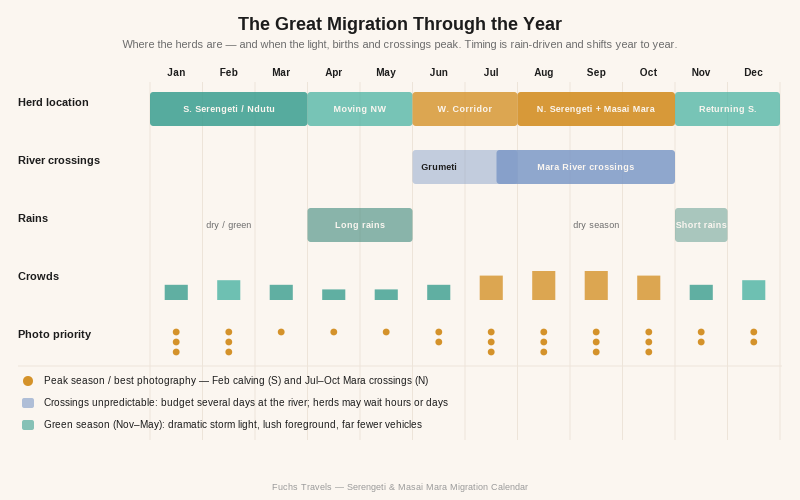
| Period | Herd location | Photographic prize | Crowds |
|---|---|---|---|
| Dec–Mar | Southern Serengeti / Ndutu | Calving peak (~Feb), dense predator action, green plains | Moderate |
| Apr–May | Moving northwest | Dramatic storm light, lush foreground, low prices | Low |
| Jun–Jul | Western Corridor | Grumeti River crossings, fewer vehicles | Low–moderate |
| Jul–Oct | Northern Serengeti + Masai Mara | Mara River crossings — the headline event | High |
| Nov | Returning south | Short-rains green-up, newborn zebra | Low |
A strategic note the brochures skip: the green season (roughly November–May) is undersold. Fewer vehicles, lush emerald foregrounds, theatrical storm skies, and the calving spectacle make it a landscape-and-action photographer’s season — you simply won’t get the Mara crossings. If crossings are your goal, you accept the crowds of July–October. If you want the ecosystem at its most beautiful and least busy, go green.
Remember that the migration answers to rain, not the calendar. Every month above can shift by weeks year to year. Build slack into your itinerary and never book a trip on the promise of a specific crossing on a specific date.
Photographing a River Crossing
The crossing is the migration’s defining test of a photographer’s readiness. It rewards preparation and punishes fiddling.
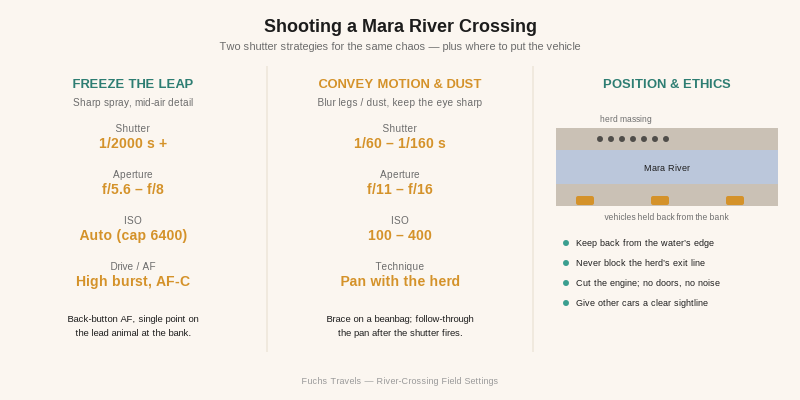
Commit to a shutter strategy before it starts. You broadly have two: freeze the leap (1/2000 s or faster, f/5.6–f/8, Auto ISO capped, high-speed burst, continuous AF on the lead animal) for sharp spray and mid-air detail; or convey the motion and dust (1/60–1/160 s, f/11–f/16, low ISO, panning with the herd) for atmospheric blur with a sharp eye. You cannot do both in one crossing. Decide, set the camera, and leave it.
Position early and ethically. Crossings happen at traditional points that guides know. Arrive before the herds commit, hold back from the water’s edge, and never let your vehicle block the animals’ entry or exit line — a poorly parked car can turn a herd back and cost every other photographer the shot (and stress the animals). Cut the engine. The river-crossing settings diagram above summarises both the exposure and the etiquette.
Watch the whole scene. The crocodile strike, the calf separated from its mother, the dust rising gold against the far bank — the story is bigger than the leap. Keep one eye out of the viewfinder.
Be patient beyond reason. Herds mass at a bank for hours, then retreat without crossing. This is normal. The photographers who get the shot are the ones still there when the dam finally breaks.
Drones, Balloons and the Aerial View
Do not plan on flying a drone. Both countries prohibit recreational drone use inside these protected areas. In Tanzania, TANAPA and the Ngorongoro authority bar UAVs in the Serengeti and Ngorongoro regardless of any national TCAA permit; in Kenya, drones are banned inside national parks and reserves including the Masai Mara, and legal flight requires a stack of KCAA and Kenya Wildlife Service permissions reserved for vetted professional projects. Flying without authorization risks confiscation and heavy fines. Treat the aerial view as off-limits unless you are on a formally permitted film production. (Regulations change — confirm the current position with your operator before travelling.)
The sanctioned aerial photograph is the dawn hot-air balloon safari, a durable fixture over both the Serengeti and the Masai Mara. You launch around first light and drift low over the plains for roughly an hour, often ending with a bush breakfast. Long-established operators run them on both sides of the border; budget on the order of US$450–650 per person. From the basket, shoot straight down for abstract patterns of animal trails and tree shadows, and out to the horizon for the scale of the grass sea. A mid-range zoom (24–105mm) is more useful aloft than a super-telephoto; the balloon’s gentle motion and the low light call for a moderately fast shutter and image stabilisation.
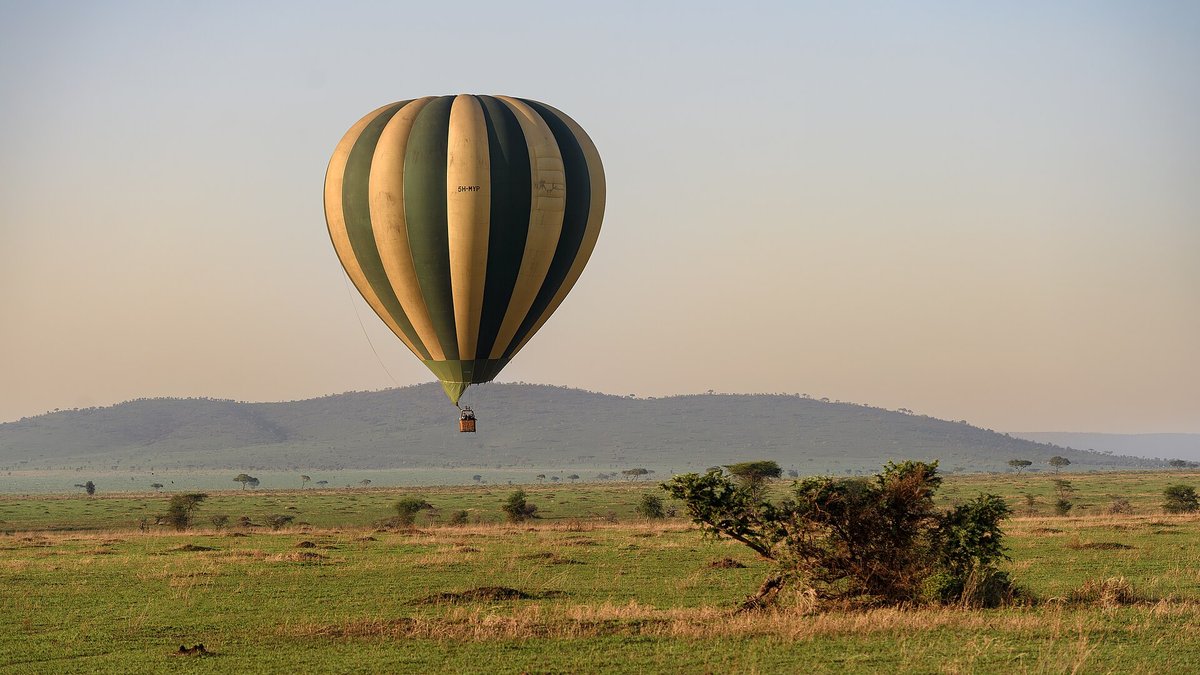
The sanctioned aerial view — a dawn balloon over the Serengeti. From the basket, shoot both straight down for abstract trails and out to the horizon for scale. Photo: Eric Kilby / Wikimedia Commons (CC BY-SA 2.0)
Ngorongoro Crater
The Crater Floor
GPS: ●●.●●●●° S, ●●●.●●●●° E
The Ngorongoro Crater is the world’s largest intact (unbroken and unflooded) volcanic caldera — a roughly 260-square-kilometre floor ringed by walls some 600 metres high. That natural amphitheatre concentrates an extraordinary density of game: all of the Big Five, one of Africa’s highest lion densities, and one of the most reliable chances anywhere to photograph the critically endangered black rhino, a small and closely watched resident population. Most itineraries fold a crater day in en route to or from the southern Serengeti.
Best light: The high walls mean the crater floor lights late and shadows early — you lose the first and last direct sun to the rim. Descend as early as vehicles are allowed to catch the soft window before the light hardens, and use the frequent mist and the wall as a moody backdrop.
Key compositions: Use the crater wall as a constant environmental frame — an elephant or rhino small against that 600-metre backdrop conveys the place. The Lerai forest and the soda-lake edge (flamingos, hippo pools) offer contrasting habitats within a single day.
Technique tips: Rhinos are usually distant here — a 500mm+ lens and a beanbag are essential, and even then you are often making an environmental portrait rather than a frame-filler. Meter for the shaded floor under the bright rim.
Access: The crater is busy and tightly managed. Expect a per-person area fee plus a separate per-vehicle crater service fee to descend (see logistics). Vehicle numbers and descent routes are controlled; your driver-guide handles the permits.
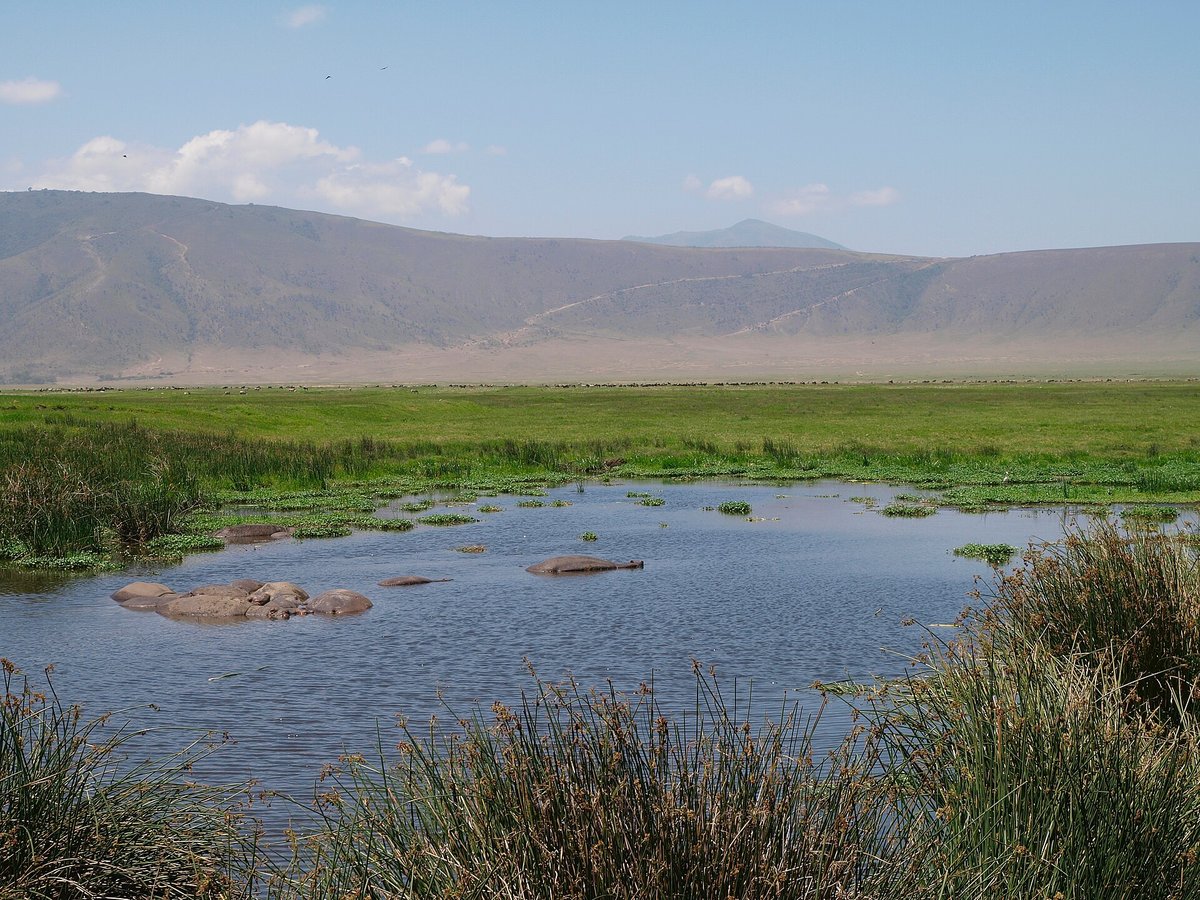
The Ngorongoro caldera — a 260 km² floor under 600-metre walls, cradling one of Africa’s densest concentrations of game. Photo: John Mackenzie Burke / Wikimedia Commons (CC BY-SA 4.0)
Photographing the Maasai
The Maasai are central to this landscape’s human story, and a village visit is a common add-on. Approached with respect it can yield strong environmental portraiture; approached carelessly it produces stiff, transactional snapshots.
- Agree terms first. Most village visits involve a fee, and photography is part of the arrangement. Confirm with your guide before you lift the camera, and honour it.
- Ask, then engage. A portrait made after a few minutes of genuine conversation — even through a guide translating — is worth ten grabbed frames. Learn a name.
- Shoot the culture, not a costume. The red shúkà against ochre earth, the adumu (the jumping dance), the beadwork and the long shadows of late afternoon make honest, dignified images. Work the colour and the gesture.
- Mind the light. Midday village visits are common but harsh; if you can influence timing, late afternoon transforms the same scene. Fill flash can tame the deep shadows of overhead sun on dark skin — use it gently.

The adumu, or jumping dance — photograph the gesture and the colour with consent and patience, not as a grabbed snapshot. Photo: Lali.dee / Wikimedia Commons (CC BY-SA 4.0)
Logistics and Planning
Getting There
Most photographers fly into Kilimanjaro (JRO) or Arusha (ARK) for the Tanzanian Serengeti, or Nairobi (NBO) for the Kenyan Mara, then connect by light aircraft to bush airstrips (Seronera, Kogatende, or the Mara strips). Given the distances and the black-cotton mud, flying between regions saves days. There is no self-drive here — you travel in a guided safari vehicle arranged through your camp or operator, and a good driver-guide is the single biggest factor in your photographic success.
Park Fees
Fees are the most volatile part of any plan and have risen sharply in recent years — treat every figure below as approximate and confirm the current tariff before you travel.
| Area | Recent non-resident fee (approx.) | Notes |
|---|---|---|
| Serengeti N.P. (TANAPA) | ~US$60–70 / adult / 24 hr | VAT included; valid 24 hours |
| Ngorongoro Conservation Area | ~US$70 / adult / day | Plus a separate ~US$295 per-vehicle crater service fee to descend |
| Masai Mara N.R. (Narok County) | ~US$100 (Jan–Jun) / ~US$200 (Jul–Dec) / adult | Ticket now valid 12 hours (6am–6pm), not 24 |
| Mara Triangle (Mara Conservancy) | Comparable seasonal rate | Cashless (card / mobile money) |
| Private conservancies | Bundled into lodge rates | Funds Maasai landowner leases |
The Mara reserve fee in particular changed steeply in 2023–2024 and moved to a 12-hour ticket, so verify before booking.
Accommodation
| Type | Style | Rough cost (per person / night, all-in) |
|---|---|---|
| Budget | Public campsites, basic lodges | US$120–250 |
| Mid-range | Permanent tented camps | US$300–600 |
| Premium | Mobile “migration-following” camps, private conservancy camps | US$700–1,500+ |
The photographer’s move is a mobile camp that follows the migration — pitched near the calving grounds in February, near the Mara in August — so you wake up already in position rather than driving hours to the action.
Rough Daily Budget
| Component | Approx. per day |
|---|---|
| Camp / lodge (mid-range, all-inclusive) | US$300–600 |
| Park & conservation fees | US$70–200 |
| Vehicle & guide (shared) | US$100–250 |
| Light-aircraft transfers (amortised) | US$50–150 |
| Typical mid-range total | US$500–900 / day |
Health and Safety
This is a malaria region — take prophylaxis and cover up at dusk. Yellow-fever vaccination is required for entry in some cases; check current requirements. The wildlife is genuinely wild: stay in the vehicle except at designated points, and follow your guide’s instructions without exception.
Gear for the Migration
| Category | Recommendation | Why |
|---|---|---|
| Bodies | Two, ideally — one long, one wide | No lens changes in dust; a second body saves the crossing shot |
| Long lens | 100–400mm or 200–600mm zoom, or 500/600mm prime | Reach for cats and crossings; zoom flexibility for changing distance |
| Standard zoom | 24–70mm or 24–105mm | Landscapes, balloon work, environmental context |
| Support | Beanbag (the safari essential) | Steadies a long lens on the vehicle door; tripods are useless inside a car |
| Filters | Polariser | Cuts haze, saturates the sky over the plains |
| Protection | Dust covers, rocket blower, sealed body | Black-cotton dust gets into everything |
| Power | Double the batteries you think you need | Charging in bush camps is limited; cold dawns drain cells |
| Cards | Fast, high-capacity, plus backups | A crossing burst fills a card fast |
Leave the drone at home — it is banned and will only cause trouble at the airport and the gate.
Field Exercises
- The pre-committed crossing. Before any crossing, decide your shutter strategy (freeze or motion-blur), set the camera, and do not change it. Shoot the whole sequence one way. Review, then next time try the other. Learn which story you prefer telling.
- Three-layer kopje frame. At Moru or Simba, build a single image with three depth layers: animal on rock, rock in plain, plain under sky. Make the scale legible without a caption.
- The clean-background cat. On the southern plains, position the vehicle so a cheetah or lion sits against unbroken green grass with no distracting twig or vehicle in frame. Move the car, not the crop.
- Silhouette discipline. At a Mara sunset, expose for the sky and deliberately place a lone tree and the sun. Make five frames that differ only in the sun’s position relative to the tree. Choose the strongest.
- The consented portrait. In a Maasai village, spend ten minutes in conversation before making a single frame. Then make one environmental portrait that shows the person, their dress and their setting with dignity.
Final Thoughts
The Great Migration humbles the photographer who arrives expecting to command it. You cannot summon a crossing, schedule a hunt, or order the light. What you can do is understand the cycle well enough to be in the right region in the right month, master your craft well enough that the ninety-second window doesn’t catch you fumbling, and cultivate the patience to sit on a riverbank for six hours for a chance that may not come today.
That is the deal the ecosystem offers, and it is a fair one. The photographers who come home with the leaping wildebeest, the kopje lion at dawn, the cheetah family on green grass and the red Mara sunset are not luckier than the rest. They read the calendar, they did the reps, and they were still there — ready — when the herd finally, suddenly, poured over the bank.