Introduction
Antarctica does not care about your photography. The continent operates on a scale and with an indifference that makes human concerns irrelevant. Icebergs the size of apartment buildings drift past in silence. Penguin colonies numbering tens of thousands carpet rocky shorelines. Glaciers calve into the sea with the sound of distant thunder. And the light — when the clouds break — transforms ice into colors that sensor and film struggle to reproduce faithfully.
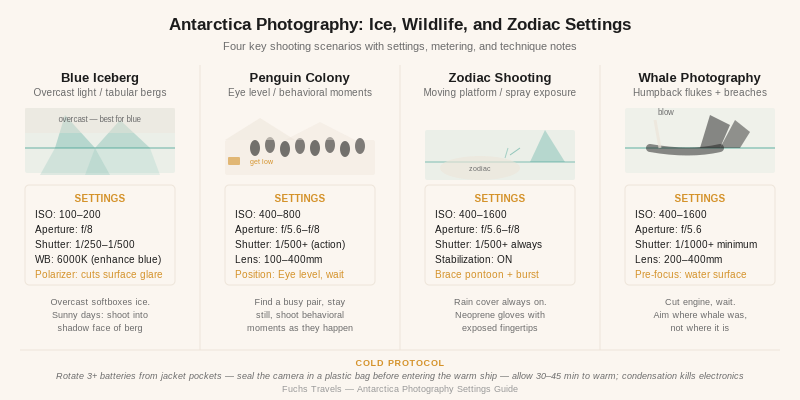
Quick-reference settings for the four main Antarctica shooting scenarios
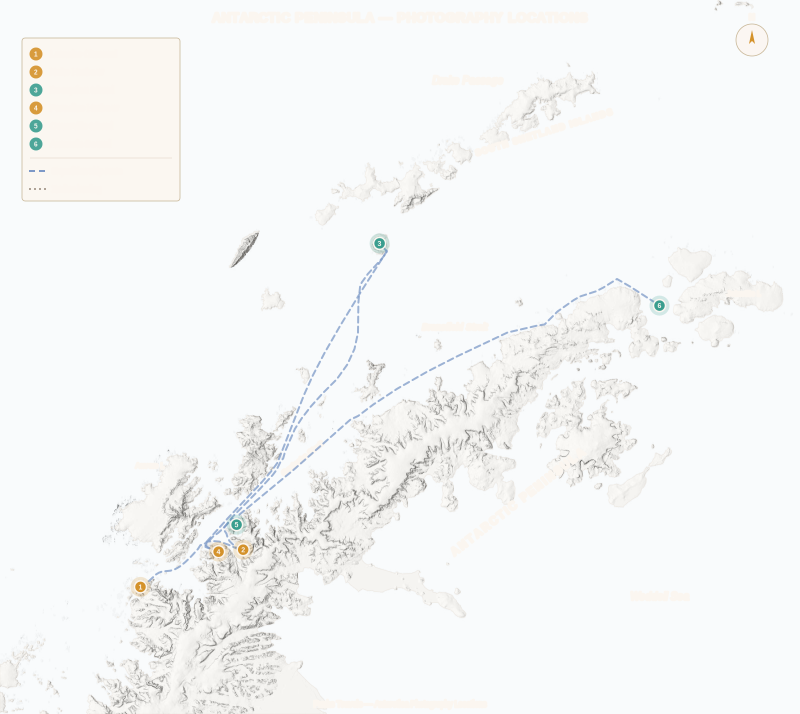
This is expedition photography in its purest form. You arrive by ship after crossing the Drake Passage — two days of some of the roughest seas on Earth. You photograph from zodiacs that pitch and roll in icy water. Your camera gear operates at the edge of its thermal tolerance. And when the weather turns, you wait — sometimes for days — because Antarctica’s schedule is non-negotiable.
The photographers who do best in Antarctica are not the most technically skilled. They are the ones who adapt fastest, stay patient longest, and have the lowest resistance to cold.
Understanding Expedition Photography
Antarctica is not a destination you visit independently. Every photographer arrives as part of an organized expedition, which means your photography is embedded in a group experience with schedules, landing rotations, and IAATO (International Association of Antarctica Tour Operators) guidelines. Understanding this context before you arrive determines how much you get from the trip.
The critical difference between a standard expedition and a photography-focused one is time per location. Standard expeditions optimize for the number of sites visited. Photography expeditions optimize for light, behavioral moments, and time in the field. If you are serious about Antarctica photography, book a photography-focused expedition even if it costs significantly more — the difference in output is not marginal.
IAATO Rules That Affect Photography
- Minimum 5-meter distance from all wildlife (penguins do not read the rules, but you must maintain your end)
- Do not step off the marked paths at historic sites
- No touching wildlife, rocks, or objects
- Recreational drone use is prohibited in coastal Antarctica under IAATO policy — passengers cannot fly drones from ships, zodiacs, or landing sites; only separately permitted commercial and scientific flights operate
- 100 visitors maximum ashore at any time
- Travel with an IAATO-member operator — the association’s wildlife and landing protocols are the industry standard
- Biosecurity is mandatory: boots and outer gear are cleaned and inspected before and after every landing, and current avian-influenza protocols prohibit sitting, kneeling, or lying on the ground near wildlife
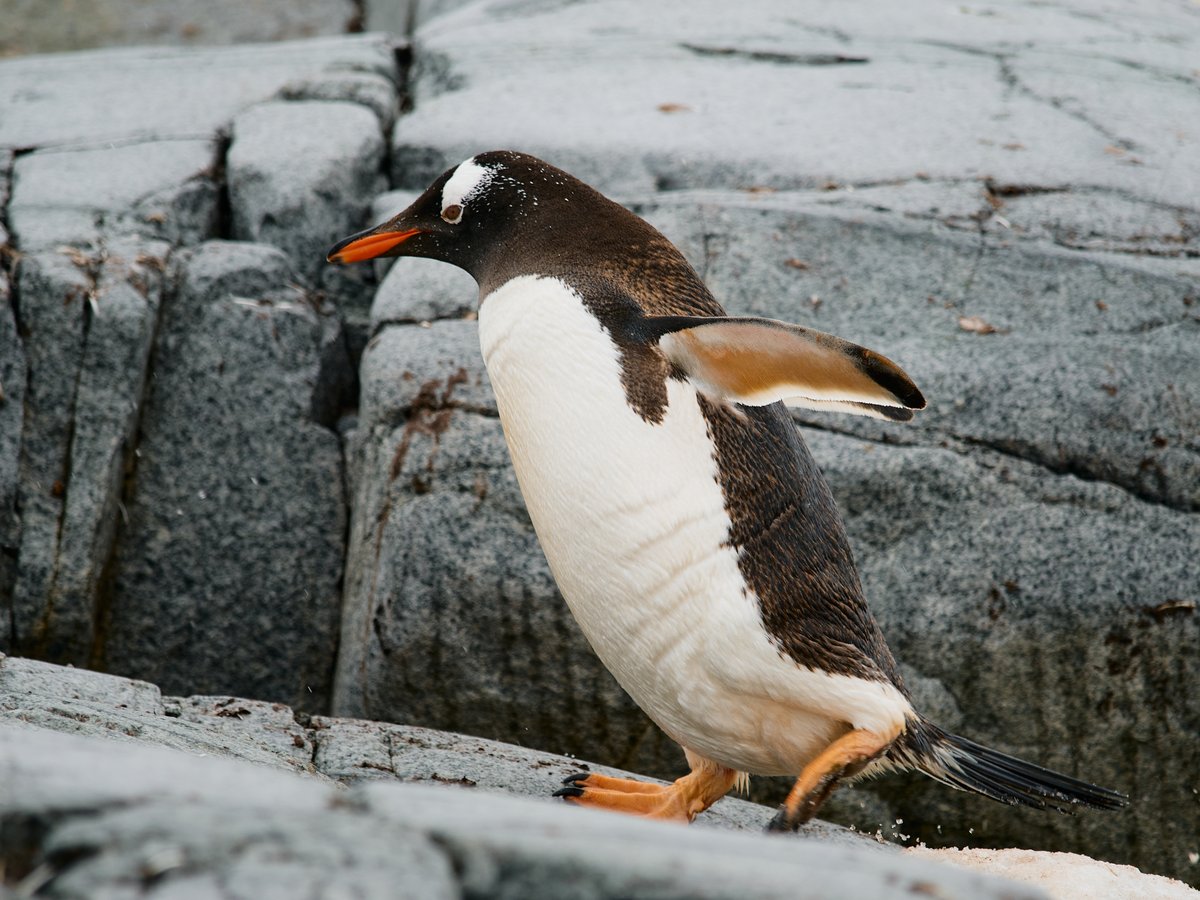
Gentoo penguin — the orange bill and white eye patch are the species’ field marks; a 70-200mm captures portraits like this without disturbing the birds. Photo: Pedro Szekely / Wikimedia Commons (CC BY-SA 2.0)
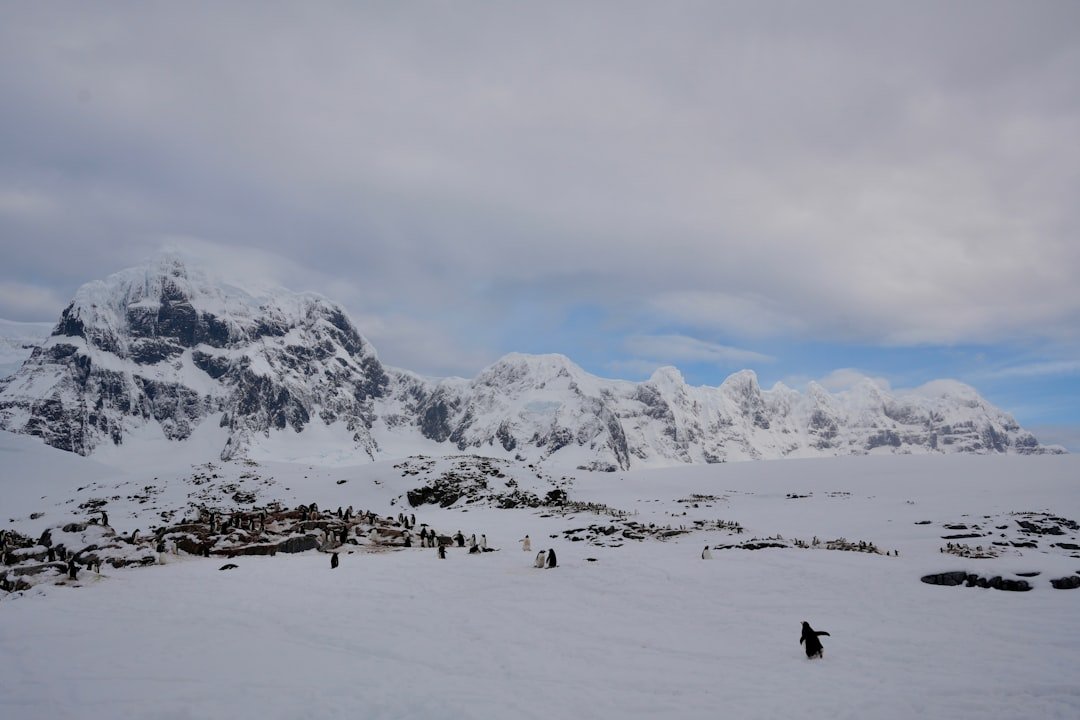
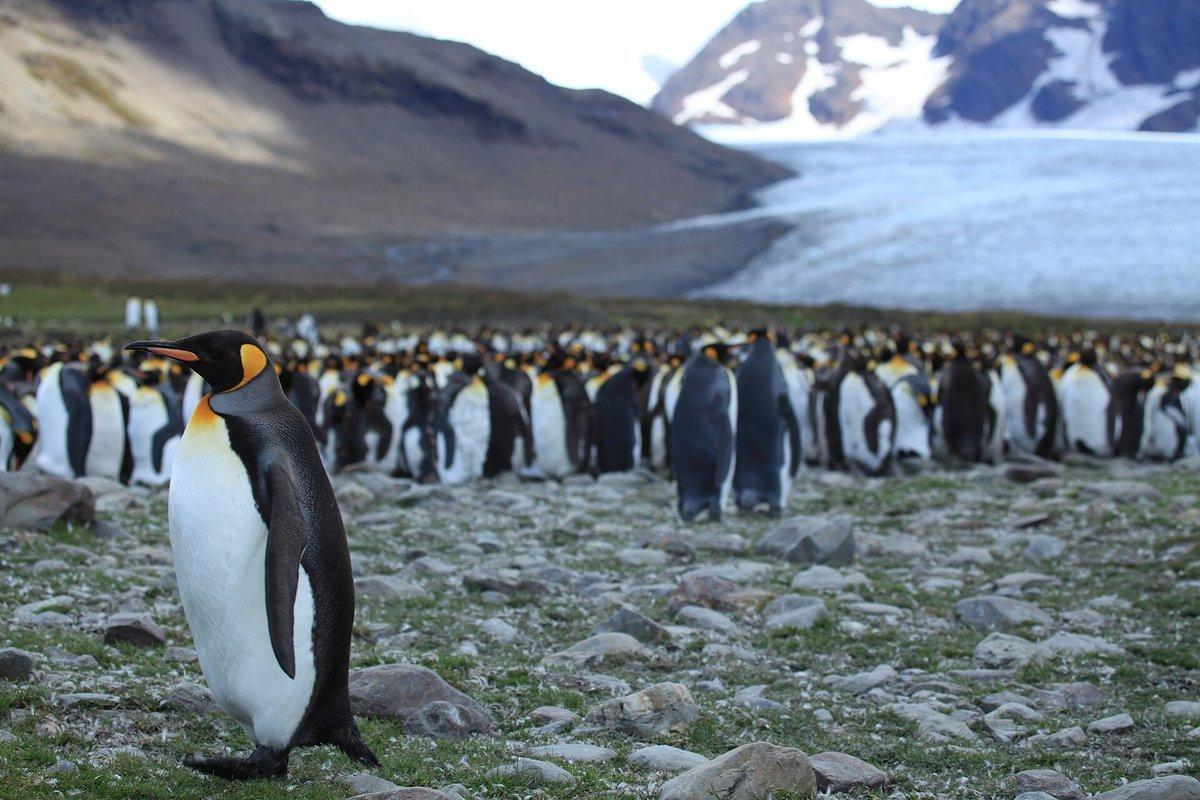
Penguin colonies — shoot from as low as the rules allow; the constant motion of birds against enormous terrain makes compelling wildlife documentary compositions. Photo: Jean Pierre Cabáni / Unsplash
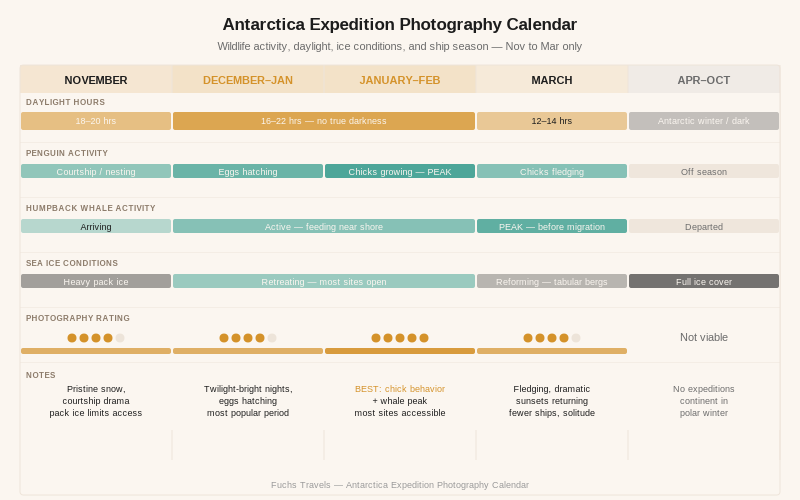
Best Times to Visit
Early Season (November to December)
Pristine snow cover on peaks and icebergs. Penguin courtship and egg-laying. Pack ice may limit access to some landing sites. The longest daylight hours — up to 20 hours of usable light. Fresh, untracked snow on shore creates clean, graphic compositions. Temperatures are coldest.
Peak Season (January to February)
Warmest temperatures (relatively). Penguin chicks hatching and growing — behavioral photography peaks. Whale activity increases significantly. Most ship departures and highest availability. Ice has retreated, opening more landing sites. The most crowded period if crowd matters to you.
Late Season (March)
Dramatic sunsets return as days shorten. Penguin chicks fledging. Humpback whales are most active before their northward migration. Pack ice begins reforming — dramatic ice photography opportunity. Fewer ships, more solitude. The season ends abruptly.
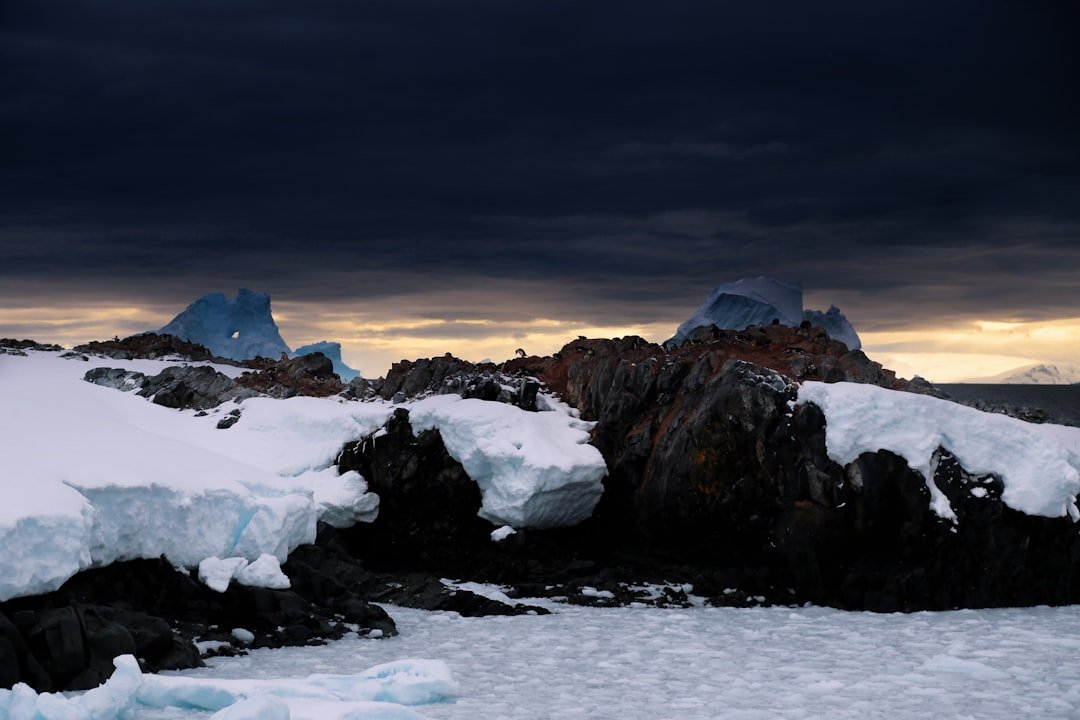
Antarctic dusk — even under heavy cloud the low sun finds gaps at the horizon; in December and January this light lingers past 10PM. Photo: Lucas Huffman / Unsplash
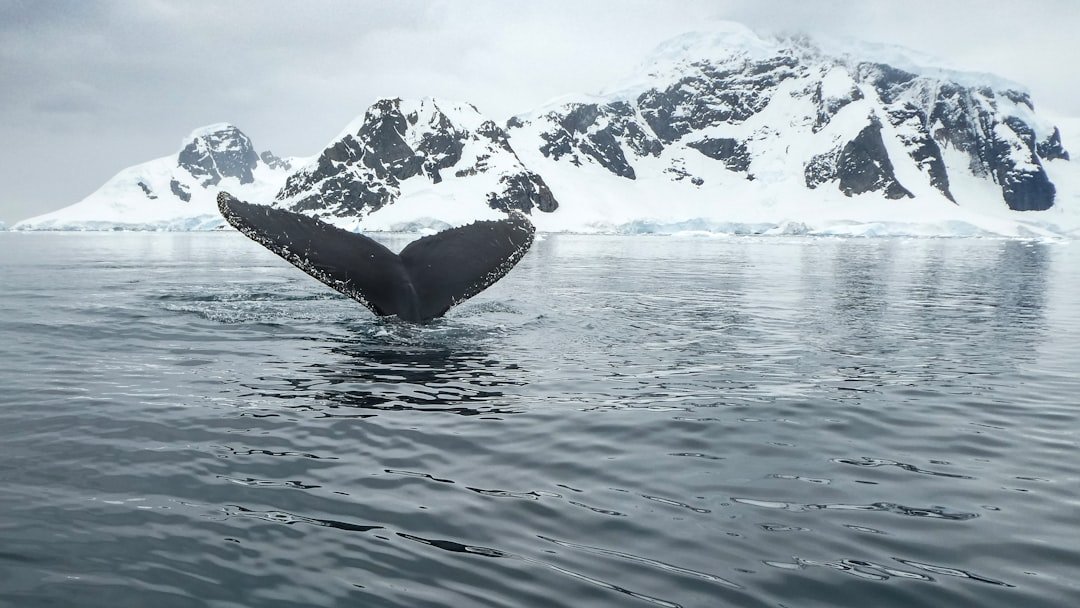
Whale encounters — humpbacks feed in Antarctic waters from December through March; keep your camera at 1/2000s with continuous AF. Photo: Derek Oyen / Unsplash
| Period | Temperature | Daylight | Wildlife Focus | Ice Conditions |
|---|---|---|---|---|
| Nov–Dec | -2 to 3°C | 18–22 hrs | Nesting, courtship | Heavy pack ice |
| Jan–Feb | -1 to 5°C | 16–20 hrs | Chicks, humpbacks | Retreating |
| Mar | -3 to 2°C | 12–14 hrs | Fledging, whale peak | Reforming |
Top Photography Locations
1. Lemaire Channel
GPS: ●●.●●●●° S, ●●●.●●●●° W
A narrow 11-kilometer channel between the Antarctic Peninsula and Booth Island. When ice-free, the passage reveals steep mountain walls on both sides with glaciers calving directly into the water. Often called “Kodak Gap” — no expedition passes through it without everyone reaching for their camera.
The Lemaire’s power is in compression. The channel is narrow enough that 400mm telephoto lenses pick up ice textures on walls 2 kilometers away. Wide-angle lenses capture the full corridor when shot from the bow. The ship’s movement through the channel creates continuously evolving compositions — you cannot anticipate the next frame, which requires you to keep shooting.
If the channel is blocked by ice (a common occurrence in November-December), the captain will turn back. This is not a failure — pack ice blocking the Lemaire is itself extraordinary to photograph, and the adjacent peninsula offers alternative landings.
Pro Tips:
- Position at the bow for widest framing and unobstructed compositions
- Shoot in burst mode — the ship’s motion means not every frame will be sharp
- Reflections in still water double the walls — pray for calm conditions at dawn
- Ice chunks in the water foreground add depth at wide angle
- The channel can be impassable — the captain makes the final call
2. Neko Harbour
GPS: ●●.●●●●° S, ●●●.●●●●° W
One of the few mainland Antarctica landing sites. Gentoo penguin colony on a rocky beach backed by an enormous glacier that regularly calves. The calving creates waves that surge up the beach — both spectacular and dangerous.
Neko is one of those places where scale becomes the subject. The glacier behind the beach is hundreds of meters tall and several kilometers wide. The penguins in the foreground are the size of toddlers. The contrast between biological and geological scale — between creatures 50 centimeters tall and ice masses 200 meters high — is the visual argument of the place.
Calving events are partially predictable by sound: a deep rumble, a crack, then a wall of ice falling into the water. The resulting wave takes approximately 90 seconds to reach the beach. The wave itself is often small but photographically significant — it scatters penguins and creates motion in an otherwise static foreground.
Pro Tips:
- Stay clear of the waterline — calving waves arrive with little warning
- Gentoo penguins will approach you if you stay still — let them come (stay 5m back yourself)
- The hillside viewpoint above the colony provides scale context — glacier to colony to sea
- Include the expedition ship in distant compositions for scale
- A 100-400mm picks up individual penguin behavior from the hillside; 16-35mm for environmental shots
3. Deception Island
GPS: ●●.●●●●° S, ●●●.●●●●° W
An active volcanic caldera — it last erupted between 1967 and 1970 — with a dramatic narrow entrance (Neptune’s Bellows) between two cliff walls. The interior harbor has black volcanic sand beaches where steam rises from geothermal vents. The abandoned Norwegian whaling station (Whalers Bay) adds layers of industrial history to the volcanic landscape.
The geology makes Deception unique. Everywhere else on the Peninsula is ice, rock, and ocean. Here you have volcanic steam rising from a black beach while icebergs float fifty meters offshore. The visual contradiction — tropical geology in polar geography — creates compositions impossible anywhere else on the Peninsula.
The whaling station ruins are themselves a significant subject. Rusted oil tanks, collapsed wooden structures, and old whale boats remain where they were left when whaling ceased in 1931, battered since by the 1967–1970 eruptions and mudflows. The decay is photogenic — muted orange rust against black rock against white snow.
Pro Tips:
- The Neptune’s Bellows entrance, shot from zodiac level, creates a dramatic frame of rock and sky
- Steam from volcanic beach contrasts against ice and blue water — include both in one frame
- The whaling ruins: rusty industrial subjects against Antarctic backdrop reward 24-70mm exploration
- Some visitors swim in the geothermally heated shallows — human-interest photography opportunity
- Black sand means standard metering is more reliable here than on white ice
4. Paradise Harbour
GPS: ●●.●●●●° S, ●●●.●●●●° W
Aptly named. When conditions align — still water, broken cloud, surrounding glaciers — Paradise Harbour produces reflections that make every photographer question whether they are looking at reality or a mirror. The Argentine research station Brown provides a small human element against the otherwise wild landscape.
The magic of Paradise Harbour is temporal. Early morning, before wind disturbs the water, the reflections are near-perfect — the surrounding mountain walls and glaciers appear twice in the frame, creating a vertical symmetry that plays with spatial orientation. By mid-morning the breeze arrives and the mirror breaks into ripples.
Kayaking excursions, offered by some expedition operators, place you at water level among the icebergs at dawn. This perspective — the eye at the waterline, icebergs towering above, their reflections below — is the single most compelling Antarctica experience available to photographers.
Pro Tips:
- Zodiac cruising at dawn produces the best reflections — arrange an early wake call
- The surrounding peaks create a 360-degree panorama — stitch for the full circumference
- Trapped icebergs provide foreground texture at every angle
- Kayak tours (where offered) put you at water level with icebergs — reserve early
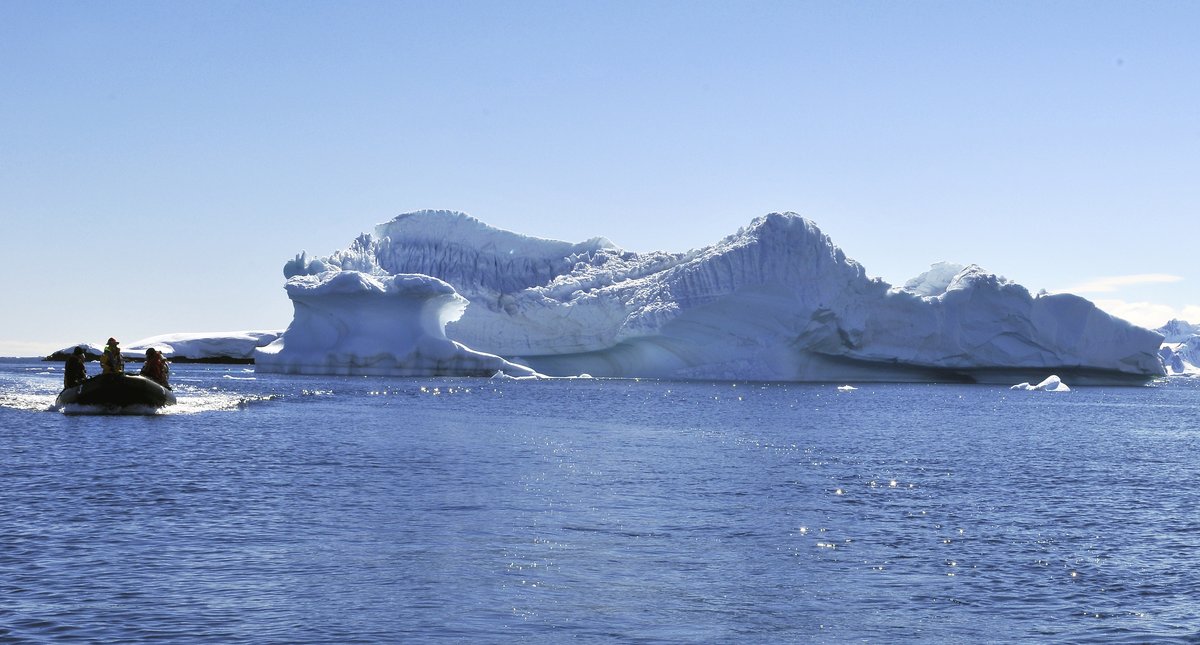
Zodiac cruising — the small boats put you at water level with the ice; this berg drifts near Foyn Harbour in the Gerlache Strait. Photo: LBM1948 / Wikimedia Commons (CC BY-SA 4.0)
5. Cuverville Island — Penguin Colony Scale
GPS: ●●.●●●●° S, ●●●.●●●●° W
Home to one of the largest Gentoo penguin colonies on the Antarctic Peninsula — approximately 6,500 breeding pairs occupying a rocky hillside with snow-capped peaks above. The sheer density of the colony, and the constant motion within it, creates a subject where the challenge is not finding something to photograph but managing visual complexity.
Penguin behavior follows predictable patterns that reward patient observation. The “penguin highways” — worn paths through the colony where birds travel between sea and nest — create natural leading lines. Breeding pairs engage in stone-stealing (critical for nest-building), which creates repeated behavioral moments throughout the day. Chick-feeding scenes (in January-February) happen constantly and are among the most emotionally engaging wildlife subjects in Antarctica.
Get low. Shooting from standing height, looking down on penguins, flattens their environment and reduces them to objects. A deep crouch at penguin eye-level, with the colony stretching to the horizon behind a single pair, is the composition that works — note that current avian-influenza protocols prohibit sitting, kneeling, or lying on the ground near colonies, so low means crouching, not going prone.
Pro Tips:
- Position at penguin eye level from a deep crouch (biosecurity rules prohibit sitting or lying on the ground)
- Penguin highways create natural leading lines through the colony
- Chick-feeding moments (Jan-Feb) are frequent — find a breeding pair and wait
- A 100-400mm isolates individual penguins with clean background separation
- Look for behavioral conflict: stone-stealing, territorial displays, pair reunion
6. Antarctic Sound — Tabular Icebergs
GPS: ●●.●●●●° S, ●●●.●●●●° W
The passage between the tip of the Antarctic Peninsula and the Joinville Island group, where massive tabular icebergs from the Weddell Sea drift through. Individual bergs can be kilometers long, with vertical walls of blue ice rising 30+ meters above the waterline.
Tabular icebergs from the Weddell Sea are qualitatively different from the peninsula’s smaller, more sculptural bergs. Their scale makes comparison impossible — standing on a ship’s deck with a 40-meter ice wall a quarter-kilometer away, the mind simply cannot process the information correctly. This is the photography of scale and light, where the iceberg is essentially a landscape unto itself.
Blue ice is most saturated on overcast days. Direct sunlight washes out the blue and creates harsh surface reflections. Overcast soft-boxes the ice, revealing the true color range from near-white at the surface to deep cerulean in shadow sections.
Pro Tips:
- Overcast days reveal blue ice at its most saturated — don’t wait for sun
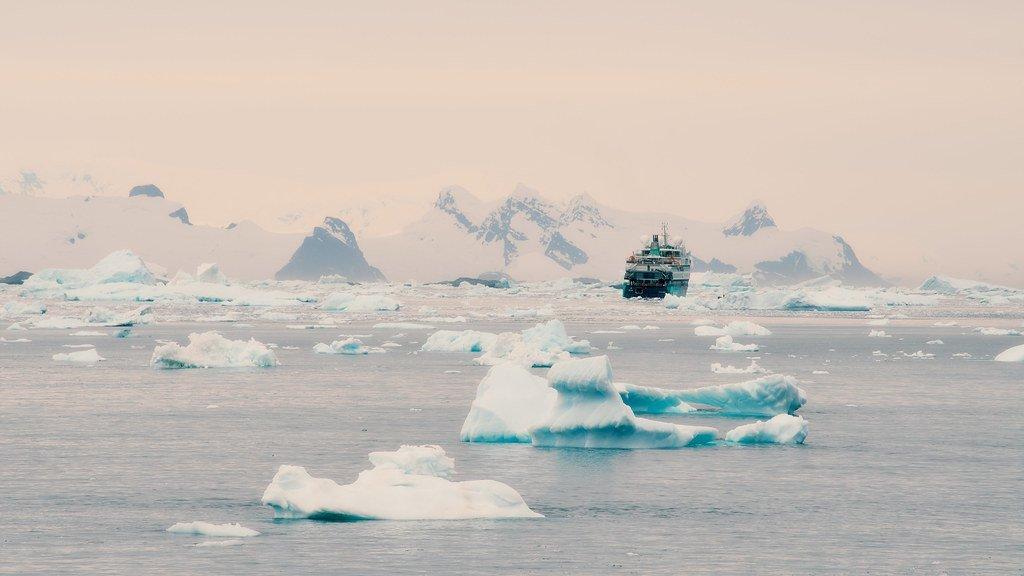
- Include ship or zodiac for scale — without context, icebergs could be any size
- The elevated ship deck provides perspective looking down onto the ice top surface
- Wave-eroded arches and caves in older bergs are fleeting — photograph them while they last
- Telephoto (200-400mm) compresses the iceberg mass and eliminates distracting foreground water
Gear for Extreme Cold
Camera Systems
Antarctica’s photography demands are more about durability and redundancy than pixel count. The following table covers the essential systems.
| Equipment | Purpose | Antarctic-Specific Notes |
|---|---|---|
| Weather-sealed body (2x) | All shooting | -10°C operation tested |
| 70-200mm f/2.8 | Wildlife + icebergs | Primary Antarctica lens |
| 100-400mm or 200-600mm | Penguin portraits, whale flukes | Reach for distant subjects |
| 16-35mm f/2.8 | Landscape, colony context | Ship passages, wide scene |
| 24-70mm f/2.8 | General purpose, zodiac | Day-to-day versatility |
| 8+ batteries | Cold drain | Rotate from inside jacket |
| Silica gel packs | Condensation | Essential on ship return |
| Waterproof bags | Zodiac spray | Hard cases for transport |
| Rain covers (body + lens) | Zodiac spray | Standard |
| Cleaning kit (daily) | Salt spray, moisture | Clean sensors every night |
Battery Management in Extreme Cold
At -10°C, standard lithium batteries deliver 40-50% of rated capacity. At -15°C, some batteries refuse to fire entirely. The solution is rotation: three to four batteries in use, two warming in inside pockets, one charging on the ship. Never leave a battery in the camera while you warm up inside — remove it and bring it with you.
The worst mistake is not the drained battery. It is the battery that shows 60% charge, fires several frames, then dies without warning because the cold masked the actual remaining capacity. Check batteries frequently and swap at the first sign of sluggish performance.
Condensation Protocol
The transition from cold deck (–5°C) to warm ship interior (+18°C) creates instant condensation on every cold surface. Water droplets form on sensors, lens elements, and circuit boards. The solution is to place the entire camera system in a sealed plastic bag before going inside. The condensation forms on the outside of the bag, not on the gear. Leave the bag sealed for 30-45 minutes until everything reaches ambient temperature.
This is not optional. Skipping this step risks corrosion, fogged elements, and electronic damage.
Zodiac Shooting Protocol
Most Antarctic photography happens from zodiacs — inflatable boats that cruise among icebergs and approach shore. The zodiac environment is unique: constantly moving, spray is constant, and your hands are cold and wet.
| Challenge | Solution |
|---|---|
| Camera shake | Brace against pontoon, shoot in burst mode |
| Spray | Rain covers on body and lens, small zip bag for quick stow |
| Cold hands | Neoprene gloves with exposed fingertips, chemical hand warmers in pockets |
| Camera storage | Waterproof bag in your lap between shots |
| Stability | Shoot at 1/500+ for icebergs; 1/1000+ for whale action |
| Horizon leveling | Shoot slightly wide, correct in post — horizon rarely stays level |
Wildlife Photography Techniques
Penguin Behavioral Moments
Antarctica’s wildlife photography success is built on understanding behavior patterns and positioning for them in advance, not reacting after the fact.
Stone stealing: Gentoo and Adélie penguins use pebbles to build nests. Dominant birds steal from subordinates. The dynamic — crouching posture, speed, the defender’s response — creates active subjects in an otherwise static scene. Find a penguin near the nest boundary and wait.
Porpoising return: Penguins entering the colony from the sea run and leap through the shallows before walking up the beach. The combination of motion, spray, and the colony background creates a compelling subject. Position at beach level with a 70-200mm, motor drive active.
Pair reunion: Breeding pairs separated by foraging recognize each other through vocal calls. The reunion — bill touching, mutual preening — is one of Antarctica’s most emotionally resonant behavioral moments. It takes patience to find a pair mid-reunion, but the scene repeats throughout the day.
Chick feeding: In January-February, hungry chicks pursue returning parents with frantic persistence. The parent regurgitates food while the chick shoves its bill deep into the parent’s throat. Graphic, vital, and constantly happening. Get low, use a telephoto, and shoot into the behavior.
Whale Photography from Zodiacs
Humpback whale encounters are common on the Antarctic Peninsula, particularly in January-March. The strategy is stillness and patience — cut the zodiac engine and wait. Whales often approach still zodiacs out of curiosity.
The key shots are: the blow (vertical water column, with context behind it), the fluke (just before diving, the tail lifts and pauses for a fraction of a second), and the breach (explosive, rare, requires continuous shooting and luck). For flukes and breaches, 400mm minimum and continuous autofocus on the water surface in advance of where the whale was last seen.
Seabirds of the Drake Passage
The two-day Drake Passage crossing is not wasted photography time. Wandering albatross — the largest wingspan of any living bird at up to 3.5 meters — follow the ship, riding the updrafts off the hull. Royal albatross, cape petrels, and giant petrels are constant companions. At sea surface level from the ship’s stern, these birds slice through the wave tops at speeds exceeding 90 km/h with wing beats of deceptive laziness.
For seabird photography from a moving ship, the technique is panning. Use a 200-400mm focal length, continuous AF with bird-eye tracking if your camera system supports it, and a shutter speed of 1/1500s or faster for clean wing freezing. The albatross’s slow banking motion makes it more tractable than smaller, faster species. The challenge is the ship’s own motion — brace your elbows against a railing, shoot in portrait orientation to give yourself vertical tracking room, and allow for 80% of frames to be unusable.
Logistics and Planning
Getting There
Most Antarctic Peninsula expeditions depart from Ushuaia, Argentina — the southernmost city on Earth. The Drake Passage crossing takes two days each way. Budget for a night before embarkation and a buffer day on return (Drake weather can delay arrival).
Fly-cruise options (fly from Punta Arenas to King George Island, ship one way) eliminate the Drake crossing but are significantly more expensive and weather-dependent.
Choosing Your Ship
| Ship Type | Passenger Count | Landing Time | Photography Suitability |
|---|---|---|---|
| Small expedition | 50–100 | Maximum | Excellent |
| Medium expedition | 100–200 | Good | Good |
| Large expedition | 200–500 | Limited | Moderate |
| Cruise ship (500+) | 500+ | None (IAATO) | Scenic only — no landings |
| Photography charter | 50–100 | Maximum + flexible | Best |
Cost Expectations
Budget $8,000–$15,000 per person for standard expedition berths (10-14 days). Photography-focused expeditions with dedicated photographer-guides and extended landing time: $15,000–$25,000+. The incremental cost of the photography expedition typically returns several thousand dollars’ worth of images not possible from a standard trip.
Sample 11-Day Itinerary
| Day | Location | Photography Focus |
|---|---|---|
| 1 | Depart Ushuaia | Embark, safety briefing |
| 2–3 | Drake Passage | Albatross, petrels, open ocean |
| 4 | South Shetland Islands — Deception | Volcanic landscape, whaling ruins |
| 5 | Antarctic Sound | Tabular icebergs |
| 6 | Neko Harbour | Mainland landing, glacier calving |
| 7 | Paradise Harbour | Zodiac dawn cruise, reflections |
| 8 | Lemaire Channel, Cuverville | Channel transit, penguin colony |
| 9 | Flexible — captain’s choice | Weather-dependent optimization |
| 10–11 | Drake Passage return | Seabirds, debrief |
Field Exercises
1. Ice Color Study: Photograph 10 different icebergs and document the blue variations. Note the relationship between ice density, age, lighting conditions (overcast vs. direct sun), and the resulting blue intensity. Create a visual reference guide from your own frames.
2. Penguin Behavioral Narrative: Spend one full shore landing (60-90 minutes) photographing a single penguin pair. Document their interactions — pair reunion, stone management, territorial dispute, chick interaction if applicable. Edit to a 5-image behavioral story arc.
3. Zodiac Perspective Series: From a zodiac, create three compositions of the same iceberg — one at water level looking up, one with the widest lens you have, and one telephoto isolating a specific detail (color band, arch, texture). Compare how perspective changes the perceived character of the same subject.
4. Reflection Inversion: In calm harbor conditions, create three images where the reflection is the primary subject, not the object it reflects. Evaluate whether each image works when turned upside down — if it does, the reflection is a complete composition in itself.
5. Scale Documentation: Throughout the expedition, systematically include a consistent scale reference in one frame of every major subject — a person, the ship, a zodiac. Assemble these frames as a sequence showing Antarctica’s scale across different subjects (penguin colony, tabular iceberg, calving glacier, open channel).
Conclusion
Antarctica is the most humbling photography destination on Earth. The scale defies comprehension. The conditions test every piece of gear you own. The logistics place you entirely at the mercy of weather, ice, and the captain’s judgment. You cannot reschedule. You cannot extend your stay. The continent operates on its own schedule and your plans are irrelevant to it.
But when a humpback whale breaches alongside your zodiac, or the Lemaire Channel opens into a corridor of impossible beauty, or a curious Gentoo penguin waddles up to inspect your lens — those moments transcend any image you will make. The photographs are the record. The experience is the point.
Go prepared for the cold. Pack more batteries than you think you need. Book a photography-focused expedition if you are serious about output. And accept, from the moment you board, that the continent will give you what it decides to give you, not what you planned to capture.