The forecast said cloud. Every app on your phone said cloud — a solid grey lid from the Norwegian coast to the Finnish border, the kind of night a photographer three hundred kilometres south would write off and go to bed. But you are standing on the frozen surface of Lake Torneträsk at Abisko, and directly overhead there is a ragged tear in the overcast, a window of black sky and hard stars. Within it, a pale green ribbon begins to fold and brighten. This is the “blue hole” — a genuine, documented microclimate — and it is the single reason serious aurora photographers cross an ocean to shoot in this exact valley rather than the more famous towns to the west.
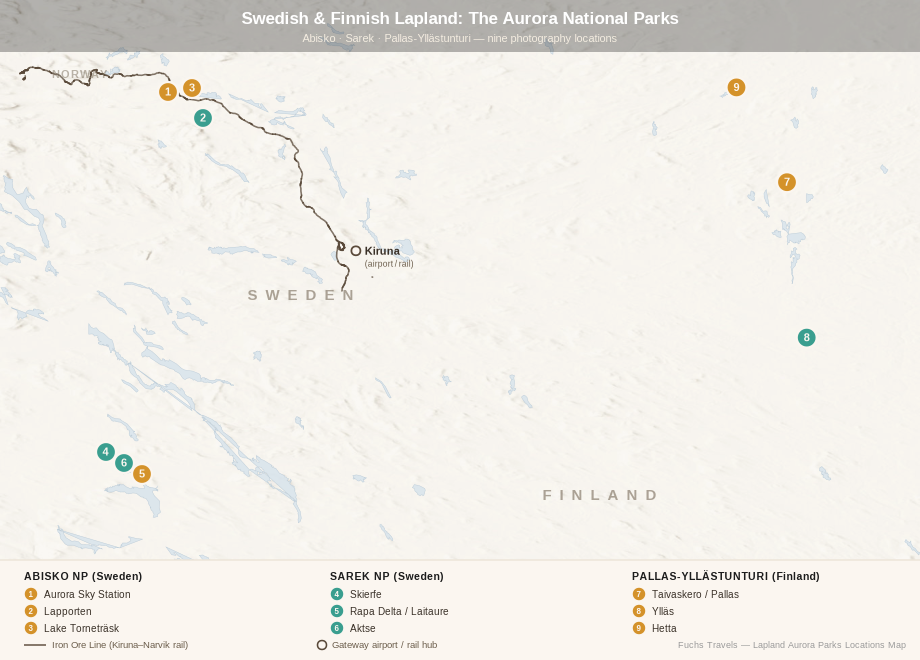
Swedish and Finnish Lapland hold three of Europe’s great northern parks, and each one solves a different photographic problem. Abisko National Park gives you the clearest winter skies in the auroral zone and an easy, road-and-rail-accessible base. Sarek National Park — roadless, hut-poor, trail-poor, the wildest ground in Western Europe — hides the Rapa Valley delta, a braided masterpiece best seen from the cliff-edge of Skierfe. Pallas-Yllästunturi National Park in Finland trades drama for a hundred kilometres of rolling fells, the most reliable ruska autumn color in the north, and Finland’s more permissive access rules. This guide treats all three as one trip, built for a photographer who wants aurora, wilderness, and autumn fire in a single itinerary — and who wants to plan around the region’s calendar instead of fighting it.
A word up front about latitude. Everything here sits between 67° and 68.4° North, well inside the auroral oval. That changes the rules you may have learned further south: you do not need a big geomagnetic storm. On a clear night, even a Kp of 0 to 2 can put a quiet arc directly overhead. The scarce resource up here is not aurora — it is clear sky and dark hours. Plan for the sky, and the light will come.
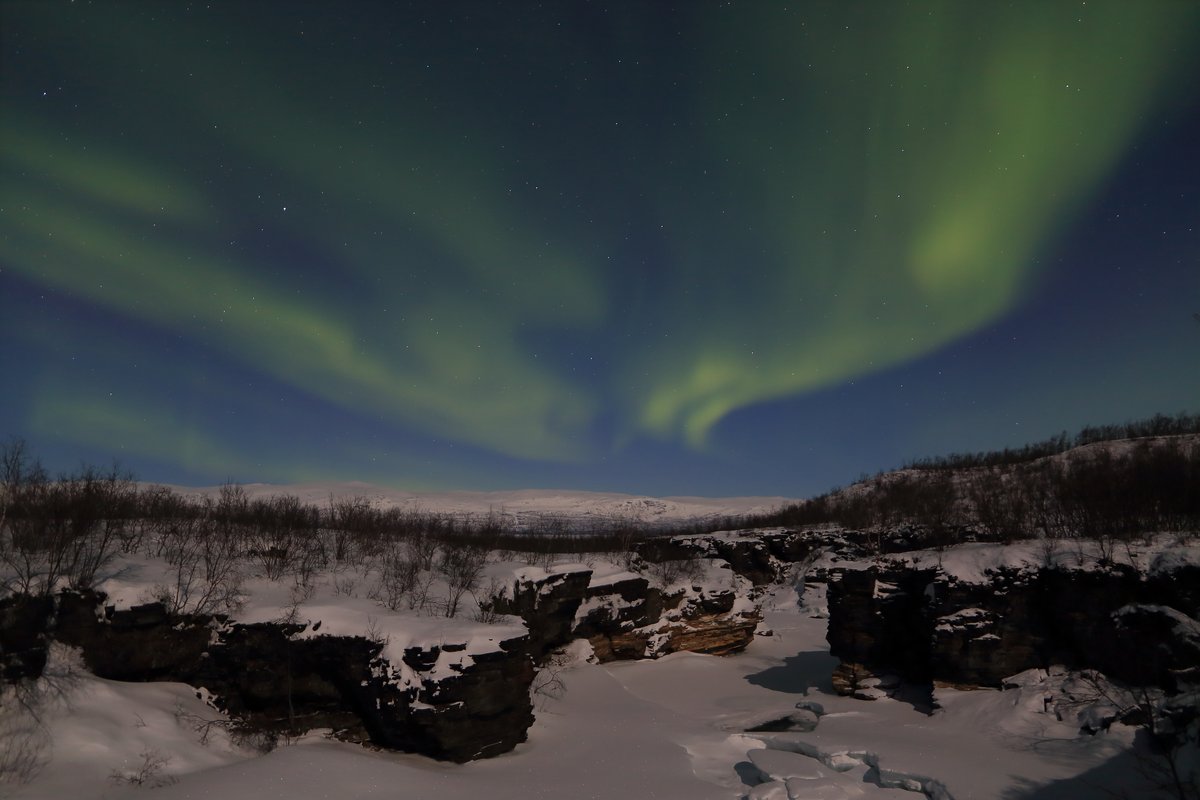
Aurora over the frozen Abiskojåkka canyon in Abisko National Park — the “blue hole” delivering a clear window when the wider region is clouded. Photo: Pavel Shyshkouski / Wikimedia Commons (CC BY-SA 4.0)
Abisko National Park: Sweden’s Clear-Sky Aurora Capital
Abisko is small — 77 square kilometres — but it occupies the most useful weather on the whole Scandinavian mountain chain. The park wraps the southern shore of Lake Torneträsk, a seventy-kilometre inland sea, and sits in a rain shadow east of the Skanderna range. Prevailing westerly air dumps its moisture on the Norwegian peaks and descends into the Torneträsk basin dry and settling. The result is the phenomenon the tourism industry markets and the meteorologists confirm.
The blue hole, honestly explained
The “blue hole of Abisko” is not a magic clear patch that hovers over the village. It is a persistent statistical tendency: because the same westerly flow dries out over the same mountains night after night, Abisko records a materially higher rate of clear or broken skies in winter than surrounding stations. It is a rain-shadow microclimate, not a guarantee. You will still get socked-in nights. But over a week-long trip, Abisko will hand you more shootable sky than almost anywhere else in the auroral zone — and when the whole region is grey, that overhead tear is often exactly where the tourism photos come from. Treat it as an edge, not an insurance policy. Book a week, not two nights.
Aurora Sky Station and Mount Nuolja
GPS: ●●.●●●●° N, ●●●.●●●●° E
The STF Aurora Sky Station sits at roughly 900 metres on the flank of Mount Nuolja (Njullá), reached by a two-kilometre chairlift from the Abisko Turiststation. From the deck you look south over Lake Torneträsk and straight down the throat of Lapporten. At the time of writing the winter night-visit season runs 1 October 2026 to 27 March 2027, with evening sessions typically from around 8:30 p.m. until no later than 1:00 a.m.; confirm dates and chairlift status directly with the operator before you build a night around it, and know that refunds are not given if weather closes the lift.
For photography, the Sky Station is a mixed proposition. The elevation lifts you above valley haze and the view is genuinely commanding, but you are shooting alongside a paying crowd on a fixed schedule, and the chairlift ride is cold and slow. Many photographers prefer to shoot the lake shore below, where you have all night, a car nearby, and a frozen foreground. Use the Sky Station for the vantage and the experience; use the shoreline for the serious work.
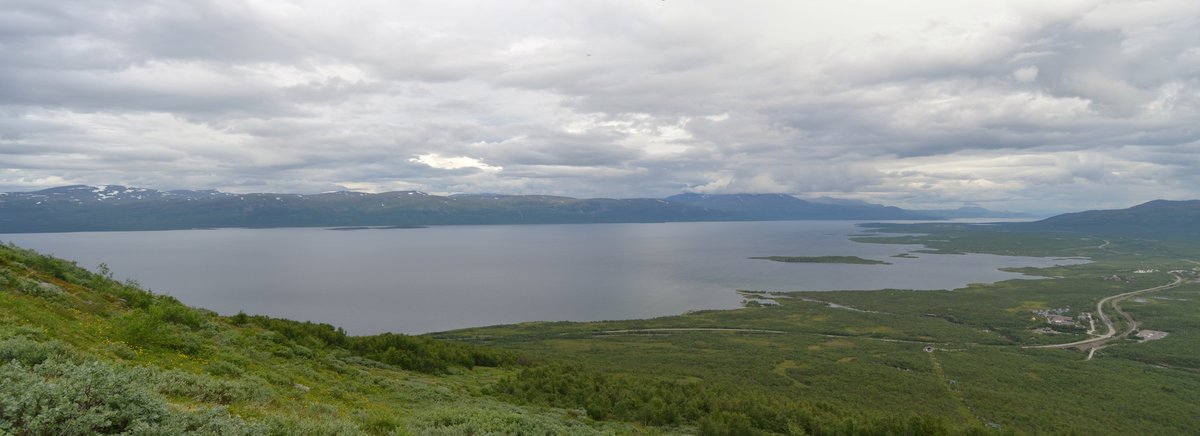
The view down over Lake Torneträsk from the slopes of Mount Nuolja — the Abisko settlement sits on the far shore. Photo: Antti Leppänen / Wikimedia Commons (CC BY 4.0)
Lapporten: the gate of Lapland
GPS: ●●.●●●●° N, ●●●.●●●●° E
Lapporten — Čuonjávággi in Northern Sámi, “the goose valley” — is the textbook U-shaped glacial trough that frames the skyline south of the lake. Its clean, symmetrical notch has been a Sámi navigation landmark for centuries, a gate between summer and winter grazing grounds. For a photographer it is the region’s defining foreground-to-background anchor: shoot it across the frozen lake with an aurora arc threading the notch, or in autumn with gold birch below and the twin shoulders catching first light. The classic vantage is from the Abisko shore and the Björkliden area to the west; a longer lens (35–70mm equivalent) compresses the gate against the sky better than an ultra-wide.
Lake Torneträsk and the Abisko shore
GPS: ●●.●●●●° N, ●●●.●●●●° E
The lake is your studio. In deep winter its wind-scoured ice becomes a vast reflective floor; a low arc doubles in the surface and a bright display lights the snow around your tripod. Walk out only on confirmed safe ice — ask at the Turiststation, watch for pressure ridges and inflow zones near river mouths, and never assume. The mouth of the Abiskojåkka river and the old railway pier give you leading lines and hard foreground shapes when the lake itself is too featureless. This is where you spend your patient hours: camera on the tripod, intervalometer running, waiting for the substorm.
Sarek National Park: Europe’s Last Wilderness
Sarek is the opposite of Abisko in every way that matters logistically. Nearly 2,000 square kilometres with no roads, almost no marked trails, no huts inside its core, and no bridges over its major rivers. It holds around a hundred peaks above 1,800 metres and nineteen of Sweden’s highest mountains. This is not a drive-up park; it is a serious backcountry expedition, and it rewards the effort with the most concentrated mountain grandeur in the country. The signature image — one of the great viewpoints of Europe — is the Rapa Valley delta seen from the cliff of Skierfe.
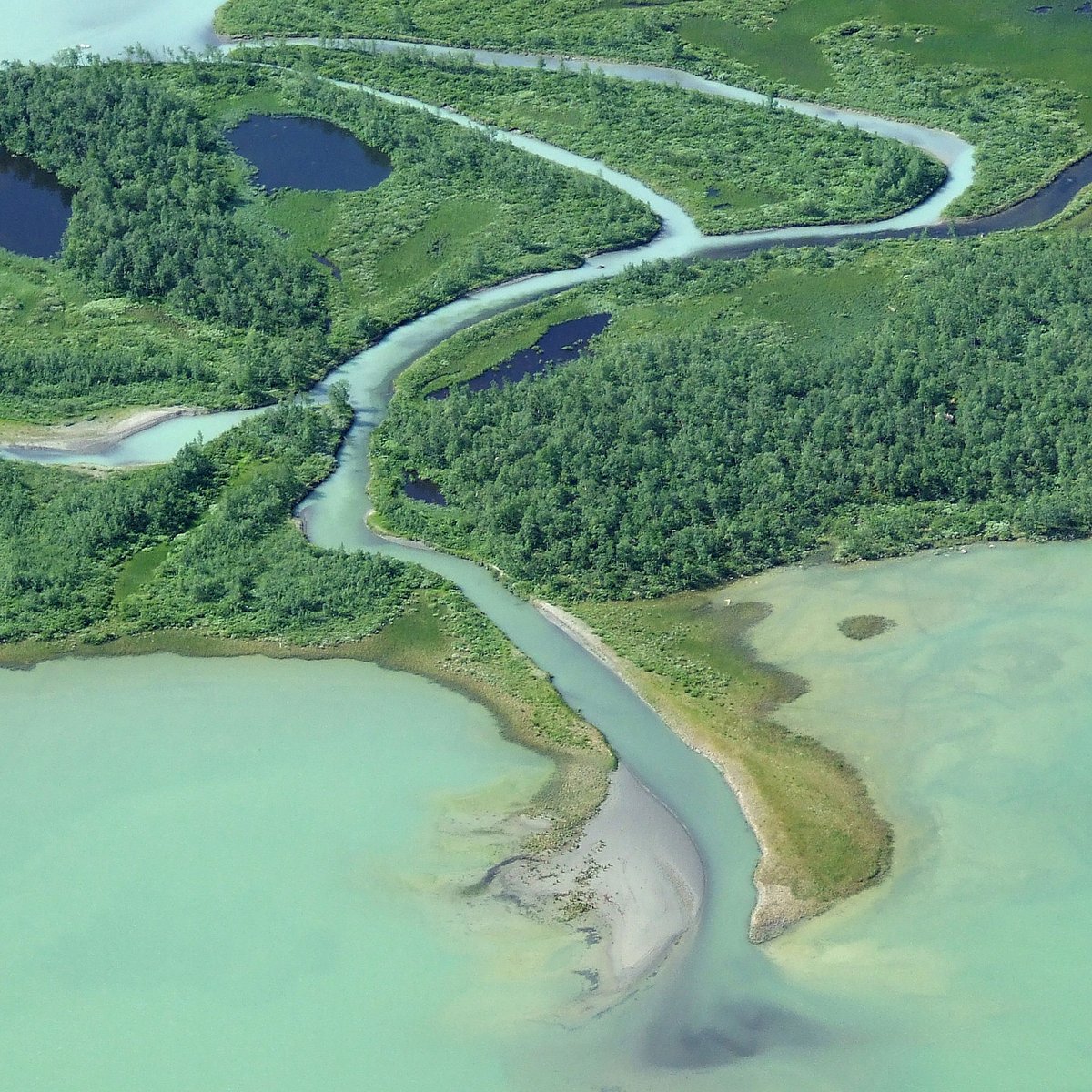
The Rapa River fans into the Laitaure delta below Skierfe — braided glacial channels reading as pure abstraction from the cliff edge. Photo: Frank Baldus / Wikimedia Commons (Copyrighted free use)
Skierfe: the great viewpoint
GPS: ●●.●●●●° N, ●●●.●●●●° E
Skierfe is a 1,179-metre peak whose western face drops almost vertically into Rapadalen. Stand at the lip and the Rapa River sprawls below you in a network of silt-blue channels, sandbanks, and oxbows — a living delta that looks, from 800 metres up, like marbled paper. It is regularly called the finest view in Sweden, and for once the superlative holds. Shoot it in the long light of an August or early-September evening when low sun rakes the sandbars and separates every channel; a polarizer will cut the sheen off the water and deepen the turquoise. The cliff edge is unfenced and genuinely lethal in wind — set your tripod back from the drop and never chase a composition toward the void.
The Rapa delta and Laitaure
GPS: ●●.●●●●° N, ●●●.●●●●° E
The delta empties into Lake Laitaure (Lájtávrre), and the water’s extraordinary color is glacial rock flour — suspended silt ground fine by the ice upstream, scattering light toward blue-green. From the valley floor the delta is a maze; from Skierfe it is a map. If you can only make one composition in Sarek, make it the delta from the cliff. If you have the legs and the days, drop into Rapadalen itself for intimate river-and-birch frames, but respect that this is unbridged country where a river crossing can turn dangerous fast.
Aktse: base for the wilderness
GPS: ●●.●●●●° N, ●●●.●●●●° E
Aktse is the small STF hut cluster on the eastern shore of Laitaure and the practical staging point for Skierfe. The realistic route: drive the gravel road from Jokkmokk or Gällivare to the Sitoälvsbron trailhead, hike roughly 10 km to the Laitaure shore, then either take a pre-booked rowboat across the lake or walk about 6 km around the forested shore to Aktse. From the hut it is roughly 8 km and about 800 metres of ascent to the summit of Skierfe — varied terrain that plateaus before a final steep pull. Budget a two- to three-night trip and carry everything: there is no resupply, no huts between Aktse and the summit, and the practical season is July through early September before the snow returns.
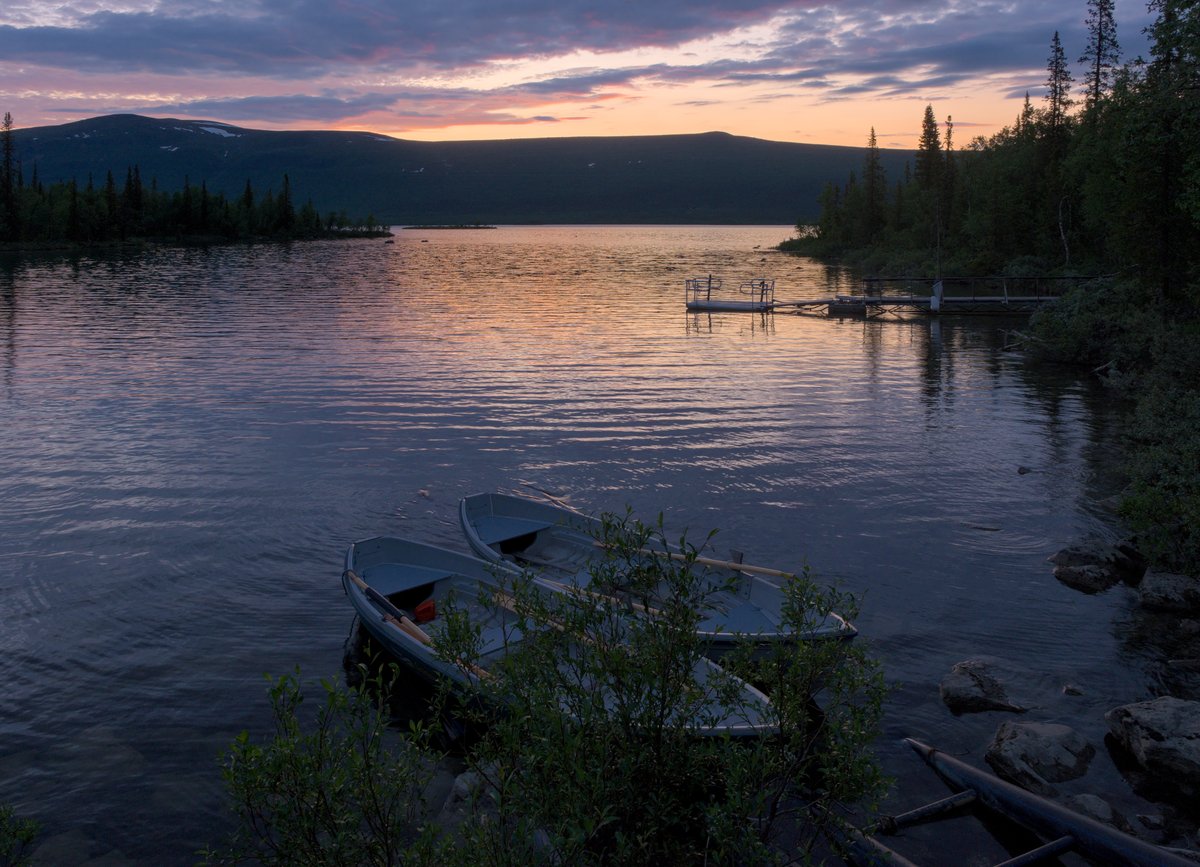
Rowboats for the Laitaure crossing on the Kungsleden near Aktse — the last easy transport before Sarek’s roadless interior. Photo: Trougnouf (Benoit Brummer) / Wikimedia Commons (CC BY 4.0)
Pallas-Yllästunturi National Park: Finland’s Fell Country
Cross into Finland and the landscape softens. Pallas-Yllästunturi is Finland’s third-largest national park and its most visited, a 1,020-square-kilometre ribbon of fells and boreal taiga running about a hundred kilometres from Ylläs in the south to Hetta in the north. The highest point, Taivaskero in the Pallastunturi group, reaches only 809 metres — these are old, rounded fells, not alpine peaks — but that is the point. Pallas is where you photograph pattern and color and light rather than vertical spectacle: the endless dwarf-birch tundra, the fell silhouettes, and above all the ruska. Finland’s rules are also friendlier to photographers than Sweden’s, as we will cover below.
Taivaskero and the Pallastunturi fells
GPS: ●●.●●●●° N, ●●●.●●●●° E
The Pallastunturi group is the park’s photographic heart, and the marked trail network from the Pallas visitor area makes the fells genuinely accessible — a rarity this far north. Taivaskero and its neighbours give clean, layered ridgelines that separate beautifully in side light, and the open fell-tops are superb aurora foregrounds: get above the treeline and you have an unobstructed northern horizon with a rolling snow field beneath the arc. This is also the classic spot for a moonlit winter frame, when a full moon turns the snow blue and a quiet green band completes it.
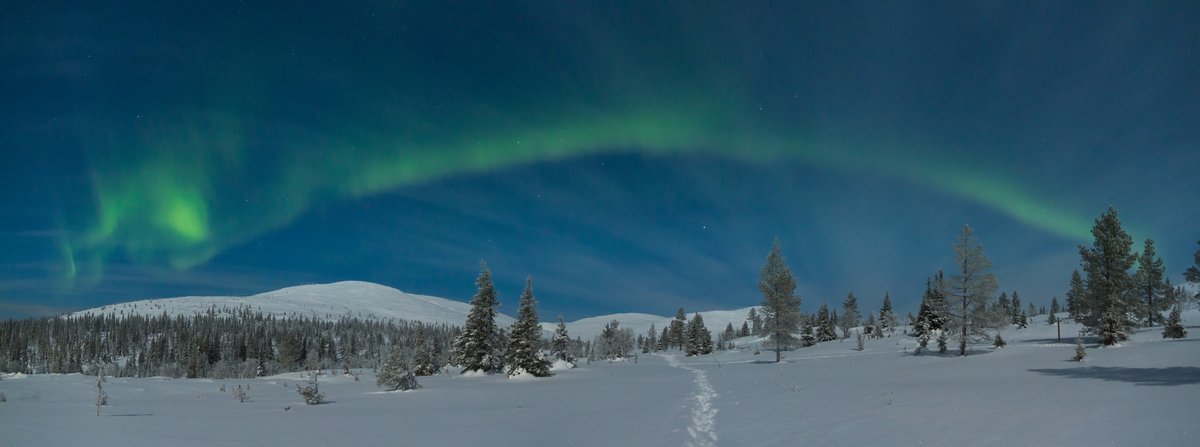
An aurora arch spans the Pallastunturi fells above moonlit spruce forest — a low Kp night is enough at this latitude. Photo: Ximonic (Simo Räsänen) / Wikimedia Commons (CC BY-SA 3.0)
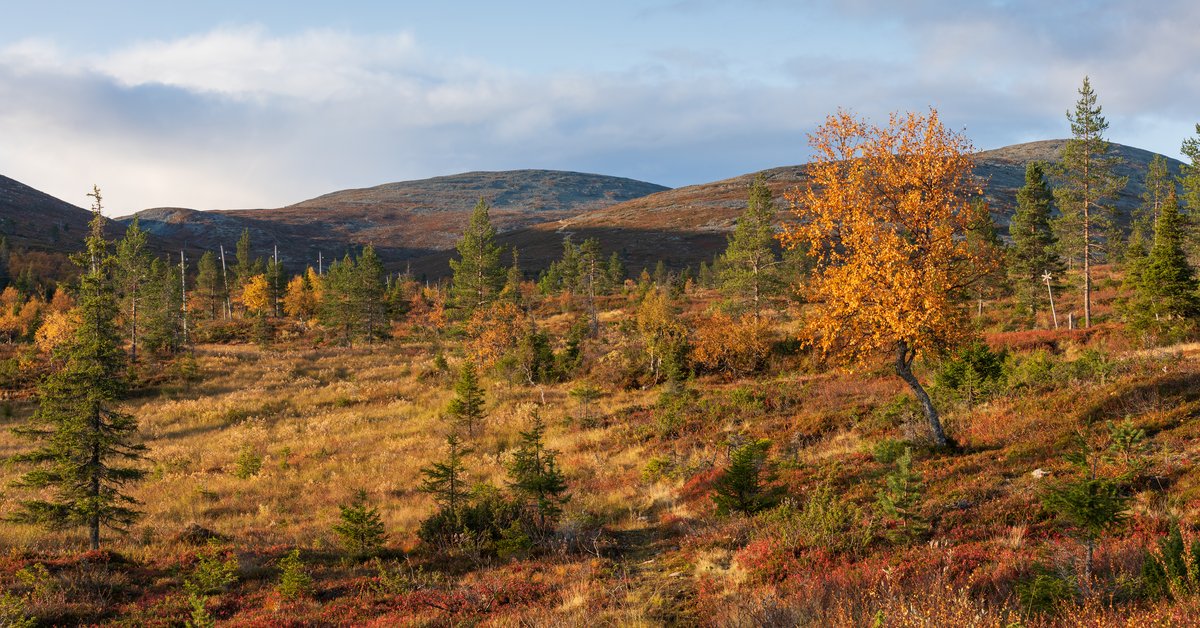
Ruska in full fire below Taivaskero — birch gold over red bilberry and crowberry, the north’s brief autumn peak. Photo: Ximonic (Simo Räsänen) / Wikimedia Commons (CC BY-SA 4.0)
Ylläs and Kesänkitunturi
GPS: ●●.●●●●° N, ●●●.●●●●° E
Ylläs, at the park’s southern end, is the largest fell and the most developed base, with lifts and lodging that make it an easy winter hub. The summit view sweeps over a sea of taiga stitched with lakes — a compression-lens landscape of receding blue ridgelines, particularly good in the low, hazy light of autumn afternoons. The neighbouring fell Kesänkitunturi and the valley between them are prime ruska and aurora ground. Ylläs is the place to base if you want comfort, quick access, and reliable services alongside the wilderness.
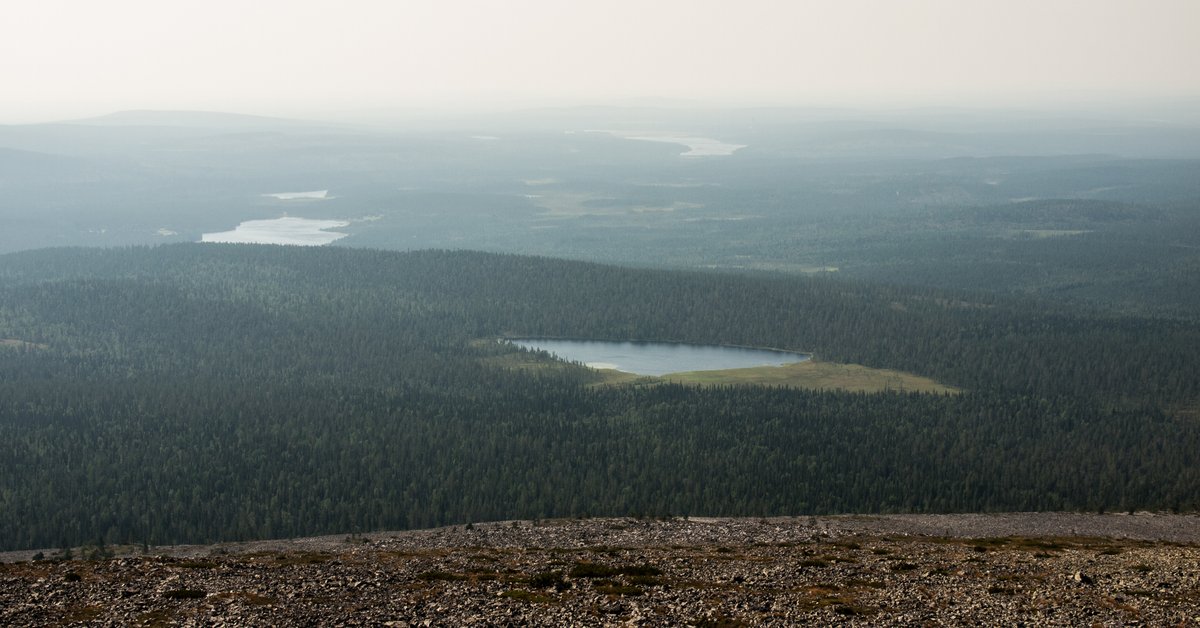
From the top of Ylläs, ridgeline on ridgeline of taiga and lakes recede into haze — a study in atmospheric depth. Photo: Heikki Immonen / Wikimedia Commons (CC BY 3.0)
Hetta and the northern fells
GPS: ●●.●●●●° N, ●●●.●●●●° E
Hetta (Enontekiö), at the park’s northern tip, is the quiet end — fewer visitors, working Sámi reindeer country, and the trailhead for the classic Hetta-to-Pallas trek across the fell chain. The Ounasjärvi lake in front of the village makes a fine aurora foreground with the Pallas fells on the far shore. This is the most culturally sensitive corner of the region; read the Sámi section before you plan to photograph here.
The Aurora Season: Timing the Light
The auroral zone runs on two clocks at once: the geomagnetic clock, which fires irregularly year-round, and the darkness clock, which decides whether you can see it. From late May to mid-July the far north has no astronomical darkness at all — the midnight sun or a bright twilight erases every aurora. The season that matters runs roughly early September to late March, and it is bracketed by two shoulders worth planning around.
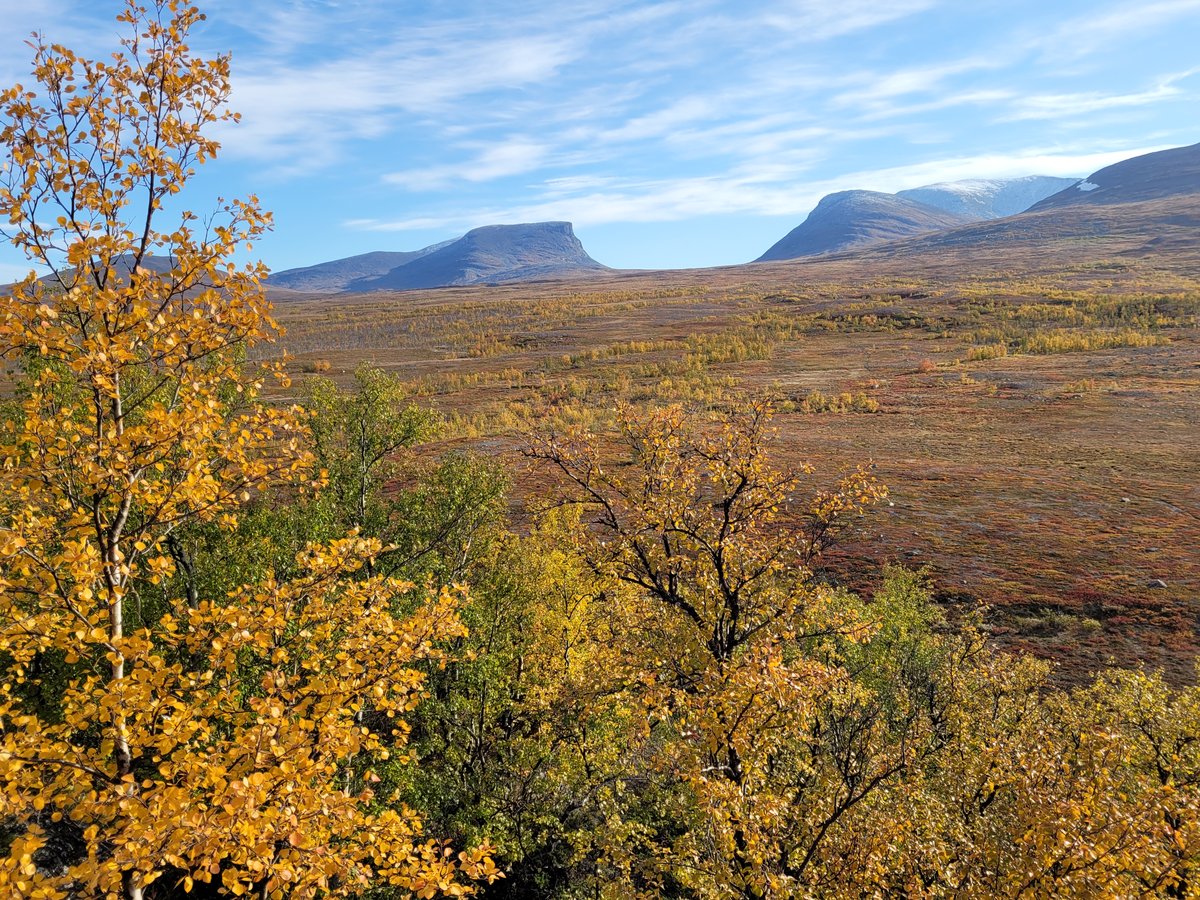
Late-August and early-September nights bring the first true darkness back to Abisko while the birch is still gold — aurora and ruska in the same trip. Photo: Torbjoern Messner / Wikimedia Commons (CC BY-SA 4.0)
| Month | Darkness | Conditions | Photographic highlight |
|---|---|---|---|
| September | Returning; long true-dark by mid-month | Cool, often clear; open water reflections | Aurora + ruska overlap; delta light in Sarek |
| October | Long dark nights | Variable; first snow on fells | Snow-dusted foregrounds, Sky Station opens |
| November | Very long nights | Cold, can be cloudy | Deepening snow; fewer crowds |
| December | Polar night near solstice | Coldest, darkest | Blue-hour ambient light, moonlit snow |
| January | Polar night ending | Deep cold, clearest statistics | Peak clear-sky odds at Abisko |
| February | Nights shortening | Cold, stable; ice strong | Frozen-lake reflections, reliable aurora hours |
| March | Balanced day/night | Milder, bright snow | Best all-round: dark enough, warm enough, long ice |
If you want one recommendation: late February to mid-March is the sweet spot for a first trip — you get long dark hours, the coldest and clearest statistics have peaked, the lake ice is thick and reflective, and the daytime temperatures are survivable for long night shoots. Early-to-mid September is the specialist’s alternative: shorter aurora windows but you catch the ruska and open, unfrozen water for reflections.
Photographing Aurora at 68° North
The technical problem of aurora photography is that it is faint, moving, and unpredictable, and you are solving it in brutal cold. The good news, again, is latitude: directly under the oval you rarely need to wait for a storm, and a quiet overhead arc is often brighter and closer than the distant curtains people chase from lower latitudes.
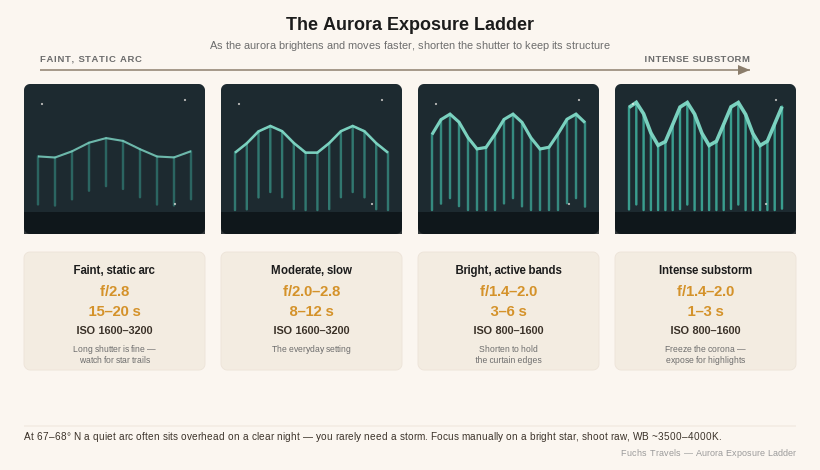
Start here and adjust
Begin with a fast wide lens at its widest aperture, a high ISO, and a shutter short enough to keep the aurora’s structure from smearing. A faint, slow arc tolerates a longer exposure; a fast, dancing substorm demands a shorter one or the curtains blur into a green fog. The table below is a starting ladder, not a fixed recipe — read the display and move up or down it.
| Aurora activity | Aperture | Shutter | ISO | Note |
|---|---|---|---|---|
| Faint, static arc | f/2.8 | 15–20 s | 1600–3200 | Watch for star trailing at the long end |
| Moderate, slow movement | f/2.0–2.8 | 8–12 s | 1600–3200 | The everyday setting |
| Bright, active bands | f/1.4–2.0 | 3–6 s | 800–1600 | Preserve the curtain structure |
| Intense substorm overhead | f/1.4–2.0 | 1–3 s | 800–1600 | Freeze the corona; expose for highlights |
Focus is the quiet killer of aurora shoots. Autofocus fails in the dark, so focus manually on a bright star or a distant light in live view at maximum magnification, then tape the focus ring so a cold, gloved hand cannot nudge it. Check focus again every hour — thermal contraction and knocks drift it. Shoot raw, set white balance to a fixed value around 3500–4000K rather than auto so your frames match across the night, and turn off long-exposure noise reduction (it doubles your exposure time and you will miss the peak).
Composition beyond the green
The mistake every intermediate aurora photographer makes is pointing straight up at the light and forgetting the ground. The aurora is your subject, but a strong foreground is what makes the frame yours: the notch of Lapporten, a pressure ridge in the lake ice, a lone spruce on a Pallas fell, the reflection in open September water. Galen Rowell built a career on the idea that landscape photography is about the relationship between the near and the far. Aurora is no different — anchor the near, let the far dance.
Ruska: The Autumn Color Window
For a few weeks in early autumn the sub-Arctic tundra ignites. Ruska is the Finnish word for the phenomenon: dwarf birch turning gold, and the ground-cover — bilberry, crowberry, bearberry — turning every shade from butter-yellow to blood-red. Because these are low, massed plants rather than tall trees, ruska photographs as sheets of color across whole hillsides, not as individual specimens.
The window is short and moves with latitude and altitude. As a rule, ruska peaks in the first half of September in the far north, arriving earlier on the high fell-tops and later in the sheltered valleys — which means you can often chase the peak up or down a slope over several days. Pallas-Yllästunturi is the most reliable ruska destination of the three parks, but Abisko’s birch turns just as gold, and September is the one time you can shoot ruska by day and aurora by night on the same trip. Use a polarizer to saturate the leaves and cut reflections off wet tundra, shoot in the soft light of an overcast morning to hold the reds without harsh shadow, and look for the interplay of gold birch against the dark green of remaining spruce and the grey of the fells.
Polar Night and Blue-Hour Ambient Light
Above roughly 68° North the sun stays below the horizon for a stretch around the winter solstice — several weeks of polar night in the northernmost parts of Abisko and Pallas, and long twilight-only days further south. This is not the pitch dark people imagine. Around midday the sky glows in a prolonged blue-and-rose civil twilight that can last hours, painting the snow in cold pastels. It is a gift for the landscape photographer willing to work slowly.
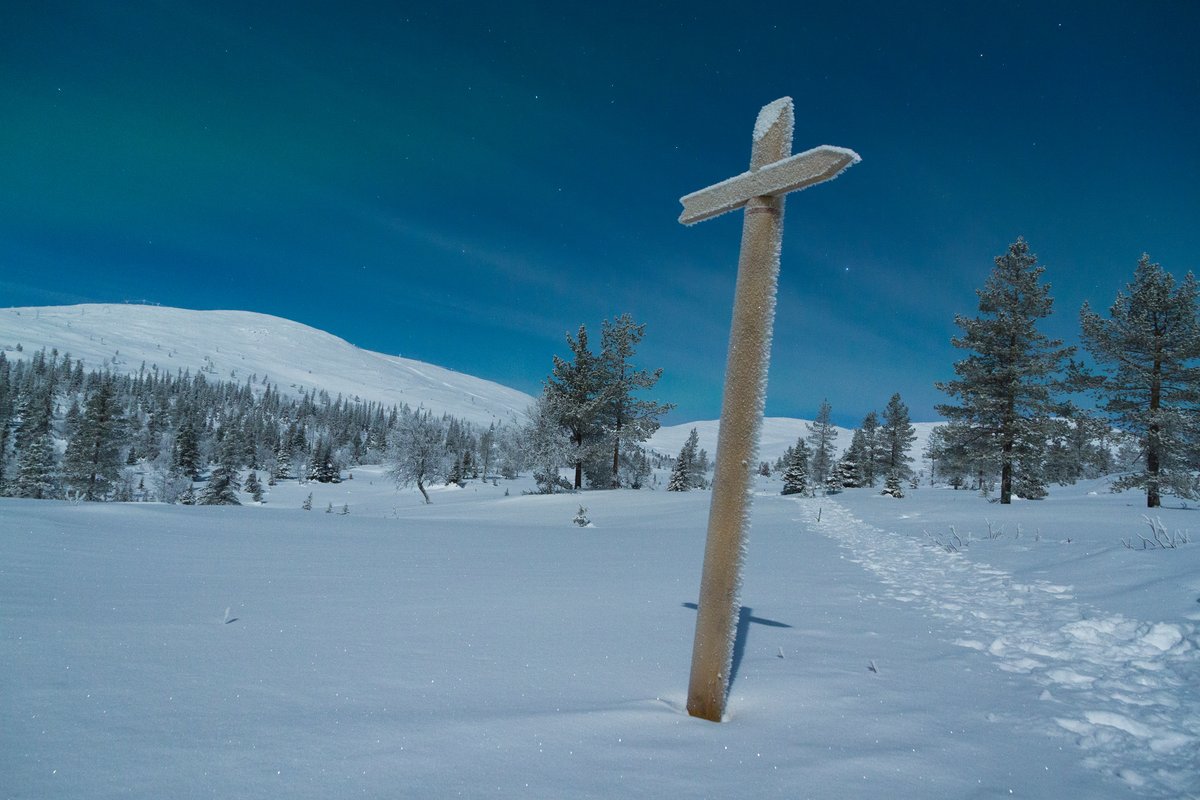
Midwinter ambient light at Pallastunturi — moonlight, a whisper of aurora, and the deep blue of the polar-night sky doing the work no sun can. Photo: Ximonic (Simo Räsänen) / Wikimedia Commons (CC BY-SA 3.0)
Shoot the polar-night twilight like a slow long exposure of a still life. Put the camera on the tripod, work at base ISO for clean files, and let the shutter gather the faint blue light over several seconds. A full moon transforms these hours: moonlight on fresh snow is bright enough to render landscape detail while the sky still holds aurora, and the color contrast between warm moonlit snow and cold twilight sky is one of the most distinctive palettes in all of photography. Check the moon phase before you book — a bright moon that ruins a Milky Way shoot elsewhere is an asset here.
Cold-Weather Gear and Battery Care
Deep-winter Lapland routinely runs to -25°C and colder, and cold is the real adversary of the aurora photographer. Two failures dominate: dead batteries and condensation.
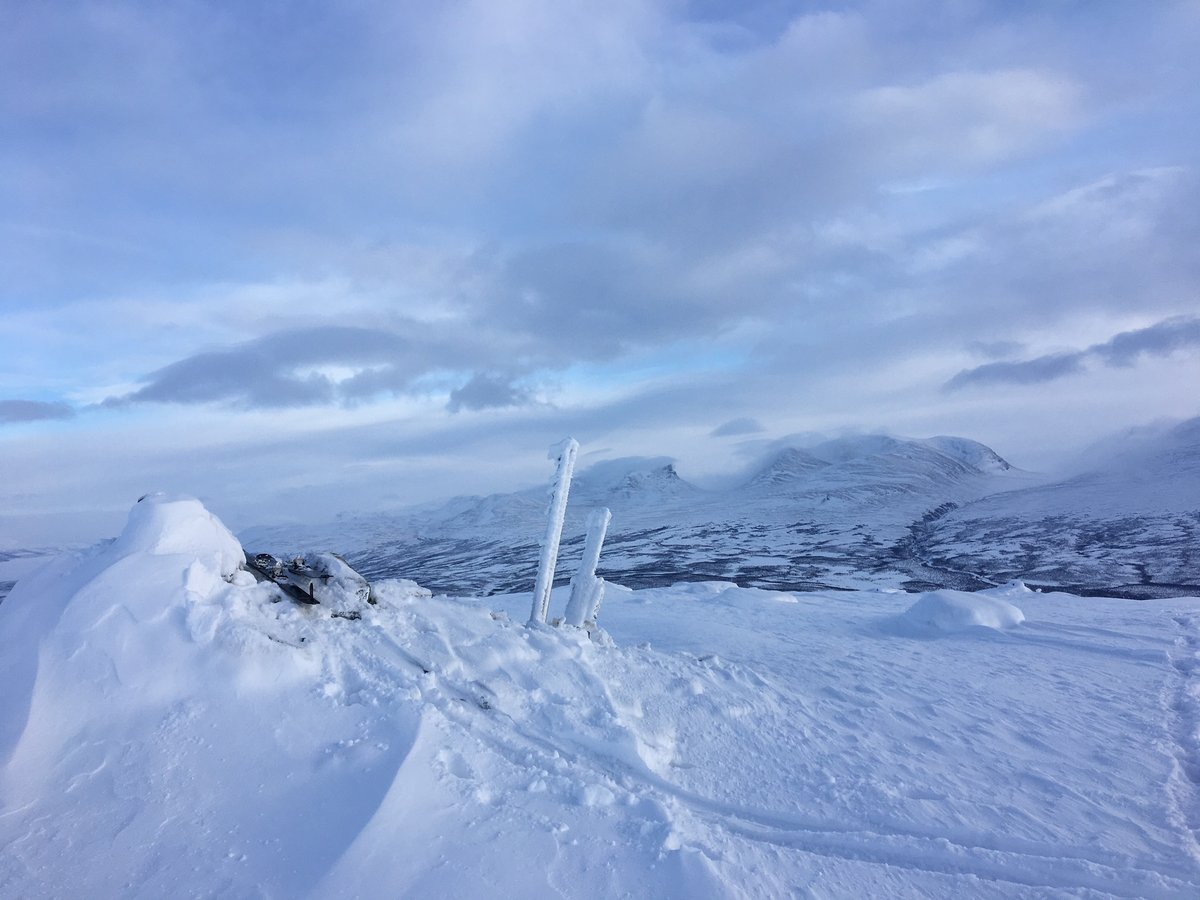
Deep-winter conditions in the Abisko high country — wind and cold are the real limiting factors on a night shoot, not the aurora. Photo: Hannestho / Wikimedia Commons (CC BY-SA 4.0)
Batteries lose most of their capacity in the cold. Carry three to four per body, keep the spares in an inside pocket against your body heat, and rotate a warm one in when the cold one fades — a “dead” cold battery often revives once warm, so never discard it in the field. Condensation forms when you bring a cold camera into a warm room: seal the gear in a zip-lock bag or your camera bag before you go inside and let it warm to room temperature sealed, over an hour or more, so moisture forms on the bag and not inside your lens.
| Item | Why it matters |
|---|---|
| Fast wide prime (f/1.4–2.0, 14–24mm equiv.) | Gathers faint aurora light; the single most useful lens up here |
| Sturdy tripod, no center-column reliance | Every aurora frame is a long exposure; wind is constant |
| 3–4 spare batteries per body | Cold halves capacity; rotate warm ones in |
| Intervalometer / built-in interval timer | For time-lapse and hands-off shooting in the cold |
| Headlamp with red mode | Preserves night vision and doesn’t blow out others’ frames |
| Insulated boots, mittens over liner gloves | You are standing still for hours; frostbite is a real risk |
| Zip-lock bags / sealed bag for warm-up | Prevents condensation when coming indoors |
| Hand and toe warmers; a warmer taped to the lens | Combats lens fogging and keeps you in the field longer |
A modern weather-sealed mirrorless body handles the cold well, but the LCD and EVF slow down and the grip metal will bite bare skin — handle with liner gloves at all times. Bring more memory cards than you think you need; a night of aurora time-lapse eats storage fast.
Sámi Country: Photographing with Respect
All three parks lie within Sápmi, the homeland of the Sámi people, and the land you are photographing is working reindeer-herding country, not empty wilderness. Reindeer husbandry is a living livelihood governed by law and season, and the Lapporten gate itself is a traditional herding landmark. A few principles keep you on the right side of both etiquette and, in places, the law.
Do not photograph reindeer round-ups, corrals, or herding activity without asking — these are private working events, not tourist attractions, and a herder’s consent is not implied by your presence. Treat individuals the same way you would anywhere: ask before making a portrait, and be especially careful not to stage or exoticize Sámi culture, traditional dress, or dwellings. Give working animals a wide berth; a drone or a close approach that scatters a herd can cause real economic harm and is exactly the behaviour that has soured relations between photographers and herders. When in doubt, put the camera down and ask. The photograph you get with permission is always better than the one you steal.
Drones in the Parks: Know the Rules Before You Pack One
Drone rules differ sharply across the border, and getting them wrong in a protected area is a serious matter. Verify the current position with the national authorities before you travel — the rules below are accurate at the time of writing but change.
In Sweden, national parks are effectively closed to drones. Abisko National Park’s regulations prohibit landing aircraft — which is read to include drones — and Swedish national parks generally sit under airspace and protected-area restrictions that require permits you are unlikely to get as a visitor. Sarek is more restricted still: parts of it fall within a designated restricted area (ESR47), and take-off or landing there requires a separate application to the County Administrative Board. In practice, plan a Swedish-parks trip as a no-drone trip.
In Finland, the picture is more permissive but not open. Finland allows recreational drone flight more broadly under everyman’s-right principles and EU drone regulations, but flight must not disturb people or wildlife, and Metsähallitus — which manages the national parks — can and does impose additional restrictions in protected areas to protect fauna and other visitors. If you intend to fly in Pallas-Yllästunturi, check the park-specific rules with Metsähallitus first, register as an operator under the EU/Traficom system, keep well away from wildlife and reindeer, and never fly over other people. When the rules are ambiguous, the aurora and the fells are better served by a tripod anyway.
Logistics and Planning
Getting there. The Swedish parks are unusually accessible for the far north. Fly to Kiruna, then take the train or drive the E10 the roughly 90 km to Abisko — the Kiruna-Narvik railway runs right through the park and stops at Abisko Östra and Abisko Turiststation, making Abisko one of the only auroral-zone parks you can reach without a car. Sarek is remoter: base in Jokkmokk or Gällivare and drive to the Sitoälvsbron trailhead. For the Finnish park, fly to Kittilä, the closest airport, then drive to Ylläs (about 40 minutes) or on to the Pallas and Hetta areas.
| Base | Park | Access | Best for |
|---|---|---|---|
| Abisko (STF, Björkliden) | Abisko | Train/E10 from Kiruna | Aurora, first-timers, no car needed |
| Jokkmokk / Gällivare | Sarek | Car + multi-day trek | Wilderness, Skierfe, experienced trekkers |
| Ylläs (Äkäslompolo) | Pallas-Ylläs | Car from Kittilä | Comfort base, ruska, winter services |
| Hetta (Enontekiö) | Pallas-Ylläs | Car from Kittilä | Quiet fells, trekking, Sámi north |
| Cost (per person/day, rough) | Budget | Mid-range |
|---|---|---|
| Lodging | Hostel/STF bunk, €40–70 | Guesthouse/cabin, €90–160 |
| Food | Self-catered, €20–30 | Restaurant, €50–80 |
| Transport | Train + walking, €10–20 | Rental car + fuel, €50–90 |
| Guided aurora / activities | — | €80–150 per outing |
Season and safety. Winter aurora trips demand real cold-weather competence: dress for hours of standing still, tell someone your plan, and never walk on lake or river ice without local confirmation that it is safe. Summer and autumn Sarek trips demand backcountry self-sufficiency: river crossings, navigation without trails, and no mobile coverage in the interior. Neither park is a place to improvise.
Field Exercises
-
The blue-hole vigil. On a “cloudy” Abisko night, commit to two full hours on the Torneträsk shore with the camera on a tripod and an interval timer running. Do not pack up when it clouds over. Learn what the microclimate actually does by watching, not by trusting an app.
-
Anchor the near. Shoot ten aurora frames where the aurora fills less than half the frame and a specific foreground — ice ridge, spruce, Lapporten notch — carries the composition. Compare them to your instinct to point straight up.
-
Walk the ruska peak. Over three September days, photograph the same fellside morning and evening and track the color moving up or down the slope. Deliver one frame that pairs peak gold birch against dark spruce and grey fell.
-
The Skierfe patience shot. If you make the Sarek trek, do not fire one frame and leave. Spend a full evening on the cliff (set back from the edge) and shoot the delta through the last two hours of light as the low sun separates the channels. Deliver a single best frame.
-
Polar-night still life. In midwinter twilight, make a base-ISO long exposure that uses only ambient blue light and, if available, moonlight on snow — no aurora required. Learn to see the light that has no sun in it.
Conclusion
These three parks ask three different things of a photographer. Abisko asks you to be patient and present, to trust a microclimate and outlast the cloud until the tear opens overhead. Sarek asks you to earn the frame with your legs and your competence, to walk into roadless country and stand at the edge of a cliff most people will only ever see in photographs. Pallas asks you to slow down, to read a hundred kilometres of subtle fells and catch the two-week window when the tundra burns gold. None of them hands you an easy picture. All of them hand you something rarer: a landscape still large enough to humble you.
Plan around the calendar — the darkness clock and the color clock and the ice clock — and Lapland will meet you more than halfway. Book the week, not the weekend. Anchor the near and let the far dance. And when the forecast says cloud, go stand on the ice anyway. The blue hole does not open for the photographer who stayed in bed.