You measure most photography trips in golden hours. Western Australia you measure in tanks of fuel. This is the largest state in the second-driest inhabited continent — roughly the size of Western Europe, with fewer people in it than a mid-sized city, and a single sealed highway that takes three long days to drive from the wildflower-strewn south to the red gorges of the Pilbara. Nobody photographs all of it in one trip. The photographers who come home with a portfolio instead of a memory card full of roadside snaps are the ones who understood that fact before they booked a flight.
What makes Western Australia extraordinary for a camera is the range of landscapes it hides behind those distances. In the Pilbara, two-billion-year-old banded iron folds into slot gorges so deep and narrow that the only usable light arrives at noon. In the Kimberley, the Bungle Bungle domes stack orange and grey like a petrified beehive city and the only honest way to shoot them whole is from a helicopter with the door off. On the coast north of Perth, an entire desert of limestone spires stands in yellow sand under the Milky Way. This guide is built around the three parks that anchor a serious WA itinerary — Karijini, Purnululu and Nambung’s Pinnacles — and then the supporting cast that turns a park trip into a state-wide expedition.
Getting the Scale Straight First
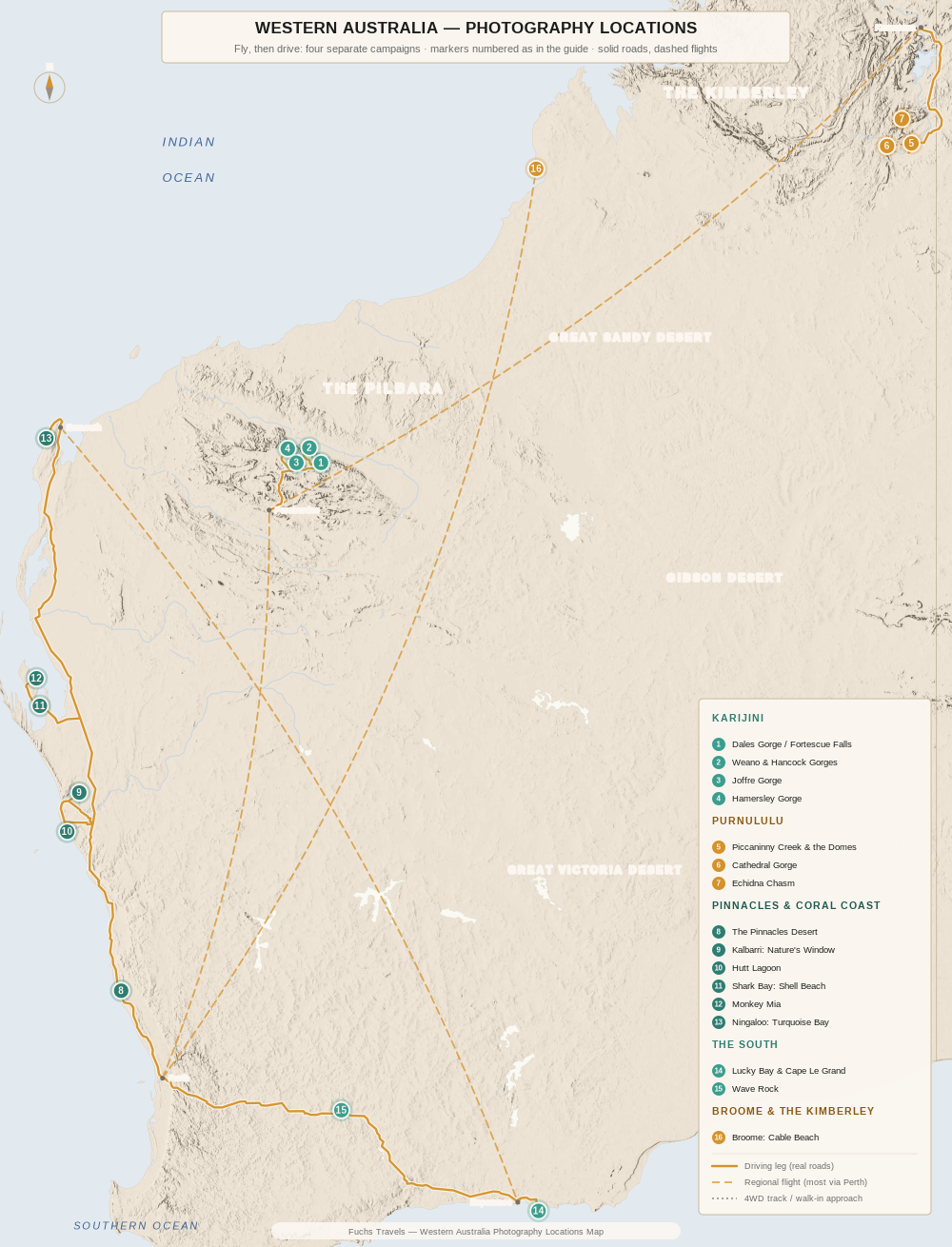
Before a word about light, understand the geography, because it dictates everything else. Perth sits low on the west coast and is your gateway airport. From Perth, the Pinnacles are a two-hour drive north. Karijini is 1,400 kilometres north — a fifteen-hour drive, or a two-hour flight to Paraburdoo or Newman and a hire car from there. Purnululu is 3,000 kilometres away in the far northeast Kimberley, reached via a flight to Kununurra and a scenic charter or a serious 4WD expedition. Broome, the Kimberley’s western gateway, is a separate flight again.
The single most important planning decision you will make is fly, then drive. Trying to connect Karijini, Purnululu and the Pinnacles by road in one trip is a two-week driving marathon that leaves no time to actually photograph. Fly to a regional hub, rent a vehicle appropriate to the terrain, work that region hard for four or five days, then fly to the next. Treat the state as three or four separate campaigns, not one loop.
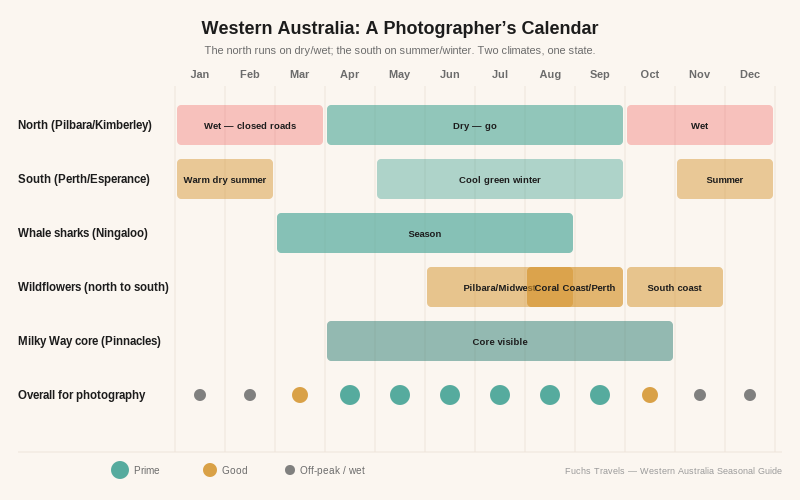
The seasons split the state in half. The northern two-thirds — the Pilbara and Kimberley — run on a tropical dry/wet cycle: the dry season from roughly April to September is the only sensible window to visit, with warm clear days, cool nights and passable roads. The wet (November to March) brings monsoonal downpours, impassable tracks, brutal humidity and closed parks. The southern third runs on a Mediterranean pattern, with hot dry summers (December to February) and cool green winters. Chase the dry up north and the wildflowers and mild light down south, and the calendar starts to organise itself.
Karijini: Photographing the Iron Gorges at Noon
Karijini is the second-largest national park in Western Australia, a plateau of Hamersley Range banded iron in the heart of the Pilbara. The rock here is around 2.5 billion years old, and rain has cut it into a network of gorges — some broad and terraced, some so narrow you wade through them shoulder-width between walls that glow like hot coals. This is the rare landscape destination where midday is prime time. In a deep slot gorge, sunrise and sunset light never reaches the floor; you get flat shadow. It is only when the sun climbs high enough to bounce off the upper walls that the gorge fills with reflected orange light and the pools turn electric green.
Dales Gorge: Fortescue Falls and Fern Pool
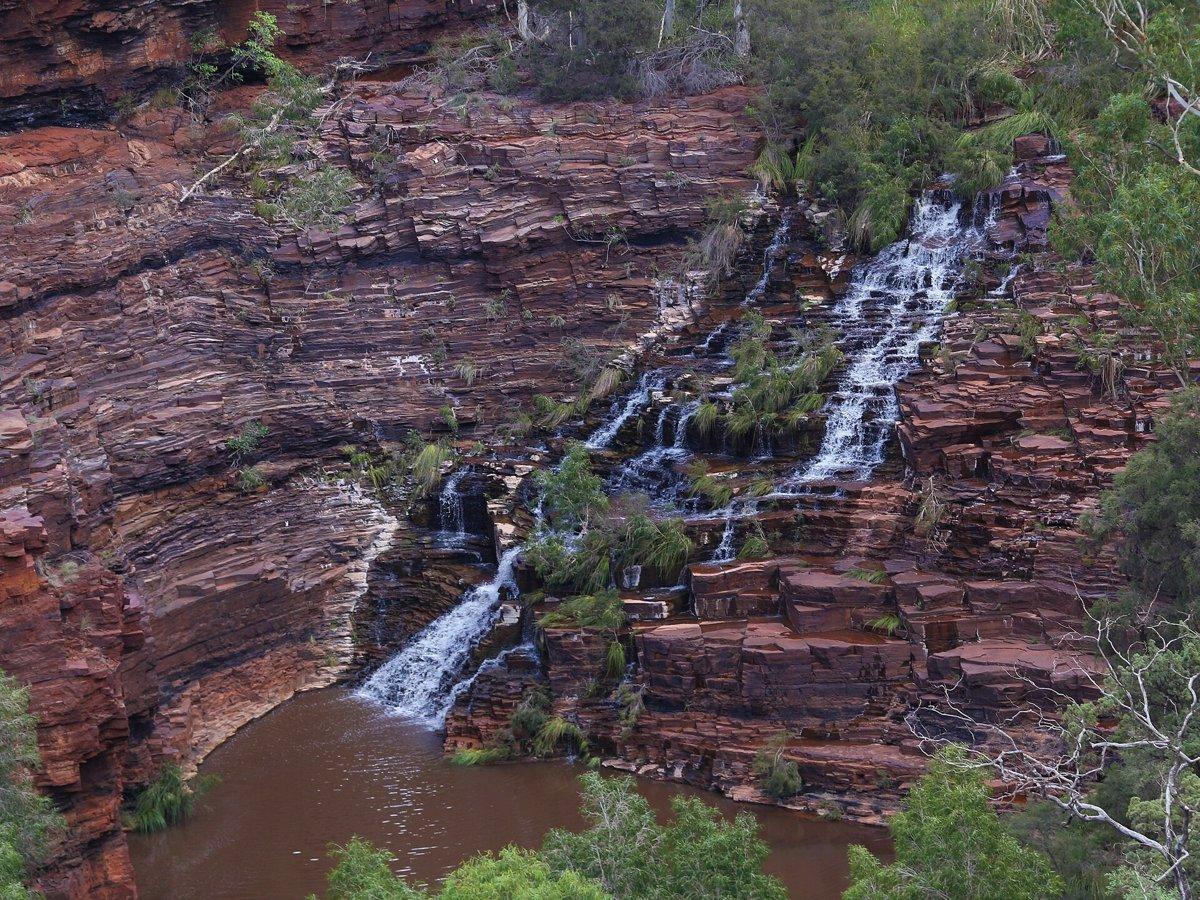
Dales is the accessible heart of the park and the best place to start. Fortescue Falls is a tiered, fan-shaped cascade dropping over red ledges into a swimming hole; a short walk downstream, Fern Pool sits in a quiet amphitheatre that is a registered sacred site for the Banyjima, Kurrama and Innawonga peoples — swim quietly and photograph respectfully.
GPS: ●●.●●●●° S, ●●●.●●●●° E
Best light: Mid-morning to early afternoon, when sun reaches the gorge floor. Overcast days are a gift here — they lower contrast and let you hold both the white water and the shadowed rock in one exposure.
Key compositions: Shoot Fortescue Falls from the base looking up, using the horizontal rock ledges as leading lines into the fall. At Fern Pool, use the timber platform and paperbarks to frame the water.
Technique: Bring a polariser to cut glare off the wet rock and deepen the green pools, and a 3- to 6-stop ND to blur the cascade to silk at f/11. A tripod is essential; the gorge floor is dim.
Weano and Hancock Gorges: the Spider Walk and Kermits Pool
This is Karijini at its most dramatic and most demanding. From the Weano day-use area, trails drop into Hancock Gorge, where the walls close to a metre apart and you brace hands and feet on opposing walls — the famous “spider walk” — to reach Kermits Pool. Oxer Lookout, above the junction of four gorges, is the great overview.
GPS: ●●.●●●●° S, ●●●.●●●●° E
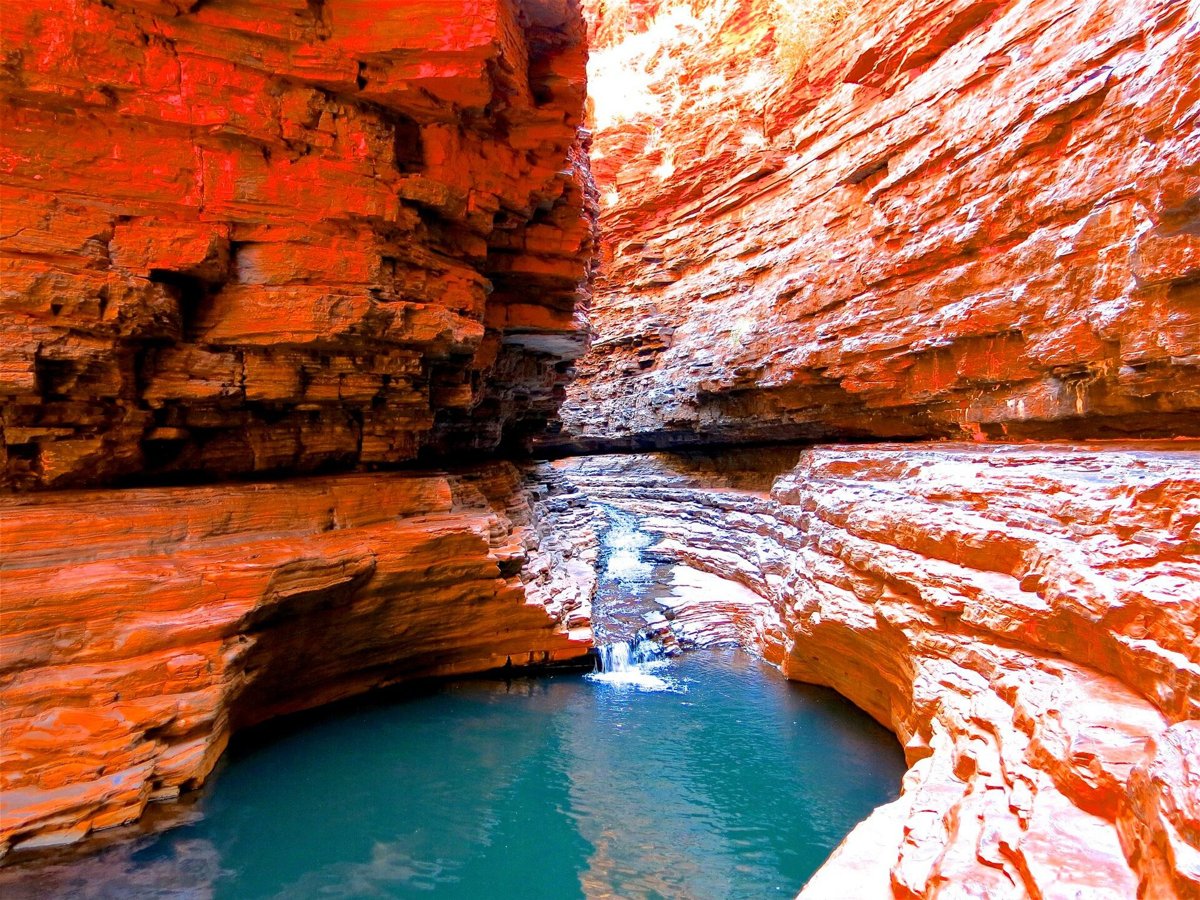
Hancock Gorge — the walls only light up like this when the sun is high enough to bounce off the upper rock. This is why you shoot Karijini’s slots at noon. Photo: Bob Tarr / Wikimedia Commons (CC BY-SA 4.0)
Best light: 11am to 1pm for the deep sections. The reflected glow is strongest and most saturated when the sun is near vertical.
Key compositions: A wide lens (16–24mm) low near the water, letting the converging walls funnel the eye to the light beyond. Include a sliver of the green pool for colour contrast against the orange rock.
Difficulty and safety: You will be wading and scrambling on slick rock. Wear proper water shoes with grip — not thongs — and carry your gear in a dry bag. Gorges flood fast and lethally after rain. Rain falling kilometres upstream can send a wall of water down a slot with no warning. Check conditions with rangers, never enter a narrow gorge if storms are forecast, and get out if the water rises or clouds build.
Joffre Gorge
Joffre is a natural amphitheatre with a curved, stepped waterfall that reduces to a trickle in the dry but leaves a photogenic curved wall of layered rock. The lookout at the rim is a short walk from the Karijini Eco Retreat.
GPS: ●●.●●●●° S, ●●●.●●●●° E
Best light: Late morning, when light rakes across the curved terraces and reveals their texture. Shoot the curve as an abstract of line and shadow.
Hamersley Gorge
An hour’s drive from the park’s core on the western edge, Hamersley rewards the detour with spectacularly folded, wave-like rock strata and the jewel-box Spa Pool just upstream. The folding here — rock bent like taffy by ancient tectonics — is unlike anywhere else in the park.
GPS: ●●.●●●●° S, ●●●.●●●●° E
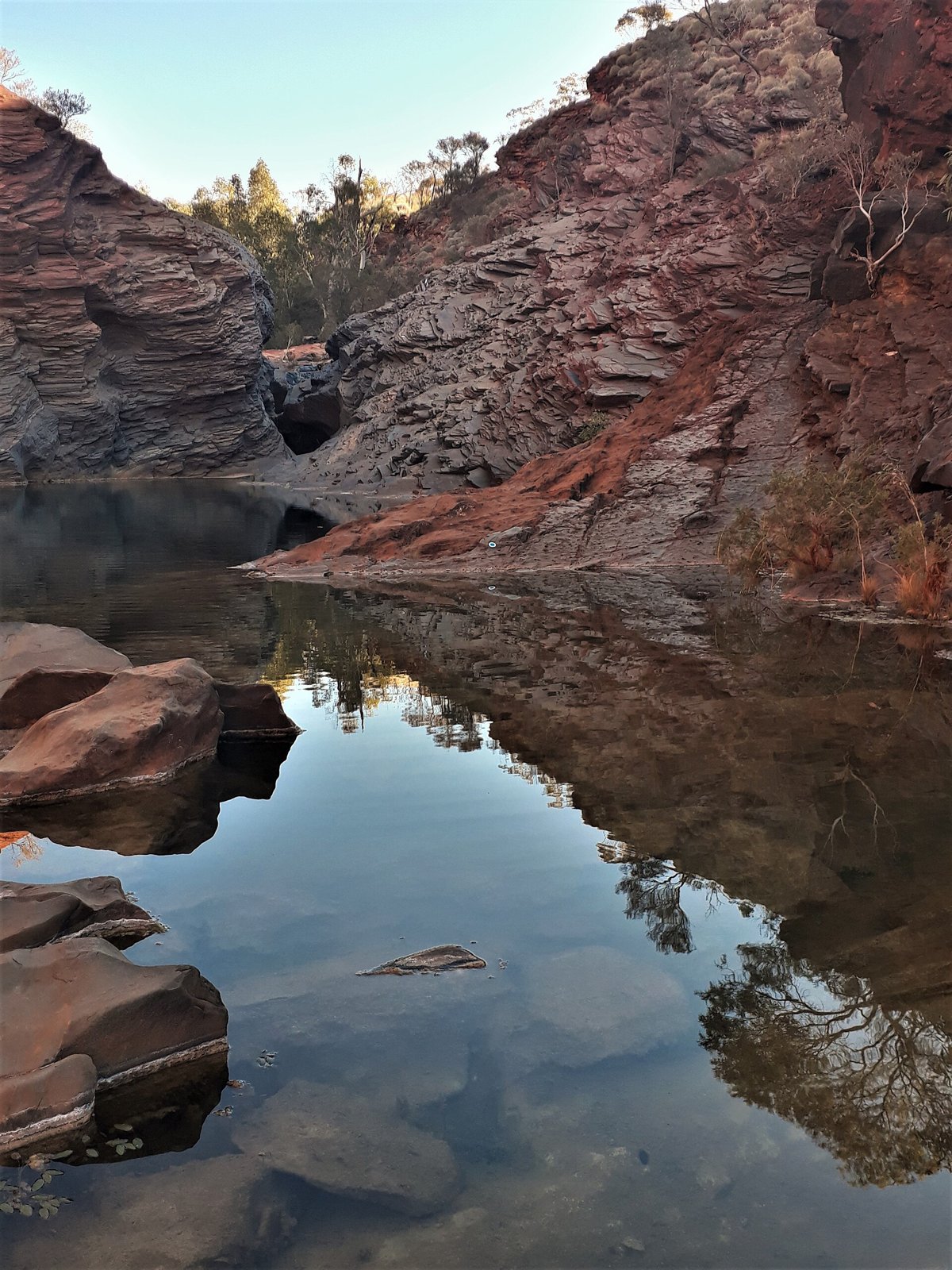
Hamersley Gorge’s contorted strata mirror in a dawn-still pool. The reflections are best before wind stirs the surface. Photo: Muliany / Wikimedia Commons (CC BY-SA 4.0)
Technique: The reflections in the main pool are best early, before wind ripples the surface — the one place in Karijini where dawn is worth the drive. Focus-stack from the foreground rock to the far wall to hold everything sharp.
Access and base: Karijini Eco Retreat (eco-cabins and a campground) sits near the western gorges; the Dales campground is on the eastern side. Both are remote — carry water, fuel and spares. The red Pilbara dust gets into everything, so seal your gear (more on that below).
Purnululu and the Bungle Bungle Range
Purnululu — a UNESCO World Heritage site — protects the Bungle Bungle Range, a labyrinth of banded sandstone domes striped orange and grey. The orange bands are iron-stained; the darker grey bands are a fragile crust of cyanobacteria that holds the soft sandstone together. Touch them and you damage something that took centuries to form, so stay on the tracks. The range is only reachable in the dry.
Access: the Spring Creek Track Reality
There is no sugar-coating this: getting in is half the challenge. The park is open in the dry season, roughly April to November (dates shift year to year with the weather — always confirm current status with the Department of Biodiversity, Conservation and Attractions before committing). The only road in is the Spring Creek Track, a 53-kilometre unsealed, high-clearance 4WD route off the Great Northern Highway that crosses creek beds and takes one and a half to three hours in each direction. Conventional vehicles and dual-axle caravans are not permitted. If you are not confident in a serious 4WD, fly in: scenic charters run from Kununurra and Warmun, and many photographers combine the flight with a night at one of the in-park wilderness camps.
Piccaninny Creek and the Domes
The classic dome country is at the southern end, along the Piccaninny Creek and Domes walks. This is where you make the archetypal Bungle Bungle image — the striped beehives receding in rows.
GPS: ●●.●●●●° S, ●●●.●●●●° E
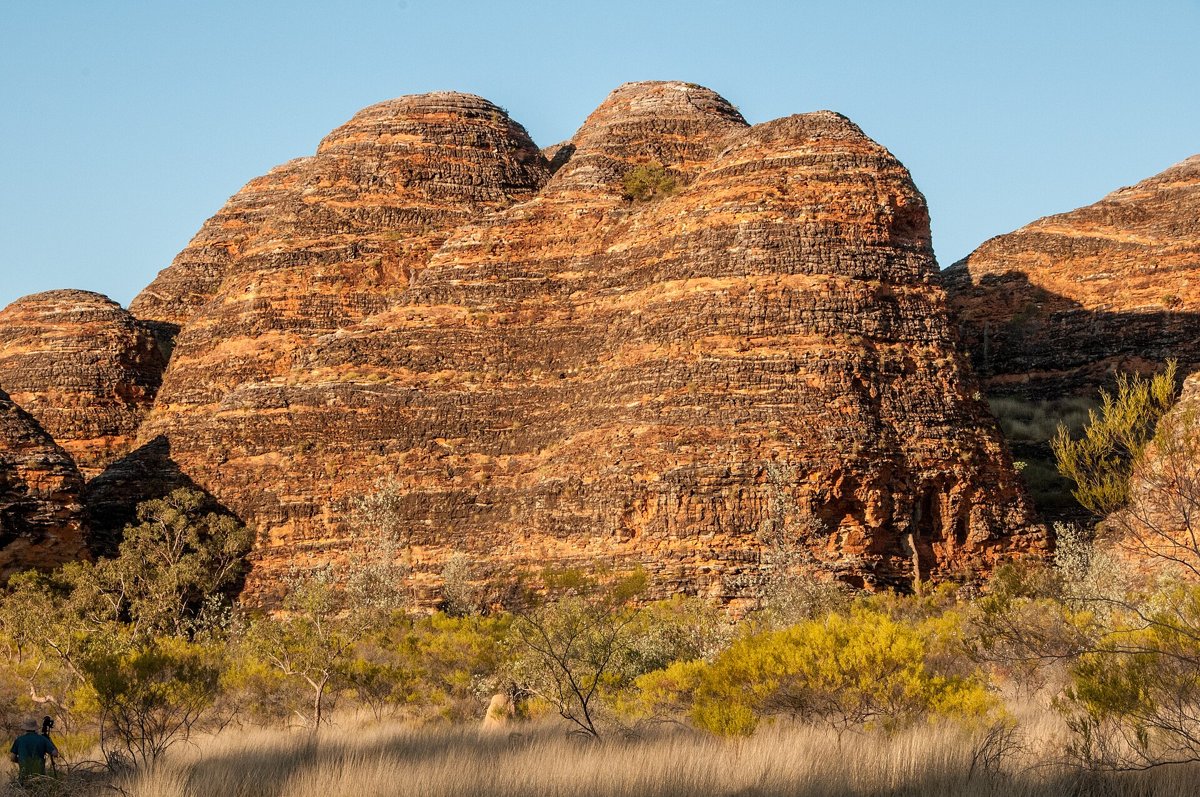
The banded domes at the southern end of the range catch warm side light near the end of the day. Photo: Graeme Churchard / Wikimedia Commons (CC BY 2.0)
Best light: Early morning and late afternoon, when low side light rakes across the bands and models the domes into three dimensions. Midday flattens them into stripes.
Key compositions: Use the spinifex-dotted floor as foreground and let a line of domes lead diagonally into the frame. A short telephoto (70–200mm) compresses the rows into a stacked wall of pattern.
Cathedral Gorge
A short walk into the domes opens into Cathedral Gorge, a vast natural amphitheatre with a sandy floor, a still pool and curved walls that soar overhead. The acoustics are startling — a whisper carries — and photographers come for the way soft, bounced light fills the chamber.
GPS: ●●.●●●●° S, ●●●.●●●●° E
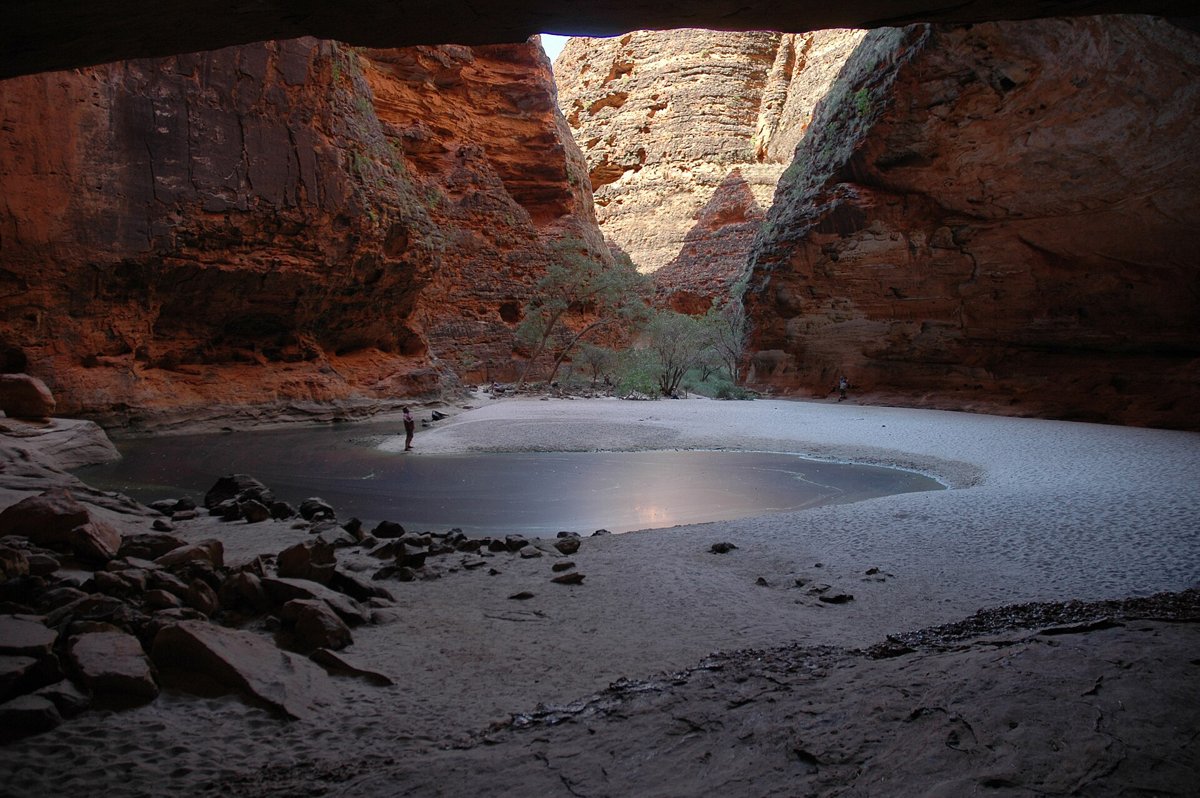
Cathedral Gorge’s amphitheatre. The soft indirect light and the human figure give a sense of the chamber’s scale. Photo: TerryT2 / Wikimedia Commons (CC BY-SA 4.0)
Technique: This is a high-dynamic-range interior — bright sky through the opening, deep shade in the chamber. Bracket exposures and blend, or expose for the walls and let the sky opening blow. Include a person for scale; the space is impossible to read otherwise. A tripod and a wide lens are essential.
Echidna Chasm
At the northern end, Echidna Chasm is a slot so narrow you can touch both walls, cut into red conglomerate. Like Karijini’s gorges, its magic is a midday phenomenon: when the sun is near vertical, roughly 11am to 1pm, it drops a shaft of light into the chasm and the walls ignite in glowing orange.
GPS: ●●.●●●●° S, ●●●.●●●●° E
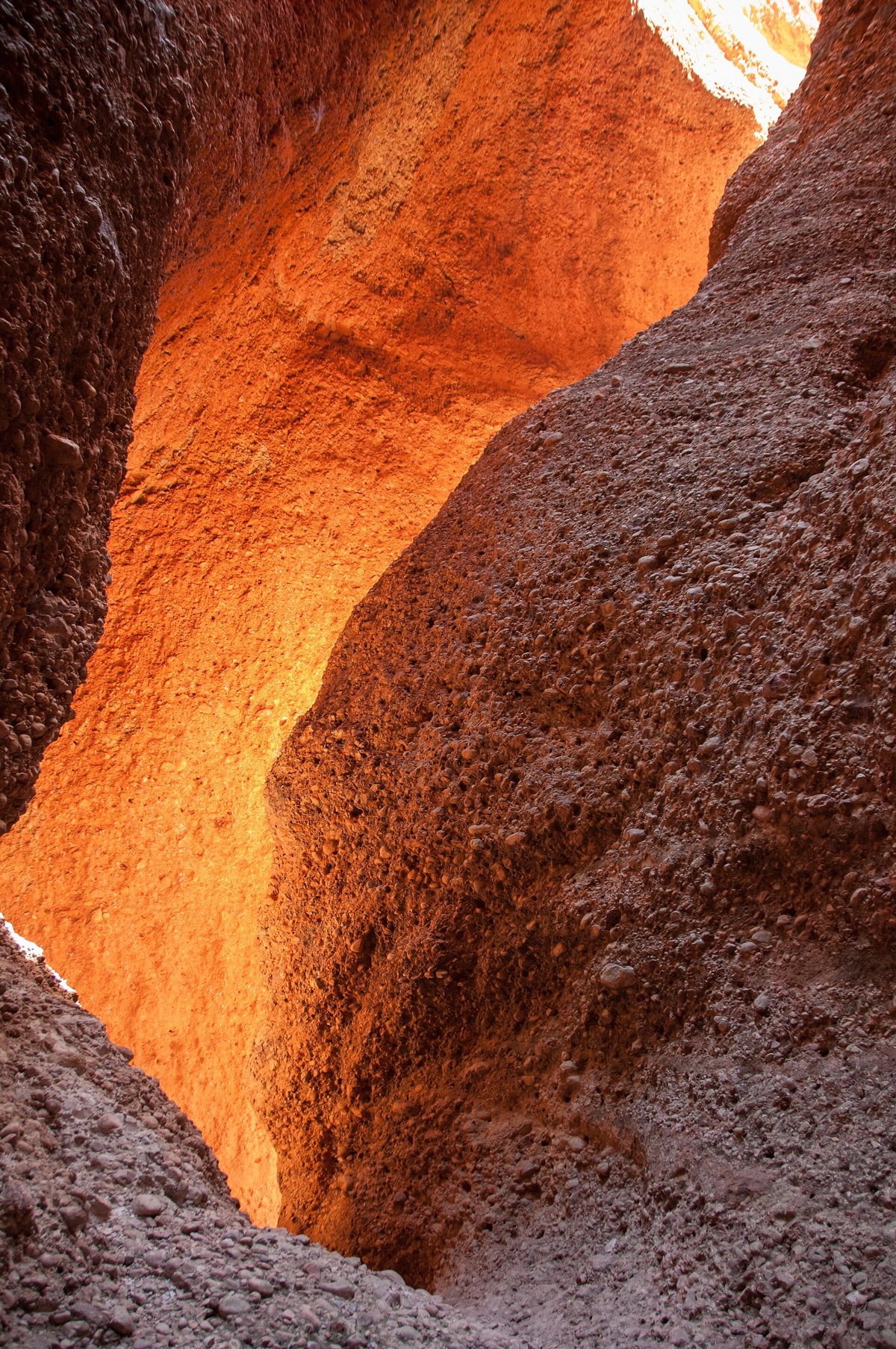
Echidna Chasm at midday, when overhead sun sets the conglomerate walls alight. Timing your arrival to the sun is everything here. Photo: Graeme Churchard / Wikimedia Commons (CC BY 2.0)
Technique: Shoot vertically, looking up the chasm toward the light. Expose for the glowing wall and let the shadows go dark for drama. Time your walk so you are deep in the chasm at solar noon, not arriving as the light leaves.
The Aerial Angle: Helicopter Over the Range
Here is the honest truth about Purnululu: you cannot photograph the range as a range from the ground. The domes are so densely packed that from below you only ever see the nearest few. The whole striped labyrinth — the image that put the Bungles on the map — exists only from the air. Doors-off helicopter flights run from the Bellburn airstrip inside the park and from Warmun and Kununurra. Book a doors-off seat specifically (standard fixed-wing flights shoot through scratched windows), fly in the first or last light of the day for long shadows across the domes, and use a fast shutter (1/1000s or faster) and a strap. This is the one place in this guide where the aerial isn’t a bonus perspective — it is the defining one.
The Pinnacles: A Limestone Desert Under the Stars
Two hours north of Perth in Nambung National Park, the Pinnacles Desert is a field of thousands of limestone spires — some knee-high, some taller than a person — rising out of bright yellow sand. They are ancient: fossilised remnants of an old coastal dune system, exhumed by wind. A one-way loop drive, the Pinnacles Drive, lets you park and wander among them, and this is a rare desert you can photograph on foot without a hike.
The Pinnacles Desert
GPS: ●●.●●●●° S, ●●●.●●●●° E
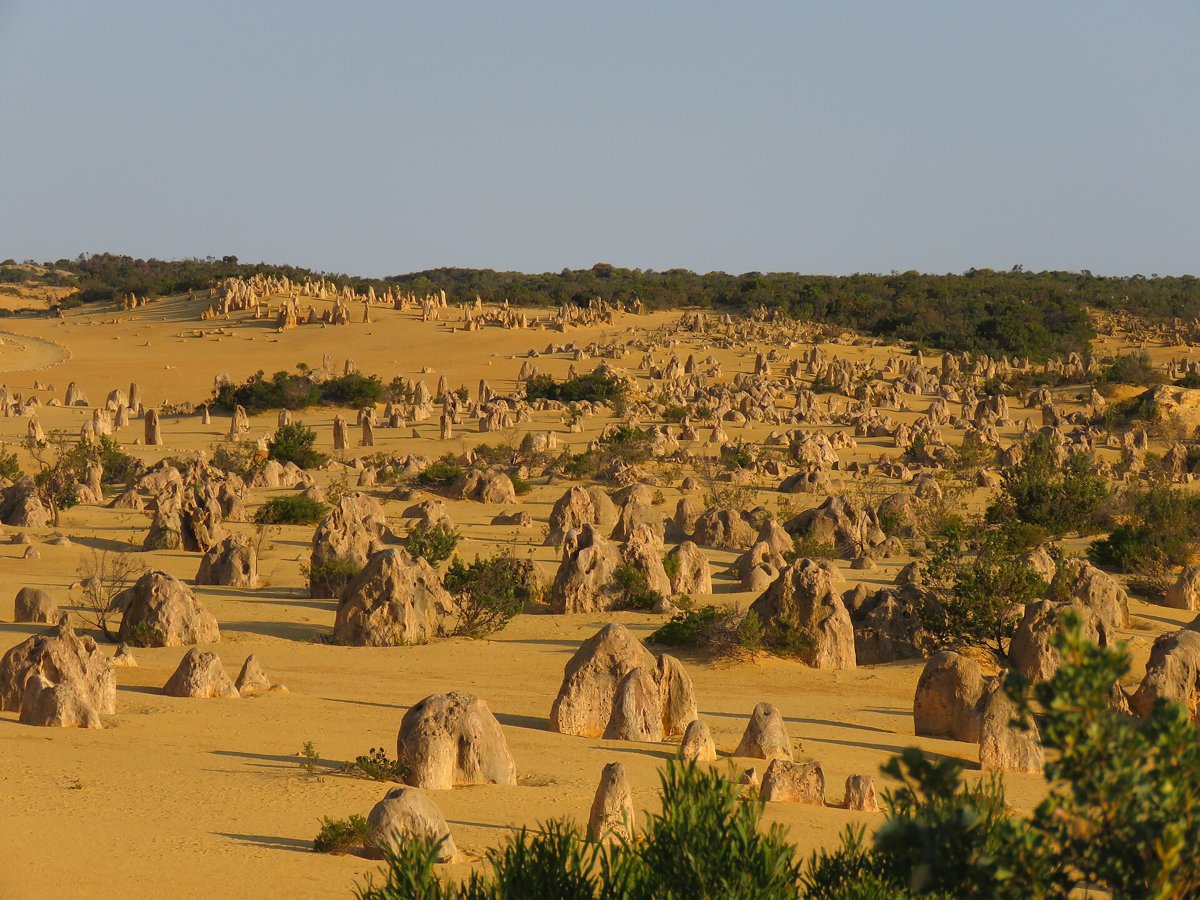
The Pinnacles at day’s end, when low sun rakes across the field and every spire throws a long shadow. Photo: Calistemon / Wikimedia Commons (CC BY-SA 4.0)
Best light: Sunrise and sunset both work, and they work differently. Low raking light throws every spire’s shadow across the sand into long dark fingers — shoot toward or across the sun and use those shadows as your composition. Sunrise gives you the field to yourself; sunset draws the day-trip crowds.
Key compositions: Get low. Kneeling puts a foreground spire large in the frame and lets the field recede behind it. Isolate a single striking pinnacle against clean sky with a telephoto, or go wide and use the shadows as leading lines.
Astrophotography among the spires: This is the Pinnacles’ secret weapon. The site is dark, accessible and full of natural foreground subjects, and the Milky Way core arcs over the field through the austral winter. Light-paint a foreground spire with a brief, warm torch, expose the sky at roughly ISO 3200, f/2.8, 20 seconds, and you have a foreground no other astro location gives you. The desert reads best after rain, when the sand darkens and saturates. Note that after-dark access is managed — check current opening hours and any astrophotography arrangements with the park before planning a night shoot.
The Coral Coast: Kalbarri, Shark Bay and Ningaloo
String together the coast between Perth and Exmouth and you have a road trip that stands on its own. This is the supporting cast that turns a parks trip into an expedition.
Kalbarri: Nature’s Window
Where the Murchison River has carved a red-rock gorge, a single wind-sculpted arch frames the river bend below. Nature’s Window is the signature shot of the Midwest, and it is genuinely worth the pre-dawn walk.
GPS: ●●.●●●●° S, ●●●.●●●●° E
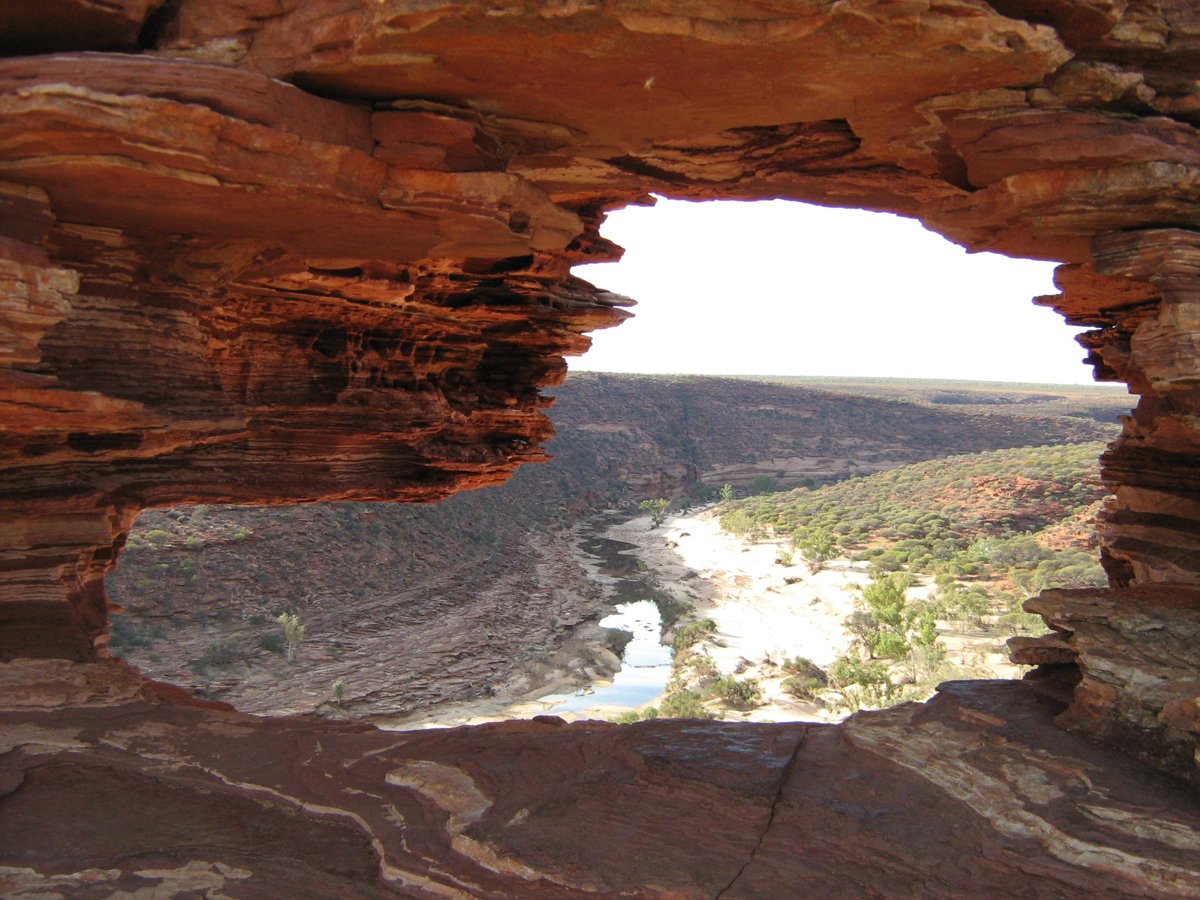
Nature’s Window frames the Murchison River bend. Arrive before dawn to shoot it without a queue and to catch first light on the far gorge wall. Photo: Orderinchaos / Wikimedia Commons (CC BY-SA 3.0)
Best light: Dawn. Shoot through the arch to the gorge, exposing for the landscape beyond and letting the frame of rock go dark, or bracket to hold both. It is a popular spot — the early start also buys you an empty frame. Kalbarri’s coastal cliffs south of town (Red Bluff, Island Rock, the Natural Bridge) are a separate sunset mission where the Indian Ocean hammers layered sandstone.
Hutt Lagoon
South of Kalbarri near Port Gregory lies Hutt Lagoon, a pink lake coloured by Dunaliella salina algae. Be honest with yourself about it: the hue is highly variable and depends on season, cloud, sun angle and the algae’s mood.
GPS: ●●.●●●●° S, ●●●.●●●●° E
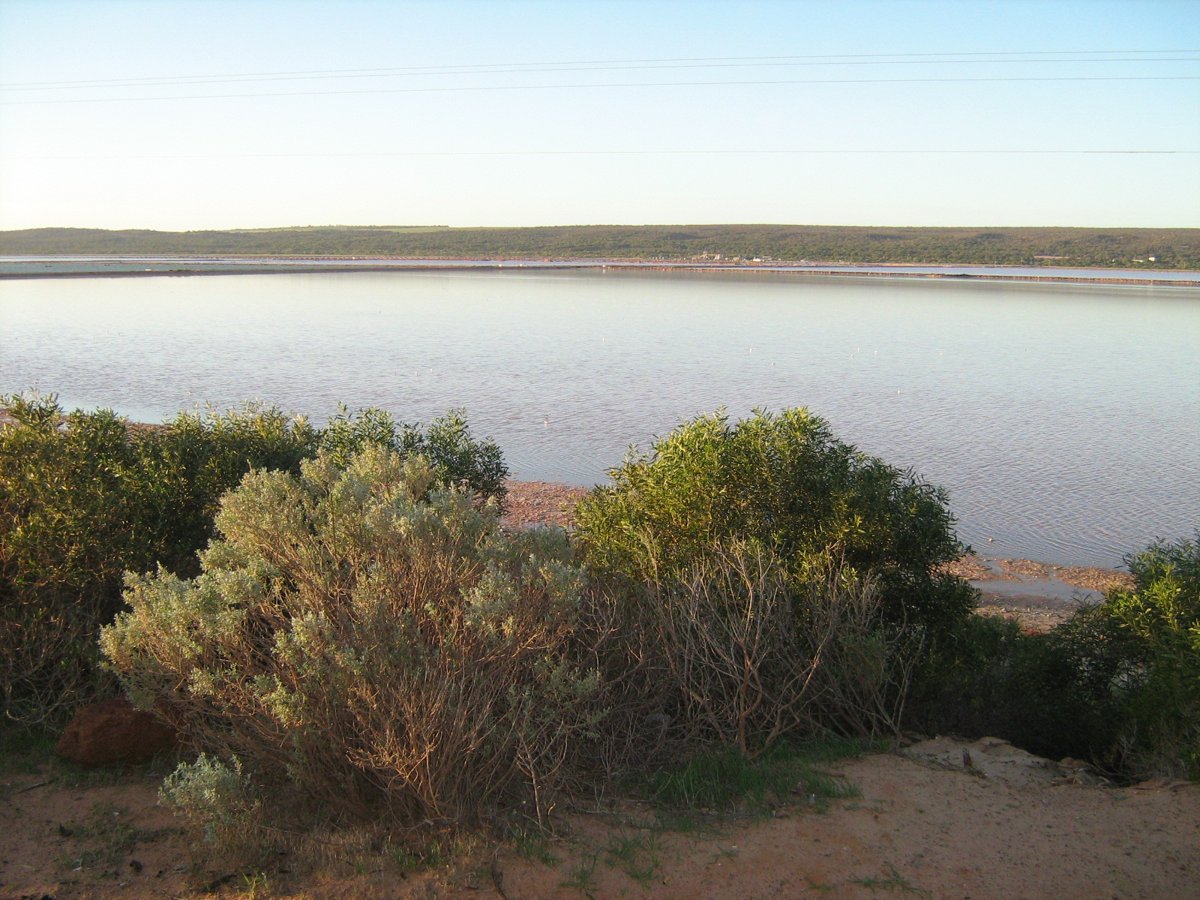
Hutt Lagoon from the roadside in soft light — the famous pink is muted here. The vivid bubble-gum hue needs strong midday sun, the right season and, ideally, height. Photo: Orderinchaos / Wikimedia Commons (CC BY-SA 3.0)
Technique: The lake photographs pinkest under strong overhead sun, and the strongest colour separation almost always comes from the air — a drone lifted 40–80 metres turns a muddy pink smudge into a clean graphic block of colour against the ocean. At ground level in flat light, expect subtle. Do not promise yourself a neon lake and you will not be disappointed.
Shark Bay: Shell Beach and Monkey Mia
A World Heritage marine area of seagrass meadows and hypersaline bays. Shell Beach is a 60-kilometre beach made not of sand but of countless tiny white cockle shells, metres deep — a blindingly white graphic surface under blue water.
GPS: ●●.●●●●° S, ●●●.●●●●° E
Technique: Shell Beach is a study in minimalism — white shells, turquoise water, blue sky in clean horizontal bands. Shoot it as an abstract of colour and line, or get low for the texture of the shells. Midday’s high sun actually helps the water glow; a polariser controls the glare.
Monkey Mia
Across the peninsula, wild bottlenose dolphins come into the shallows most mornings, in a decades-old research-supervised feeding program run by park rangers.
GPS: ●●.●●●●° S, ●●●.●●●●° E
Technique: You will be shooting into shallow water with people around, in harsh morning light. A short telephoto (70–200mm), a polariser to cut surface glare, and patience for a clean moment — a dorsal fin, a raised rostrum — beat a wide shot of the crowd. Follow ranger instructions to the letter; this is a managed wild-animal interaction, not a petting zoo.
Ningaloo and Cape Range: Turquoise Bay and the Whale Sharks
Ningaloo Reef fringes the coast at Cape Range National Park near Exmouth — a rare reef you can snorkel straight off the beach. Turquoise Bay’s drift snorkel is justly famous, and the range behind it drops rocky gorges to the sea.
GPS: ●●.●●●●° S, ●●●.●●●●° E
Technique: For the reef and beach, a polariser is non-negotiable to punch through surface reflection to the coral and colour beneath. Shoot the turquoise-to-deep-blue gradient of the water from a low dune at either end of the day. Cape Range’s gorges (Yardie Creek, Mandu Mandu) are best in early light.
Whale sharks: Ningaloo is one of the most reliable places on Earth to swim with whale sharks. The season runs roughly mid-March through July or August, peaking April to July, when the world’s largest fish gather to feed. Swim-with tours out of Exmouth and Coral Bay use spotter aircraft and drop small groups into the water ahead of a passing shark. For images you need a proper underwater housing and a wide lens; keep the mandated distance (tour operators brief you on the rules), never touch or block the animal, and shoot slightly upward with the sun behind you.
The South: White Sand, Kangaroos and a Wave of Rock
Lucky Bay and Cape Le Grand
East of Esperance, Cape Le Grand National Park holds a run of bays whose sand is so white and fine it squeaks, against water the colour of a swimming pool. Lucky Bay is the icon — and yes, the kangaroos really do lounge on the beach.
GPS: ●●.●●●●° S, ●●●.●●●●° E
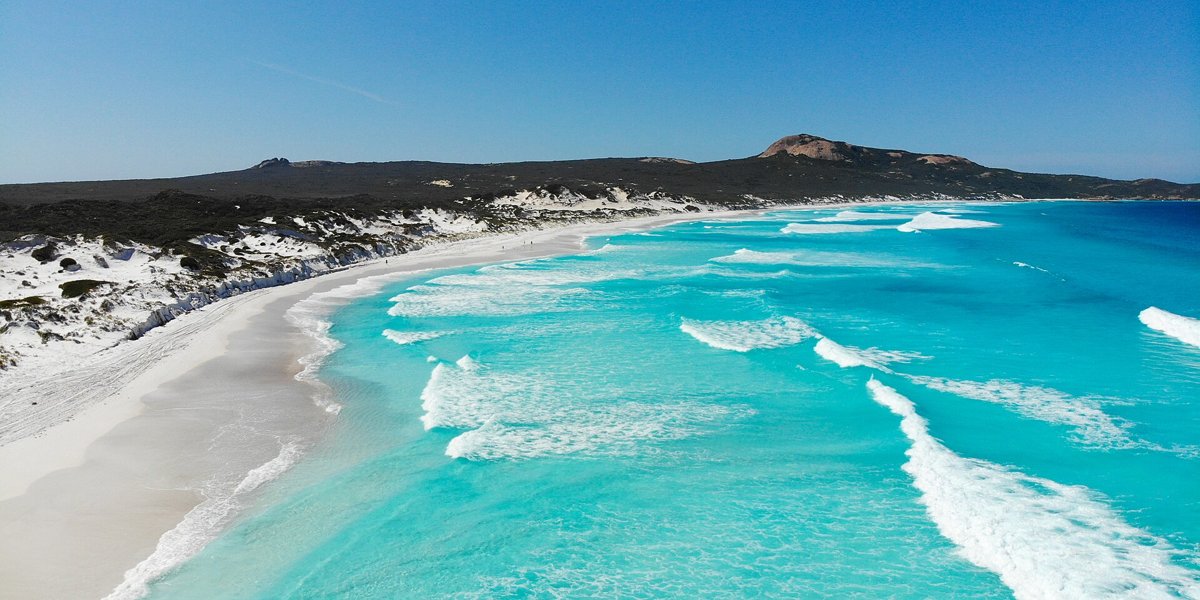
Lucky Bay’s blinding white sand and turquoise water. The kangaroos that rest on this beach are the classic Cape Le Grand image — approach slowly and shoot low. Photo: Stan Feldman / Wikimedia Commons (CC BY-SA 4.0)
Best light: The colour of the water sings under high sun, so this is a rare beach that rewards a midday visit; the low granite peaks (Frenchman Peak) light warmly at either end of the day. For the kangaroos, work early morning when they are on the sand and the light is soft. Get low, keep a respectful distance, and let the white sand and turquoise fill the background behind them. Nearby Twilight Beach, closer to town, is a first-rate sunset location with its offshore granite boulders.
Wave Rock
Inland in the Wheatbelt near Hyden stands Wave Rock, a 15-metre granite face weathered into the shape of a breaking wave, streaked with vertical bands of mineral stain. It is a long detour from anywhere, best folded into a wildflower-season loop.
GPS: ●●.●●●●° S, ●●●.●●●●° E
Technique: The vertical streaks read best in soft light — overcast or the shaded part of the day — when you can hold detail in the grey and ochre bands. A person at the base gives scale to the overhang. Shoot it straight-on for the graphic wave form, or from an angle to emphasise the curl.
Rottnest quokkas — a note on ethics: Off Perth, Rottnest Island is famous for the quokka, a small, photogenic marsupial. Selfies are encouraged, but touching or feeding them is illegal and carries fines — human food harms them. Use a longer lens or a low, respectful crouch, let the animal approach on its own terms, and never crowd, bait or handle it. A relaxed quokka going about its day makes a better photograph than a stressed one anyway.
Broome and the Kimberley Gateway
Cable Beach
Broome’s Cable Beach is 22 kilometres of white sand meeting the Indian Ocean, and its signature image is the string of camels padding along the tideline at sunset — a legacy of the region’s pearling and cameleer history.
GPS: ●●.●●●●° S, ●●●.●●●●° E
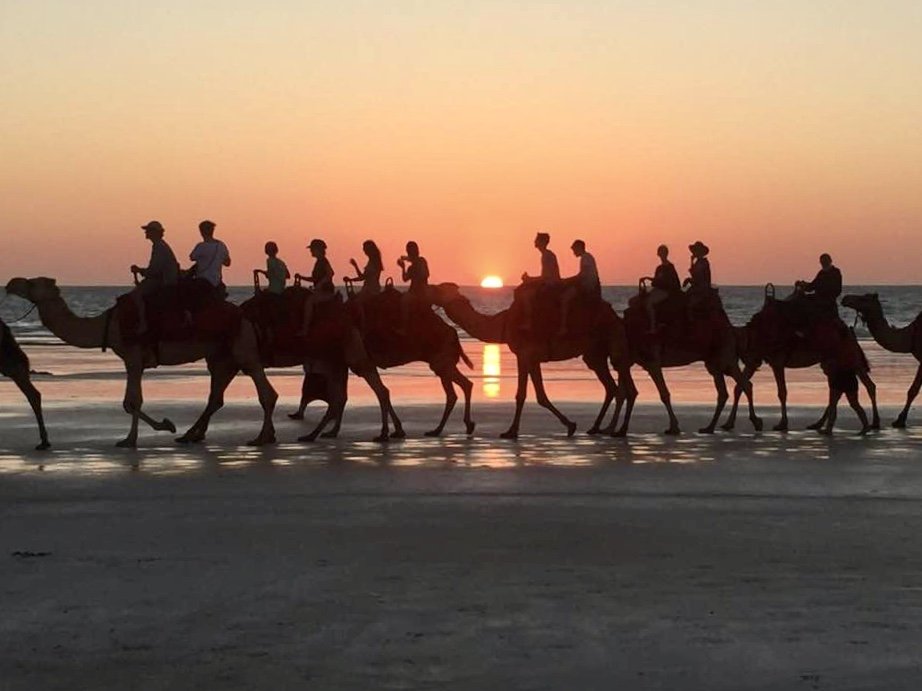
The Cable Beach camel train at sunset — a classic Broome silhouette. Expose for the sky and let the camels go black. Photo: Teresa / Wikimedia Commons (CC BY-SA 4.0)
Technique: Expose for the bright sky and let the camels and riders fall to clean silhouette. Shoot from a low angle so the animals break the horizon and their reflections stretch across the wet sand. A short telephoto compresses the string into an overlapping line.
Staircase to the Moon: On a handful of nights between roughly March and October, when a full moon rises over the exposed mudflats of Roebuck Bay at low tide, the reflection breaks into a shimmering “staircase” of light climbing to the moon. Dates are published each year by tourism authorities — plan around them. Shoot from Town Beach with a tripod and a mid-telephoto, expose for the moon, and use the ribbed wet mud as foreground leading up to the reflection.
When to Go: The Seasonal Calendar
Because WA spans the tropics and the temperate south, there is no single best month — it depends entirely on which half you are chasing.
| Region | Best window | Why |
|---|---|---|
| Karijini (Pilbara) | May–September | Dry, mild days; gorges accessible and swimmable |
| Purnululu (Kimberley) | May–September | Only reliable dry-season access; roads passable |
| Broome / Ningaloo | April–September (whale sharks Mar–Aug) | Dry, warm, calm seas |
| The Pinnacles | April–October | Mild temperatures; winter Milky Way core |
| South coast (Esperance) | Spring/autumn; summer for water colour | Wildflowers in spring; warm sea in summer |
Wildflowers deserve their own note. WA hosts one of the largest wildflower blooms on Earth, and it moves like a slow wave from north to south over roughly six months. It begins in the Pilbara and Midwest around June–July (Karijini’s purple mulla mullas), peaks in the Coral Coast and Wildflower Country in August (carpets of everlastings), reaches the Perth region in September, and finishes along the south coast and Esperance in October–November. Rainfall drives the timing, so it shifts year to year — chase the bloom southward and you can follow it for months.
The Technical Deep-Dive: Light in a Slot Gorge
The single most counter-intuitive skill in Western Australia is throwing out the golden-hour rulebook in the gorges. Karijini’s deep slots and Purnululu’s Echidna Chasm follow the same physics, and once you understand it you will plan your day around noon.
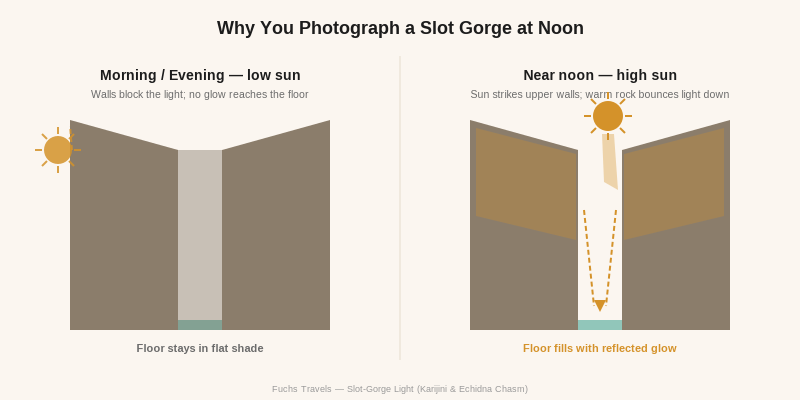
In an open landscape, low-angle golden light is everything. In a slot gorge, low light simply cannot reach the bottom — the walls block it, and the floor sits in flat shade all morning and evening. Only when the sun climbs high does a shaft finally strike the upper walls; that warm rock then bounces light down into the gorge, and the whole space fills with a glowing, indirect orange. The direct shaft itself can be too contrasty, but the reflected fill in the minutes around it is magic.
| Situation | Setting | Note |
|---|---|---|
| Slot gorge reflected light | f/11, ISO 200, tripod, shutter to taste | Meter the mid-toned wall, not the bright slot of sky |
| Blurring a cascade | f/11–f/16, 0.5–2s, 3–6 stop ND | Polariser also drops ~2 stops and kills wet-rock glare |
| Echidna Chasm shaft | f/8, spot-meter the lit wall | Let shadows go black; expose for the glow |
| Pinnacles Milky Way | f/2.8, ISO 3200, 20s, manual focus on a star | Light-paint a foreground spire briefly and warmly |
| Bungle Bungle aerial | 1/1000s+, ISO 400, continuous AF | Fast shutter beats helicopter vibration |
The practical takeaway: in gorge country, structure your day backwards. Do your open-landscape and dome work at dawn and dusk; save the deep slots for the middle of the day when everyone else is resting. It feels wrong. It is exactly right.
Drones: Western Australia’s Unusual Rule
Western Australia is, refreshingly, one of the more permissive places in the country for recreational drone photography in parks — but “permissive” is not “unregulated,” and the headline park in this guide is a notable exception. At the time of writing, the Department of Biodiversity, Conservation and Attractions (DBCA) allows recreational drone use in most WA parks without a departmental permit, provided you comply with national CASA rules and state law. That is the opposite of the blanket bans in most other Australian national parks — but always verify current rules on the DBCA Explore Parks site before you fly, because policies tighten.
The standing rules that apply across WA parks:
- Follow all CASA rules: keep below 120m, within visual line of sight, day only, one drone at a time, and never over people.
- Stay at least 30m from people and do not fly over them.
- Keep 60m from whale sharks, whales, dolphins, dugongs and seals — critical on the Coral Coast.
- Do not disturb wildlife or other visitors, respect Aboriginal heritage, and only fly over areas open to the public.
- Commercial work (any flying for profit) requires a DBCA filming/photography permit.
- Contact the relevant district office before flying so you don’t clash with park operations or fire management.
Two important exceptions. Karijini National Park specifically requires prior written permission from park rangers before any drone flight — do not turn up expecting to fly the gorges. And Purnululu flying is complicated by its remoteness and World Heritage status; assume restrictions and confirm in advance. For Hutt Lagoon and the Pinnacles surrounds, a compliant recreational flight is often the difference between an ordinary frame and an extraordinary one — but check the specific park’s page first, every time.
Logistics and Planning
Getting there and around. Perth is the international gateway. From there, regional flights (Qantas, Virgin, regional carriers) reach Broome, Kununurra, Exmouth (Learmonth), Newman, Paraburdoo and Esperance. Match your vehicle to the terrain: a 2WD is fine for the Pinnacles, Kalbarri and the south coast; Karijini’s roads suit a high-clearance vehicle; Purnululu’s Spring Creek Track demands a genuine high-clearance 4WD or a fly-in charter.
| Region | Accommodation options | Rough nightly cost (AUD) |
|---|---|---|
| Karijini | Eco Retreat cabins / campground; Tom Price motels | Camp $30–50; cabin/motel $150–350 |
| Purnululu | In-park wilderness camps; Kununurra hotels | Camp $30; camp package/hotel $150–400 |
| Broome | Resorts to backpackers | $40–450 |
| Coral Coast | Caravan parks, motels, eco-lodges | $40–400 |
| Esperance | Motels, chalets, campgrounds | $30–250 |
Costs. Fuel and distance are the big line items — budget generously for both, and for a WA Parks Pass if you are visiting several parks. Charter flights (Purnululu, whale sharks) are the premium splurges but often the trip’s defining images.
Safety. Distances between fuel and water are enormous; carry more of both than you think you need, tell someone your route, and consider a satellite messenger in remote areas. In the tropical north, respect the heat, the sun and — near any northern waterway or beach — the very real presence of saltwater crocodiles. In the gorges, respect flash-flood risk absolutely.
Gear for Western Australia
- Bodies and lenses: A weather-sealed body, a wide zoom (16–35mm) for gorges and domes, a standard zoom, and a 70–200mm for wildlife, compression and camels. A fast prime (f/1.8 or f/2.8) for the Pinnacles at night.
- Filters: A circular polariser is the hardest-working filter here — wet gorge rock, reef water, pink lakes and turquoise bays all need it. A 3- to 6-stop ND for cascades. A graduated ND helps on high-contrast coasts.
- Support: A sturdy tripod (dim gorges, long exposures, astro) and a beanbag or clamp for the helicopter and vehicle.
- Red-dust protection: The Pilbara’s iron dust is fine, red and pervasive. Change lenses as little as possible, keep bodies in sealed bags or dry boxes with silica gel, carry a rocket blower and sensor-cleaning kit, and expect to wipe everything down daily. A UV filter as a sacrificial front element earns its keep.
- Water gear: For Karijini’s slots, grippy water shoes and dry bags are not optional — you will be wading. For the reef and whale sharks, a proper underwater housing.
- Power and storage: You will be far from mains power for days. Carry spare batteries, a power bank or vehicle charging, and more cards than you think you need.
Field Exercises
- The noon gorge: In Hancock or Dales, shoot the same slot section at 9am, noon and 3pm from a fixed position. Compare how the reflected light fills the gorge only in the middle of the day. Internalise why golden hour fails here.
- One dome, four ways: At Piccaninny, photograph a single group of domes at side light, using foreground spinifex, a compressed telephoto row, and a low wide angle. Pick the strongest and articulate why.
- Silhouette discipline: At Cable Beach or Twilight Beach, expose a sunset scene so the subject reads as a clean black shape against a graded sky, with no muddy mid-tones. Nail the exposure for the highlights.
- The honest pink lake: At Hutt Lagoon, make one ground-level frame and (where permitted) one from height. Compare how much the aerial angle recovers the colour, and write down what actually controlled the hue that day.
- A five-frame arc: Build a five-image sequence of a single region — establishing landscape, detail, wildlife or human element, an intimate scene, and a closing wide — that tells that place as a short visual story rather than a set of postcards.
The Long View
Western Australia does not give itself up easily. The distances are real, the heat is real, the flash floods and the crocodiles and the red dust in your sensor are all real, and no amount of planning collapses a state this size into a comfortable week. But that difficulty is exactly why the images matter. The photographer who commits to noon in a Karijini gorge, who books the doors-off seat over the Bungles, who drives the Spring Creek Track and camps under a sky with no light pollution, comes home with frames that most travellers to Australia never even know exist.
Pick one region and do it properly rather than three regions badly. Learn the counter-intuitive light of the slot gorges, chase the wildflower wave southward, respect the country and the people whose Dreaming these places hold, and let the scale of the state teach you patience. There are no shortcuts across Western Australia — but for a photographer willing to work at its pace, there is a clear and extraordinary reward.